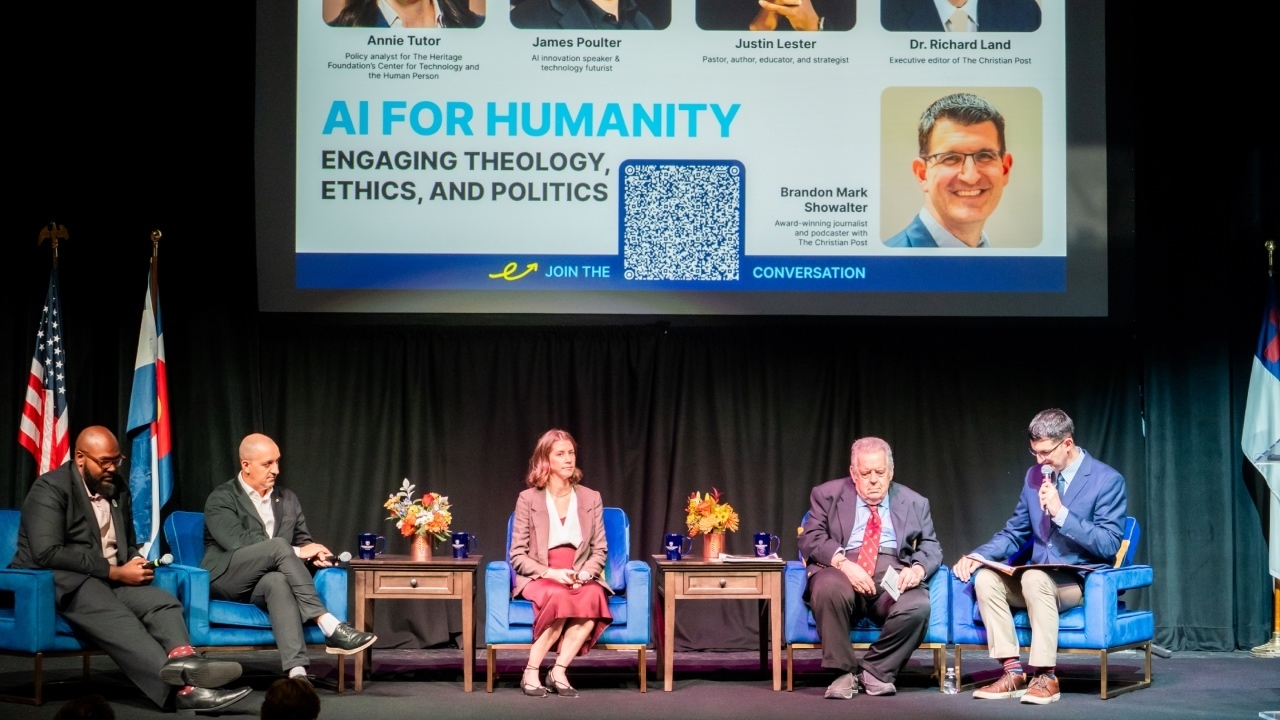
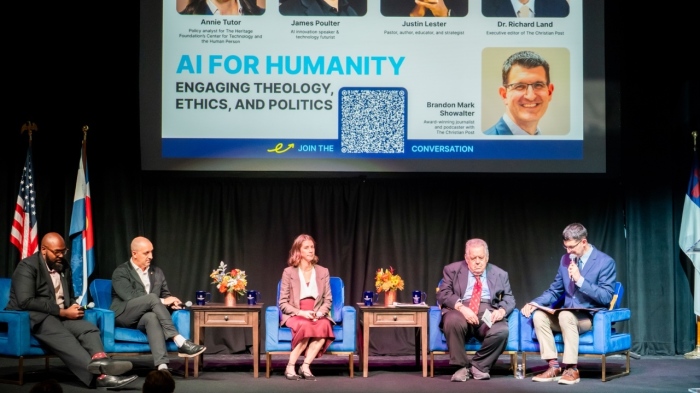
LAKEWOOD, Colo. — An expert panel that gathered last week to discuss the ethical implications of AI technology urged Christians to prepare for seismic changes while harnessing the capacities of the new technology for good.
Speaking last week to an audience of mostly college students at Colorado Christian University during “AI for Humanity: Navigating Ethics and Morality for a Flourishing Future,” which was hosted by The Christian Post and tech company Gloo, panelists urged Christians to be mindful of AI while not shying away from its potential.
‘Wake up and prepare’
James Poulter, an author who serves as head of AI and innovation at the London-based advertising agency House 337, likened AI’s arrival to an impending alien invasion. He said he believes most people “drastically underestimate the speed of change that we are not only already experiencing, but are about to experience.”
“If you listen to the creators of this technology in Silicon Valley at the moment, that’s essentially what they’re telling us: that there is an alien intelligence … and it’s coming, and it’s going to be infinitely available, scalable — and at some point, if Elon [Musk] gets the technology nailed down correctly, it’s going to be embodied, as well,” he said.
“It’ll have a physical manifestation, and it will be around you. And so, if that is the case, then we have to wake up and prepare for this in a way that I don’t think we are.”
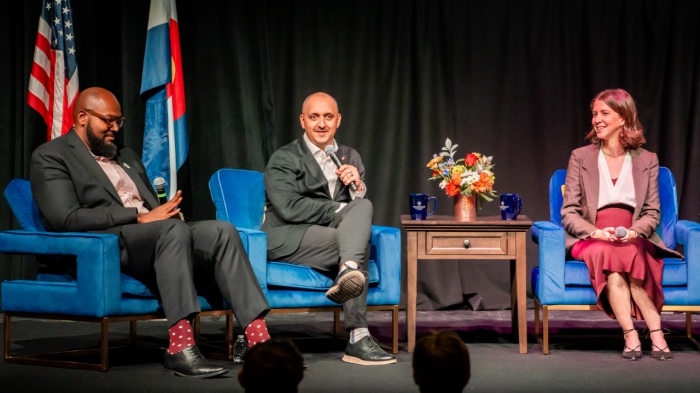
Annie Chestnut Tutor, who serves as a policy analyst for The Heritage Foundation’s Center for Technology and the Human Person, said she is concerned about AI’s unforeseen consequences and “what could become weaponization of AI tools.”
Responding to a question from moderator Brandon Showalter, who noted AI is evidently on the minds of lawmakers since Congress considered a federal moratorium earlier this year that would have placed a 10-year ban on state and local AI regulations, Tutor observed the Trump administration is leading the charge by issuing “an AI action plan.”
The 28-page strategy document issued in July was a comprehensive roadmap for the U.S. to achieve global dominance in AI.
Tutor, who specializes in age verification and potential online harms to children, also noted that legislators and those in think tanks are increasingly concerned about AI’s potentially negative impacts on society.
“Disruption is inevitable,” she said of AI and technology. “But to what degree are people going to adapt?” She expressed concern that humans will try to use it to escape God’s design, offering the example of those who speculate AI will make work unnecessary.
“From a Christian worldview, we have to remember that God created us to work,” she said. “When I hear some people talk about how, with AI, one day we won’t have to work, it will do everything for us — well, that’s outside of God’s design. Work was not a result of the Fall. It was rooted in creation, and even in the new creation, we will have work, just without all the pain and toil and frustration.”
The Rev. Justin Lester, who serves as senior pastor of Friendship Missionary Baptist Church in Vallejo, California, said “every generation is trying to make a Babel.”
He acknowledged that the breakneck speed at which technology is changing with AI might be dizzying, but advised Christians to learn how to grieve the loss of rapid change and its potential negative effects without withdrawing from it.
“I don’t want us to be shaped by this stuff; we have to be the shapers,” he said. He urged Christians to follow in God’s creative footsteps by harnessing order out of chaos for a distinct purpose. Noting that Christians have used cutting-edge technology since the Roman roads to promote the Gospel, he exhorted Christians of today to do the same.
‘A force for good’
Panelists echoed sentiments expressed by Pat Gelsinger, a Christian who formerly served as the CEO of Intel and likened AI to the invention of the printing press during his keynote address at the event at Colorado Christian University.
The chief architect of a significant Intel microprocessor who played a leading role in developing USB and Wi-Fi technology, Gelsinger is now the executive chair and head of technology at Gloo, a technology platform that connects various organizations within the faith ecosystem.
Gelsinger, whose company established an evaluation framework for AI models that aims to promote human welfare, expressed optimism to The Christian Post that AI can be “a force for good” if Christians harness it, which he framed in eschatological terms, suggesting AI might play a role in the Second Coming.
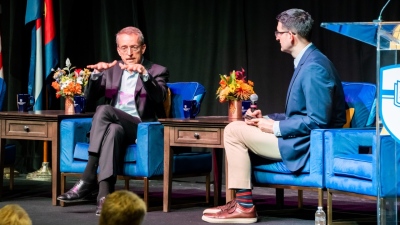
“I think the next 20 years are going to be the most fabulous years of technology in human history,” he said, adding that he finds it thrilling to consider “the diseases that we will conquer, the materials that we will identify, the ability to solve the energy and climate — so many of the other things will get solved in the next couple of decades.”
“I just hope I live long enough to see the full benefits of that, improving human life and experience,” he said. “My life mission has been that I will work with a piece of technology that will improve the quality of life of every human on the planet, and hasten the coming of Christ’s return.”
‘We’re flawed’
Dr. Richard Land, who serves as executive editor of The Christian Post and president emeritus of Southern Evangelical Seminary in Charlotte, North Carolina, urged caution and emphasized the need to preserve human dignity in the age of AI, reiterating comments he made earlier during the event.
Land expressed concern that AI’s advent comes amid an increasingly atomized society, where people are losing trust in institutions. Many young people are foregoing marriage and reality for “ersatz relationships” in a virtual world, he said, citing a recent study that found 72% of teenagers, mostly males, have at some point turned to AI for companionship.
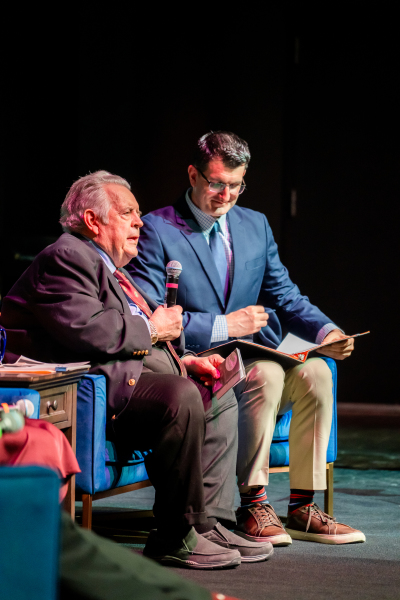
Americans “are peculiarly susceptible” to believing that all technological change is progress, said Land, who advised people to remember God’s design is inescapable.
“Sometimes it is, sometimes it isn’t,” he said of technology being progress. “And it always comes with a cost, and we often don’t count that cost before we plunge forward.”
Regarding how humans should view technology that increasingly seems to penetrate the human-machine divide, Land said, “The hard-and-fast line is that human beings are created in the image of God; nothing else bears the divine imprint.”
He noted that all human inventions are inherently broken and that men must remember they are not gods.
“We’re going to have flaws in what we create, because we’re flawed,” he said. “And we must understand that however much we may try, we’re going to have blind spots.”
“We’re going to have the will to power — which is evident in all of human history since the Fall — that is going to trick us. And we’re going to end up creating machines that will seek to be our masters.”
Thumbing through The Baptist Faith and Message, the Southern Baptist Convention’s statement of faith that he helped to revise in 2000, Land read from the document that asserts “all Christians are under obligation to seek to make the will of Christ supreme in our own lives and in human society,” a goal he suggested is ongoing and especially crucial in the age of AI.
Jon Brown is a reporter for The Christian Post. Send news tips to jon.brown@christianpost.com