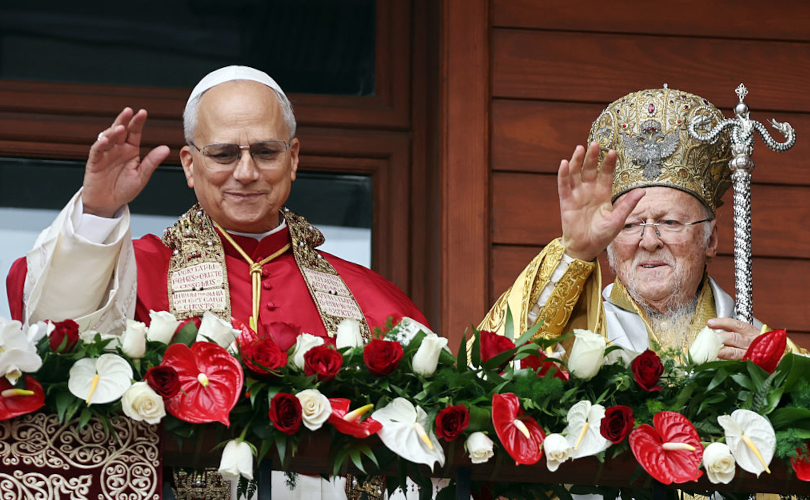
ISTANBUL, Turkey (LifeSiteNews) — As part of the last public act of his apostolic journey to Turkey, Pope Leo XIV imparted an ecumenical blessing together with the Eastern Patriarch Bartholomew I.
On November 30, Pope Leo XIV and Patriarch Bartholomew I appeared on the square of the Church of Saint George in Constantinople to bless the crowd in turn, in Latin and in Greek, respectively. Afterward, they took each other by the hand, exchanged a fraternal kiss, and entered, side by side, the seat of the Patriarchate.
Pope Leo XIV and Patriarch Bartholomew I imparting their respective Apostolic Blessing on those gathered at the Patriarchal See of Constantinople on the Feast of the Holy Apostle Andrew, the First-Called. pic.twitter.com/IxtofL26Uh
— Catholic Sat (@CatholicSat) November 30, 2025
READ: Pope Leo lays wreath at grave of Turkish leader Atatürk despite links to anti-Christian genocides
At the moment of the blessing imparted by Leo XIV, the patriarch chose not to make the Sign of the Cross, remaining still with his pastoral staff in his hand. By contrast, when it was the turn of Patriarch Bartholomew, the Pope reacted immediately to make the Sign of the Cross, showing a notable difference of attitude between the two phases of the ecumenical liturgical moment.
The entire pilgrimage of Leo XIV in Turkey was “imbued with ecumenism,” as Vatican News reports. The blessing concluded the two days of the Pope’s journey in Turkey, marked by the commemoration of the 1,700th anniversary of the Council of Nicaea and by ongoing ecumenical dialogue with Eastern Christianity, before taking a flight to Beirut for the beginning of the second and delicate stage of the apostolic visit.
The Pope’s day had begun with a meeting with the Armenian community in the Apostolic Cathedral of Kumkapi, Istanbul. Patriarch Sahak II had welcomed him amid the incense smoke and the sound of bells. After the meeting with the Armenians, the Pope joined the liturgy along with Bartholomew I, where each delivered his own homily.
At the conclusion of the celebration, the Pope and the patriarch paused in front of the reliquary containing a relic of the Apostle Saint Peter, donated to the Patriarchate in 2019 by Pope Francis as an expression of the desire for reunification between the “sister” Churches.
The kissing of the relic was presented as a gesture to highlight the spiritual bond with the shared apostolic roots of the two Churches. In this context, the Pope’s presence in Istanbul on the feast day dedicated to Saint Andrew acquires a particular significance: a sign of openness and dialogue, interpreted as a necessary ecumenical step. The emphasis placed on this symbolism appears accompanied by a choice to omit certain doctrinal contents, deemed non-essential, which raises questions about the coherence of the path toward reunification.
READ: Pope Leo XIV downplays the Filioque in new apostolic letter
After the blessing, the Pope had lunch at the Phanar in the Throne Hall, where he held a private meeting with the patriarch in the presence of several dignitaries. In the early afternoon he headed to Atatürk Airport for the farewell ceremony from Turkey, with the Honour Guard and greetings from the delegations.
The gesture at the Phanar – the ancient Greek district of Istanbul – fits into a path begun in 1964 with the historic meeting between Pope Paul VI and Athenagoras in Jerusalem, which revoked the mutual excommunications of 1054.
Since then, Rome and Constantinople have exchanged delegations on their respective patronal feasts: June 29 in Rome for Saints Peter and Paul, November 30 in Istanbul for Saint Andrew the Apostle.
The departure for Beirut, Lebanon, opened another intense phase of the journey. The last papal visit to Lebanon had taken place in September 2012 with Benedict XVI. Since then, the country has experienced a permanent political crisis, economic collapse, a dramatic increase in poverty, the continuous arrival of Syrian refugees, and an explosion at the port of Beirut in 2020. To all this were added the recent Israeli bombardments of Hezbollah-controlled districts.
The Pope met President Joseph Aoun, head of state since January 9, and then the principal religious and civil authorities. One of the most anticipated moments took place on the morning of December 2, with silent prayer before the steel monument erected in the Bay of Saint George to commemorate the victims of the 2020 explosion. Their names are engraved on that structure.