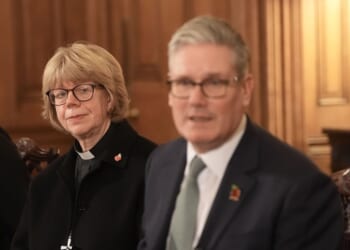
THE retiring Bishop of Leeds, the Rt Revd Nick Baines, has used his valedictory speech in the House of Lords to draw attention to the humanitarian situation in Sudan, which was, he said, “so dire that ‘urgent’ does not do justice to the need for action”.
During a debate on the topic last week, Bishop Baines, who has been one of the Lords Spiritual since 2014, described Sudan as “a country I love, where I have friends, and which I have visited a number of times”.
Its “suffering”, he said, was “almost unbearable, the worst humanitarian catastrophe on the planet. . . Whatever the causes of and motivations behind the current conflict, it is civilians — women, children, young men, and vulnerable ethnic groups — who are being targeted and abused in the most inhumane ways.”
He offered some scale of the conflict. “It is estimated that up to 150,000 people have died, and 13 million have been displaced, 9.6 million internally and 4.3 million in exile. Some 25 to 30 million people are hungry, malnourished, or severely malnourished. Save the Children estimates that 16 million children are in need of aid. . . Access to aid is frequently blocked, and funding is inadequate to the need.”
He continued: “In so-called illegal immigration to the UK, Sudan is now the most represented group.”
The Bishop went on to outline “areas where more might be achievable now”, starting with the UK’s “responsibility to step up its leadership of partner nations in working with the Quad[rilateral Security Dialogue] and others to apply diplomatic, economic, political, and moral pressure to: bring an end to the conflict; stem the flow of arms . . . and to hold publicly to account those countries which enable this brutality to continue; and to mobilise . . . immediate protection of civilians and humanitarian workers. Key to this is the need to make all sides in the conflict seriously and unmistakably aware that they will be accountable in the future for their actions now.”
He emphasised: “the need for a diplomatic surge is clear, but resolutions by themselves will not bring a ceasefire or a peace that in the longer term leads to civilian rule. . . The humanitarian disaster, the worst in the world, cannot simply be observed from a distance. It needs concerted and determined attention and action.”
Continuing the debate, Baroness Sutie (Lib Dem) said that “the situation in Sudan has deteriorated dramatically” — its “women and girls live under constant threat of violence on a daily basis.” It “should shame us all”, she said.
Lord Alton (crossbench), quoted from his foreword to a new report on Sudan, Rivers of Blood: “We cannot say we did not know. The evidence is here. The voices are here. The responsibility is ours.”
Lord Sentamu, a former Archbishop of York and former Chair of Christian Aid (2021-23), described Bishop Baines as “a tireless supporter of Sudan, even almost endangering his life”. Lord Sentamu asked how far progress “to get teams into Sudan to investigate those atrocities and hold the perpetrators to account has got? Our words must be matched by our actions. We must become peacemakers, not peace-lovers.”
The Bishop of Leicester, the Rt Revd Martyn Snow, asked about support for NGOs and local actors as they experienced “significant barriers to accessing funding due to stringent UK compliance requirements”.
Responding, the Foreign Office Minister, Baroness Chapman, paid tribute to Bishop Baines’s “longstanding commitment to Sudan and its people”, and recalled that “the Archbishop of Sudan chose to join him at Ripon Cathedral for a recent service.”
She acknowledged “the deep concern from right across the House about the dire humanitarian situation in Sudan, at a time when we must galvanise action to stop the war and end the suffering”.
She also commented on UK efforts in the UN, on humanitarian aid, and said that “support for the people of Sudan will remain a priority for this Government, as I know it does for the whole House.”