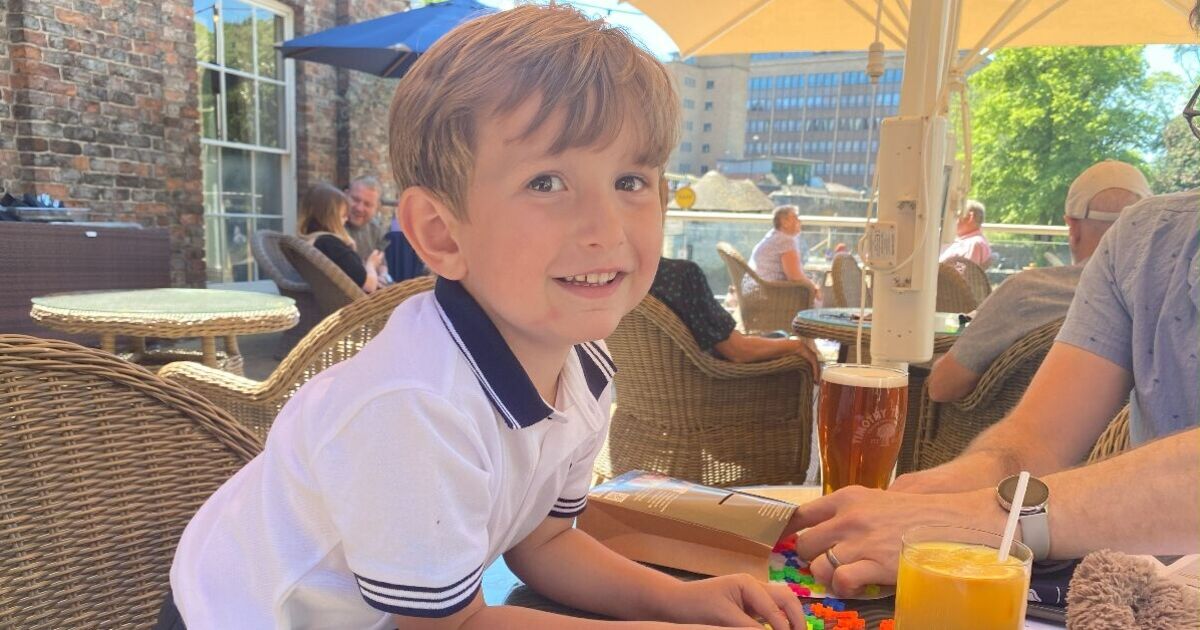
A five-year-old boy collapsed and died hours after drinking milk at school. Benedict Blythe suffered from asthma and was allergic to milk and egg.
He was a few weeks into reception year at primary school when he was unwell overnight, vomiting twice on November 29, 2021. Benedict was kept off school the next day and returned to class on December 1.
After break time that day, Benedict returned to his classroom where he was offered a drink which should have been the oat milk his parents sent into school. Benedict’s oat milk was kept separately from the cartons of cow’s milk given to his classmates, along with a carton of lactose-free milk, which was there for another child in his class who was lactose intolerant.
He decided not to drink the milk offered to him in his own cup and poured it away. His classroom teacher said she couldn’t be sure whether Benedict had sipped some of the drink when she wasn’t looking.
Minutes later, Benedict vomited and his parents were called to come to the school to collect him.
A teaching assistant cleaned Benedict up, but he vomited again. He was taken outside to get some fresh air, but he collapsed and was carried back inside.
Benedict was twice given adrenaline from an auto injector by a first aid trained teaching assistant, but he didn’t respond. When it was discovered he wasn’t breathing, CPR was carried out by teaching staff and Benedict’s dad.
Paramedics and air ambulance crew rushed to the school, with Benedict taken to Peterborough City Hospital where medics battled to keep him alive. Tragically, he died later that day.
Elizabeth Gray, Area Coroner for Cambridgeshire and Peterborough, issued a prevention of future deaths report following Benedict’s inquest.
The report, which was published on Tuesday, calls on Cambridge Constabulary and the Royal College of Pathologists to take action.
Ms Grey found police took witness statements and carried out an investigation at the school, but samples of Benedict’s vomit had not been collected by officers.
She also found no other authority requested samples be collected or evidence preserved at the scene. Tests carried out at the hospital confirmed Benedict suffered an anaphylactic reaction, according to the report.
The coroner found that the initial investigation focused on a McVitie’s biscuit Benedict had eaten during break that day which he had brought in from home.
Ms Gray’s report notes that it became evident during the investigation that the biscuit didn’t cause the anaphylactic reaction and “it was more likely than not” that Benedict’s reaction was caused by being exposed to cow’s milk protein.
She said keeping samples and testing by pathologists would have helped to identify the cause of Benedict’s reaction earlier and “may prevent future deaths”.
Benedict’s father, Peter Blythe, described finding his son at the school during a previous inquest hearing. Mr Blythe, quoted by The Sun, said: “Benedict was dying in front of us and I could not believe what was happening.”
Mum, Helen, told the inquest Benedict was well aware of his allergic reactions and woke up “as normal and in good health”.
In August, Benedict’s sister, Etta, and five other primary school pupils delivered a petition to Downing Street, calling on the Government to bring in Benedict’s Law.
It would seek to end the “postcode lottery” of safeguards around allergies in schools across the UK.
Cambridgeshire Police and the Royal College of Pathologists have been approached for comment.