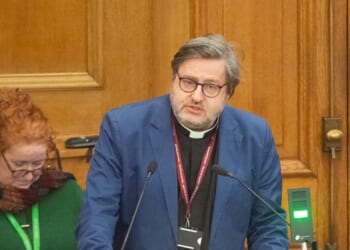

Christian apologist and author Frank Turek recently pushed back against claims that dispensationalism and Christian Zionism are heresies, but acknowledged the details of the End Times remain “veiled” and subject to honest debate among Christians.
Speaking during a Nov. 21 event at Restored Community Church in Eagle, Idaho, Turek fielded a question from a Gen Z audience member who said he increasingly hears accusations of heresy thrown at dispensationalists and Christian Zionists, even from among his friends and family.
Turek, who posted a clip of the exchange on social media this week, serves as president of CrossExamined.org. He was also a friend and mentor to the late Charlie Kirk and accompanied him to the hospital after he was assassinated in September.
“A good question to ask them is, ‘What is a heresy?'” Turek replied to the young audience member.
“Because theologians almost universally agree, when it comes to eschatology, the only true heresy is preterism,” said Turek, who defined preterism as the belief “that everything that happened in the Bible, including the book of Revelation, has already happened; that Jesus has already come and set up His Kingdom.”
“It’s quite obvious He hasn’t [returned], OK?” Turek said. “But every other eschatological viewpoint is not a heresy.”
Turek went on to warn against flippant use of the term “heresy,” which has historically been applied to serious doctrinal errors that can deprive one of salvation by undermining central tenets of the Christian faith. He suggested there is room for disagreement when it comes to the End Times.
“People who are Bible believers and scholars will argue over, ‘Is it dispensationalism? Is it historic dispensationalism? Is it preterism? Partial preterism? Is it postmillennialism, amillennialism, all these different viewpoints? Is there a rapture? Is there not a rapture?'”
“I just tell people, ‘Look, I’m not on the planning committee. I’m on the welcoming committee.’ Alright?” he added to laughter from the audience.
“When Jesus comes back, I’ll welcome Him, but it’s not a heresy to be a dispensationalist. It never has been. They have to make the case it is. But people throw terms around, not understanding what the meaning really is, or the meaning is so fuzzy.”
Turek said Christians can debate the finer points of eschatology in good faith without losing the Gospel, and exhorted them to be careful in defining their terms.
“That’s why you got to stop and say, ‘What do you mean by heresy? How did you come to that conclusion? What evidence do you have for that?’ You may not agree with it, that’s fine.”
Turek suggested that just as there were many aspects of Christ’s first advent and its related prophecies that remained unclear until they happened, His second advent is also largely shrouded in mystery.
“Look, I think God, just like He kept His first coming veiled, He’s keeping His second coming veiled,” he said.
Dispensationalism, which was popularized among Protestant Evangelicals in the United States during the 19th century by John Nelson Darby and the Plymouth Brethren, draws a distinction between ethnic Israel and the church in its eschatology. The framework divides biblical history into a series of divine “dispensations,” which contrasts with the covenant theology common among Reformed denominations.
Modern Christian Zionism, which emerges from the dispensationalist view, maintains that the founding of modern-day Israel in 1948 was a fulfillment of prophecy and a prerequisite for the Second Coming, which often translates into political support for modern-day Israel.
Christian Zionism has increasingly become a flashpoint political and theological issue, especially in recent months, as some influential voices on the political right, such as Candace Owens and Tucker Carlson, have been fiercely critical of the position and prompted accusations of antisemitism.
Carlson, a popular conservative political commentator, apologized last month for saying he dislikes Christian Zionists while dismissing their views as “heresy” and a “brain virus,” but noted he remains frustrated at what he views as the worldview’s geopolitical consequences.
According to a recent study, the number of young American Evangelicals who adhere to dispensationalism and view Israel as crucial to the End Times is declining sharply as they increasingly move toward amillennial or postmillennial eschatology, neither of which emphasize the role of the Jewish people in the Second Coming of Christ.
Jon Brown is a reporter for The Christian Post. Send news tips to jon.brown@christianpost.com