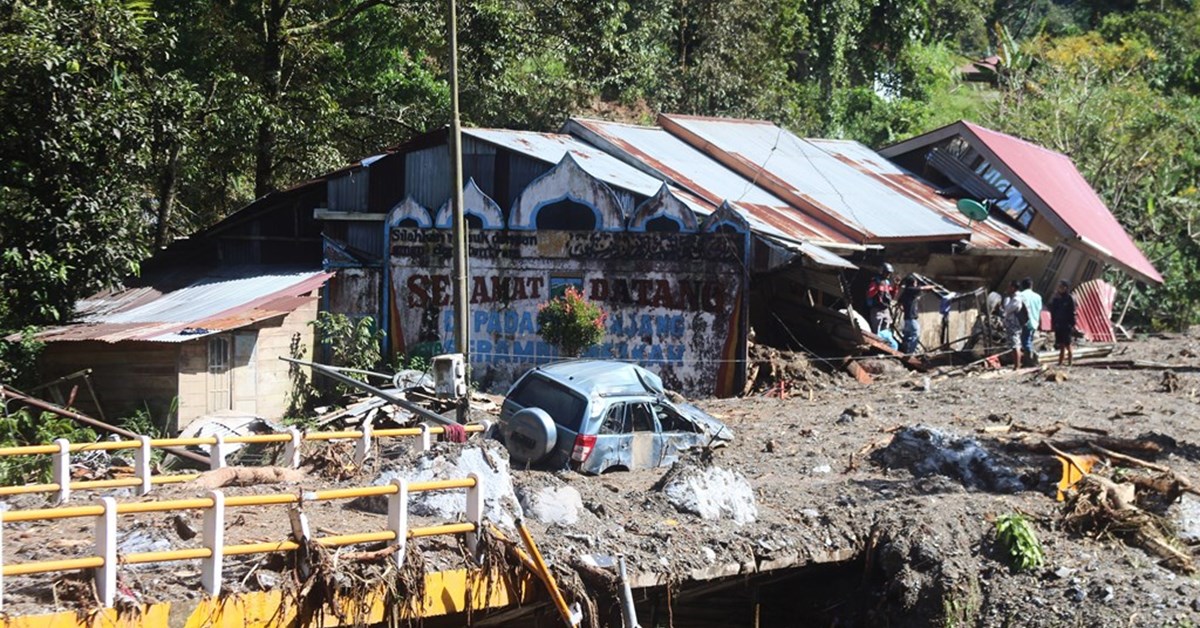
CYCLONES and extreme rainfall in South-East Asia have killed at least 1300 people, while hundreds more remain missing in Sri Lanka and Indonesia.
Cyclone Ditwah made landfall in Sri Lanka last week, causing some of the severest flooding in decades. Thousands of homes destroyed, and people were swept away in rising water and landslides. A state of national emergency has been declared by President Anura Kumara Dissanayake, who said that it was the “largest and most challenging natural disaster in our history”.
World Vision, which is working in Sri Lanka, said that homes, farms, vital infrastructure, and livestock had been lost. The charity has been transporting essentials on motorbikes and on foot to remote areas.
Cyclone Senyar also swept through Indonesia, Malaysia, and Thailand at the end of last week. The highest death toll is in Indonesia: more than 700 recorded so far, while five hundred people remain missing. About 3.2 million people have been affected and about 2600 injured. The Indonesian President, Prabowo Subianto, has also declared a national emergency, blaming climate change for the disaster. He said that local governments must do more to prepare for intense rainfall and climate disasters.
Vietnam has also recorded extremely high rainfall, up to 1.79 metres recorded in one 24-hour period.
Thousands of people have been displaced across the region and are in temporary accommodation. Rescue teams have struggled to get to remote areas, particularly mountainous ones, such as Sumatra, in Indonesia.
Meteorologists at the UN said that the region was one of the most vulnerable to floods, but that tropical cyclones such as Senyar were still rare so close to the Equator.
Clare Nullis, of the World Meteorological Association, said: “It’s not something that we see very often and it means the impacts are magnified because local communities . . . have got no experience in this.”
On Monday, the International Federation of Red Cross and Red Crescent Societies declared an “urgent need for stronger legal and policy frameworks to protect people in disasters. These floods are a stark reminder that climate-driven disasters are becoming the new normal, and investment in resilience and preparedness is critical.”
The general secretary of the Christian Conference of Asia, Dr Mathews George Chunakara, expressed solidarity with churches, national ecumenical councils, and partners actively engaged in relief work. “We lift up the bereaved, families awaiting news of missing loved ones, and all those affected, praying for comfort, hope, and protection in these times of deep suffering,” he said.
“These disasters, intensified by extreme weather and climate change, remind us of our shared responsibility to care for creation and protect vulnerable communities.”
The general secretary of the World Council of Churches, the Revd Professor Jerry Pillay, said: “We grieve with all those affected and hold you in prayer as you cope with loss and long-term recovery. For those responding, for churches serving as shelters, for all those who are caring for their neighbours, we pray for your strength and thank God for your tenacity and support.”