WRITING about the consecration, in May 1911, of St Jude-on-the-Hill, the architect Edwin Lutyens’s contribution to the social reformer Henrietta Barnett’s pioneering Hampstead Garden Suburb, the Church Times reporter ended by noting “the important fact that its acoustic properties are perfect”.
More than a century later, during which the church’s fortunes have ebbed and flowed, it is these properties — and the gifts of those harnessing them — that have ensured its survival, the Vicar, the Revd Emily Kolltveit, said this week. “If you’ve got music, everything else is possible as far as I’m concerned.”
Mthr Kolltveit arrived as Priest-in-Charge in 2023. As the benefice was vacant for 18 months, there was “a certain amount of uncertainty about where the parish was going to go from there”, she recalled.
St Jude’s had been placed on the Heritage at Risk list more than a decade ago, and there was “a lot of concern about . . . whether the parish had the energy and the experience to be able to manage a building like that”, she said. There were no churchwardens and no treasurer in post. Today, the congregation is regularly 100-strong. Weekly services have increased from one to 11.
“To me, I felt that all of the pieces of the jigsaw puzzle were there: it’s just that nobody had really pulled them together,” Mthr Kolltveit said. The presence of Nicholas Chalmers as director of music — a post that he has held since 2003, in addition to conducting for the Royal Opera House, National Youth Choir, and the BBC Singers — was an obvious strength.
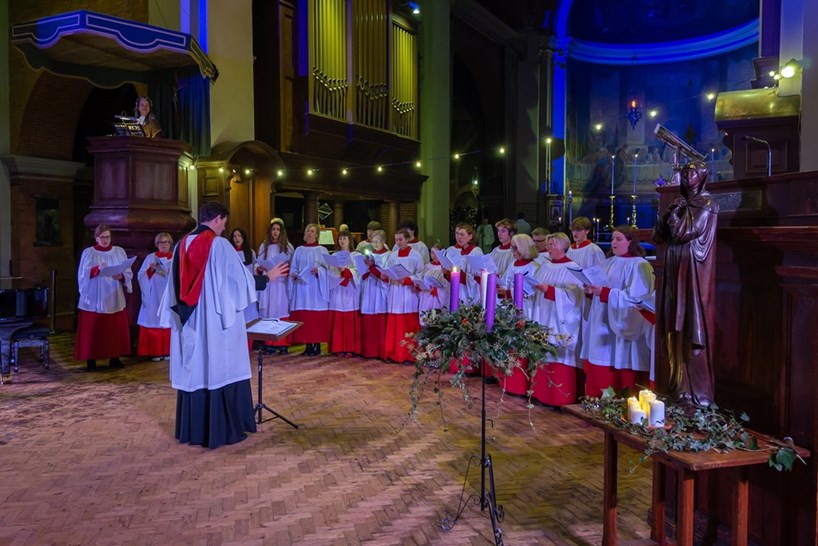 Michael EleftheriadesThe Advent procession at St Jude’s, on Sunday
St Jude’s has a venerable musical heritage. In the post-war period, it acquired a reputation for being “the place to record symphonic repertoire”, and was valued for its serene setting (and distance from the Heathrow flight path), Mr Chalmers said this week. A link with Henrietta Barnett School was established in 2003, when an organ scholarship was set up in the memory of a maths teacher, Nicholas Maines. To date, ten girls have taken part, all of whom have secured places at Oxford or Cambridge as organ or choral scholars.
The church’s choral scholars have doubled to eight since Mthr Kolltveit’s arrival, recruited from both state and private schools, and she has also established a musicians-in-residence scheme, whereby young musicians in need of accommodation in London are housed in the vicarage, in exchange for offering their gifts to the parish.
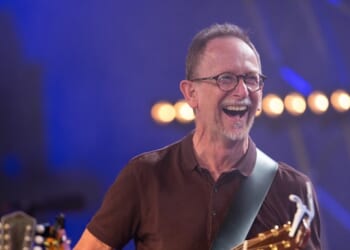
A “pop scholarship” has recently been added, with local parishioner Rob Vel as its inaugural recipient. Mthr Kolltveit, who, as a member of Mediæval Bæbes, won an Ivor Novello award, has supported the development of his first single, The Last Thing, released this week.
Music had provided continuity and renewal at the church over the years through the scholars, the rhythm of the services, and the sung eucharist, Mr Chalmers said this week. “There was a sense that music and the acoustic and the architecture kept us going.”
Having grown up in “a totally non-Christian household with a family who thought Christians were ridiculous”, Mthr Kolltveit had, she said, come to faith through her work in the Mediæval Bæbes, singing devotional music in cathedrals. “I believe very strongly that music is the way that you can hear God’s voice most clearly in the world, and if you keep putting it out there eventually people will hear.” The Church, once a major sponsor of the arts, needed to “renew those bonds”, she said. “It’s lost some of its voice in the world.”
Challenges remain at St Jude’s, which faced financial struggles even before its consecration. In 1910, its first incumbent, the Revd Basil Bourchier, wrote to the Church Times to appeal for £7000. It was more than 30 years before St Jude’s was first out of debt. The building remains on the At Risk list.
But Mthr Kolltveit said this week, however, that “good news” was on the horizon, in addition to a recent announcement that the Courtauld Institute would be restoring the Lady chapel, to be used as its postgraduate training ground.
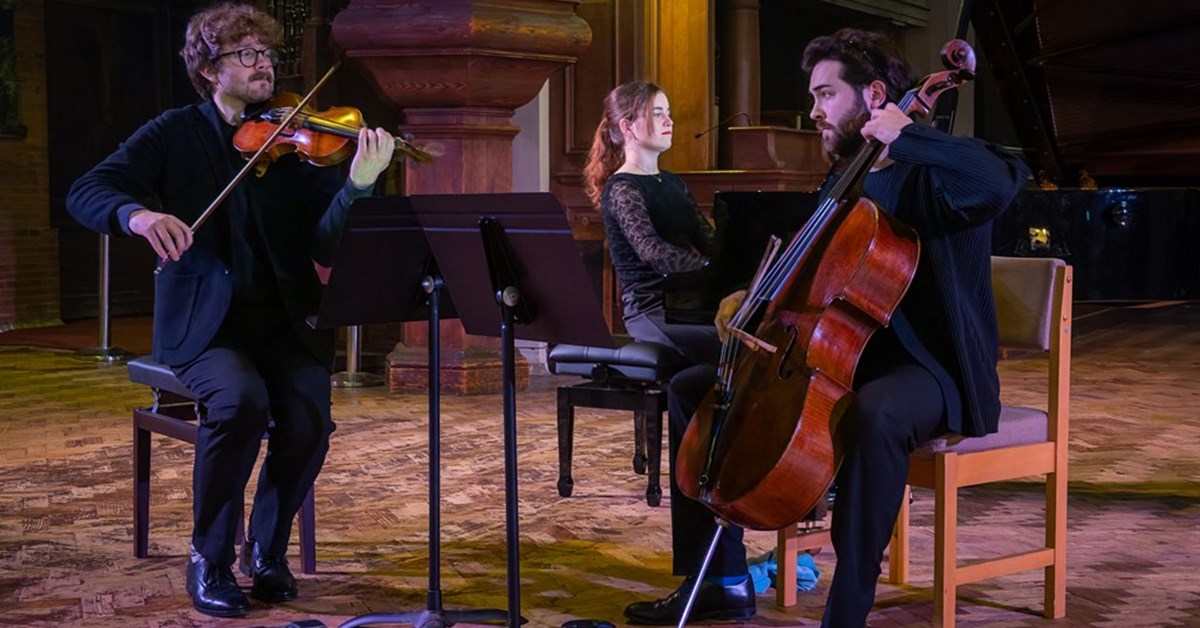
Last Sunday evening, the acoustics celebrated at its consecration enhanced an Advent procession, followed by a performance by the two latest musicians in residence — Chloé Dumoulin and Gabriel Francis-Dehqani — playing in the presence of the red sanctuary lamp that Fr Bourchier hoped to be able to fill with oil should the “requisite sum” be sent.