“CAROLS from King’s” is still an English Christmas staple. It was Eric Milner-White, the Dean of King’s College, Cambridge, who introduced the service of Nine Lessons and Carols there shortly after the Armistice in 1918.
Allen Warren, the author of this memoir, laments the destruction of many of Milner-White’s private papers from the early years of his life, and the consequent difficulties of producing a rounded picture of the man.
Contemporaries who knew Milner-White personally differ in their assessments of his personality and achievements. Archbishop Michael Ramsey knew him first as a schoolmaster at King’s College School, and finally as Dean of York. He kept a photograph of Milner-White in his study, and wrote an affectionate tribute to him after his death in 1963, which is printed as an epilogue to this book.
Archbishop John Habgood, who, as a young fellow of King’s, had post-war memories of visits to the college from the elderly Milner-White, admitted that younger dons regarded his precious manner as “somewhat ridiculous”. There is no denying, however, the extent of his achievements in many spheres of ecclesiastical life.
The special service first held at Christmas 1918 (though a precursor had been introduced under Bishop Benson in Truro in 1880, and others had followed suit) traced the biblical story leading up to the birth of Christ, introduced by a bidding prayer, composed by the Dean, in a poetic style resonant with the Book of Common Prayer. He had a fine ear for what was still apt and available in the Prayer Book tradition, and his prayer is still in use throughout the Anglican Communion.
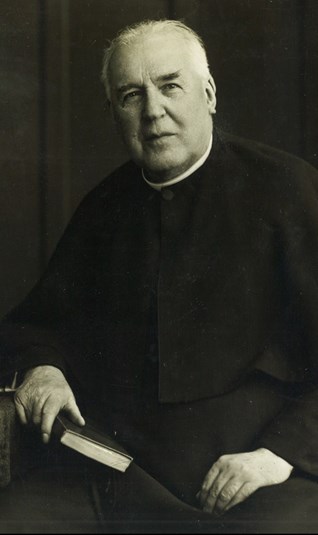 Herbert SpeedDean Milner-White
Ordained deacon in 1908, he joined the remarkable cohort of talented, university-educated Anglo-Catholic priests committed to working in the poverty and slums of Edwardian south London. He did not, however, develop the emphasis on social policy characteristic of his contemporary William Temple. Instead, his was always an aesthetic religion, and some of his sermons from this period have been described as “like verbal incense, spiritual but not readily comprehensible”.
As an academic high-flyer, Milner-White returned to King’s before volunteering as a chaplain on the Western Front, where he served throughout the entire course of the war. He was awarded a DSO for an act of conspicuous bravery.
He returned to King’s, where he remained until his translation to York in 1941. In the optimism after the Armistice, many Anglo-Catholics hoped for a new renaissance, and Milner-White’s contribution was in crafting new services and prayers, many of which have become familiar and well-loved. He was involved in establishing the Oratory of the Good Shepherd to provide a rule of life and prayer for celibate clergy. He also contributed to the columns of the Church Times a series on post-Reformation Anglican saints, with appropriate readings and prayers for use in the liturgy.
After his appointment to York, and what Dr Allen describes as the “unusually untrammelled” office of Dean, Milner-White threw himself and considerable personal resources into the post-war revival of the city and the “beautifying” of the cathedral. In alliance with the Pilgrim Trust, he was able to restore the Minster’s 80 stained-glass windows, one of the greatest collections of medieval glass in Europe.
His astonishing range of activities was informed by his profound sense of the common Catholic inheritance of the Christian world, “sacramental, universal and mystical”. He was no mere antiquarian, but appreciated beauty in many different forms, notably in the collection of modern Japanese pots which he bequeathed to the city that he had come to love and stayed to beautify.
The Rt Revd Lord Chartres is a former Bishop of London.
More Than Nine Lessons and Carols: The life of Eric Milner-White, 1884-1963
Allen Warren
Sacristy Press £30
(978-1-78959-397-6)
Church Times Bookshop £27