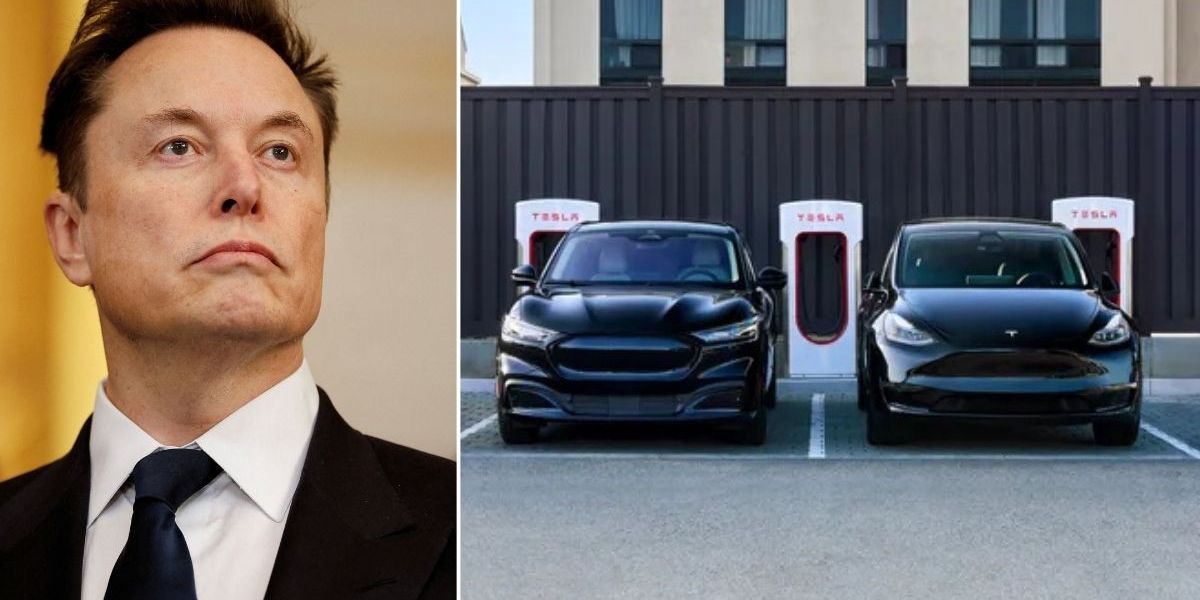
Elon Musk’s Tesla has experienced a significant drop in UK car registrations during November, with figures falling 19 per cent compared to the same month last year.
Data from the research group New AutoMotive revealed that 3,784 Tesla vehicles were registered in the UK, down from 4,680 in November 2024.
The Society of Motor Manufacturers and Traders recorded a slightly different figure, showing a 17.2 per cent year-on-year decrease to 3,772 units.
The variation stems from the two organisations using different data sources and calculation methods.
The EV manufacturer’s British performance mirrors difficulties across the continent, where the company has faced steep registration declines amid fierce rivalry from Chinese competitors.
Over the past few years, Chinese manufacturers have emerged as formidable challengers in the UK market, with BYD seeing its registrations surge more than threefold during November.
The Shenzhen-based company, which produces hybrids and plug-in hybrids alongside fully electric vehicles, has capitalised on Tesla’s struggles.
According to EV buying advice website Electrifying.com, more than 150 battery-powered models are currently available to motorists in the UK.

Tesla was one of the UK’s largest all-electric vehicle manufacturers
|
REUTERS/TESLAThis explosion of options has intensified pressure on Tesla, which has long dominated the electric vehicle segment but now finds itself competing against both established legacy manufacturers and ambitious new entrants from Asia.
Tesla’s product range has become a vulnerability, with the company grappling with an ageing lineup despite recently beginning deliveries of refreshed versions of its popular Model Y SUV.
The brand’s reputation has also taken a hit in recent months. Customer sentiment towards Tesla has declined following chief executive Elon Musk’s public endorsements of right-wing political figures.
Mr Musk’s brief tenure leading the US Department of Government Efficiency has further complicated the company’s image among some potential buyers.
These factors have combined to create a challenging environment for the once-dominant electric vehicle pioneer, which now faces questions about whether its brand appeal can recover in an increasingly competitive marketplace where consumer loyalty is no longer guaranteed.
Tesla’s November struggles extended well beyond UK shores. In Germany, the company recorded a 20 per cent fall in registrations, while French sales collapsed by nearly 60 per cent.
Other European markets experienced similar downturns, although Norway proved an exception with record-breaking Tesla sales during the month.
The broader UK car market also showed signs of weakness, with New AutoMotive data indicating that total new vehicle registrations fell 6.3 per cent to 146,780 units in November, while SMMT figures showed a more modest 1.6 per cent decline to 151,154 vehicles.

Drivers have been backing away from Tesla cars due to Elon Musk’s political views
|
TESLABattery-electric car registrations across all brands dipped 1.1 per cent to 38,742 vehicles. Plug-in hybrids bucked the trend, however, with registrations climbing 3.8 per cent to reach 16,526 units.
Industry experts suggested that perceptions around electric vehicle affordability may not reflect reality. Jamie Hamilton, automotive partner and head of electric vehicles at Deloitte, said: “On the surface, some consumers may feel that BEVs have increased in cost, but this is not necessarily the case.”
Mr Hamilton acknowledged that the forthcoming EV mileage charge would push up running costs for battery-powered vehicles.
However, he noted that adjustments to the Expensive Car Supplement threshold could offset these increases for certain drivers. “Changes to the Expensive Car Supplement threshold may mean some drivers are actually better off over the course of their lease period,” Mr Hamilton added.