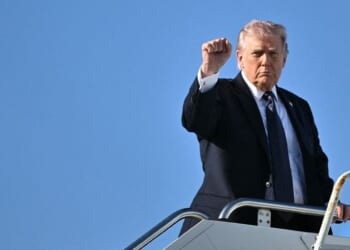
On the first day of his second term in office, President Trump issued an executive order directing that children of illegal aliens who are born in the United States are not citizens, and will not be treated as such. This order (like many others) was greeted with outrage in polite society. It has widely been asserted that the 14th Amendment plainly provides birthright citizenship to all who are born here, and that the Supreme Court has so ruled. In fact, however, it has never been disputed that some children born in the U.S. are not citizens, and the Supreme Court has never ruled on the question whether the children of illegal aliens are citizens.
My friend Ilan Wurman, a law professor at the University of Minnesota, has authored a long paper that represents the most complete analysis of the topic to date. Ilan argues that a proper reading of the key clause of the 14th Amendment, “and subject to the jurisdiction thereof,” does not support extension of citizenship to the children of illegal aliens. I think the paper’s intended audience is the United States Supreme Court. Ilan has also co-authored a New York Times op-ed with Randy Barnett, which makes the essential argument much more briefly.
On Friday, the Supreme Court granted the administration’s petition for review of Barbara v. Trump, in which a district court judge in New Hampshire enjoined enforcement of Trump’s executive order. The case will be argued in the Spring, with a decision most likely coming in June or July.
If the Court sides with the administration, howls of outrage from the Left will exceed anything we have seen since Dobbs. But the conventional wisdom is wrong: the 14th Amendment does not clearly grant citizenship to all who are born here, regardless of the circumstances. While the case is not free from doubt, it is entirely possible that the Court may come down on the administration’s side. Which, from a policy standpoint, would indisputably be a good thing.