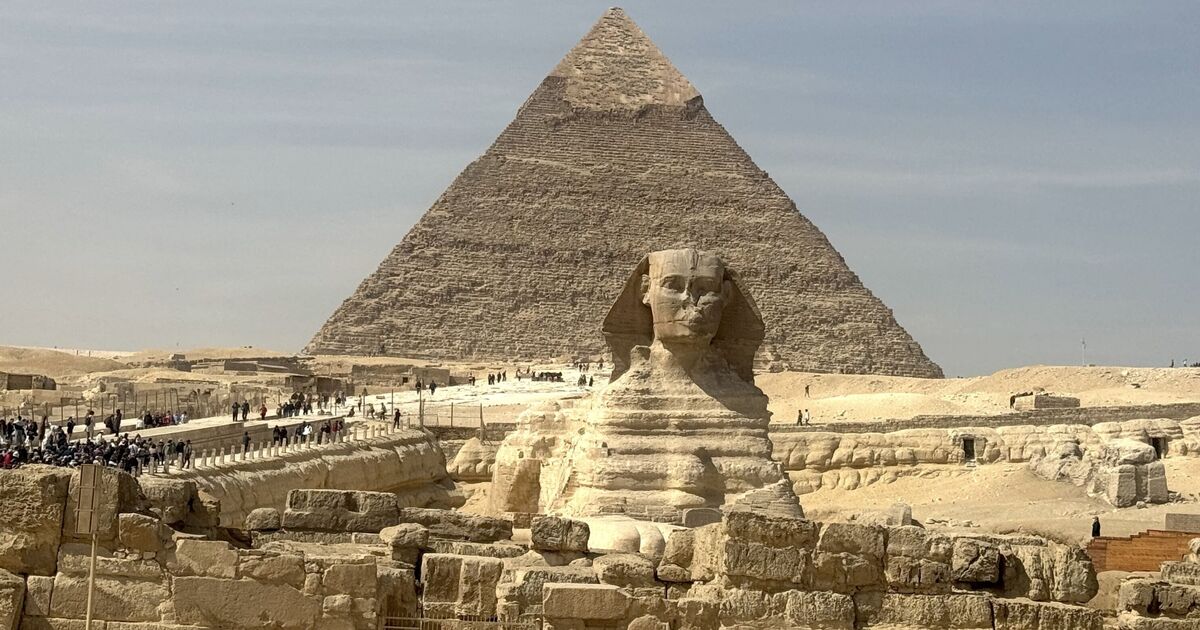
A team of Italian researchers left the world astounded last March when they revealed the discovery of an enormous subterranean network extending almost 3,500 feet below Egypt’s Giza Plateau, linking chambers reportedly the size of city blocks.
Now Filippo Biondi – the radar specialist responsible for the imaging methodology – has stepped forward with what he describes as convincing proof.
During a recent interview on Jesse Michels’ American Alchemy podcast, Mr Biondi disclosed that four separate satellite operators – Umbra, Capella Space, ICEYE, and Italy’s Cosmo-SkyMed – each generated identical raw tomography data showing the same underground formations.
Mr Biondi stated: “All four satellites produced exactly the same results. That’s truly remarkable. We can’t announce anything without these fundamental scientific checks.”
Employing a method he developed – synthetic aperture radar Doppler tomography – Mr Biondi’s team examines minute vibrations on the Earth’s surface. He explains that these vibrations contain acoustic “fingerprints” from structures thousands of feet below ground, allowing software to create 3D reconstructions despite the radar signals never actually piercing the earth.
The scans, he asserts, reveal eight massive hollow cylinders plunging vertically from the foundation of the Khafre pyramid, the central structure of the three great pyramids.
Each shaft allegedly houses a central column encased in meticulous helical coils and terminates over 3,500 feet below the plateau in cubic chambers measuring approximately 260 feet on each side – dwarfing many contemporary sports venues.
Mr Biondi declared: “The pyramids are just the tip of the iceberg. They’re merely a capstone to something much larger beneath the surface. The real structure is below.”
When questioned whether the spiral formations could be natural geological phenomena, he replied categorically: “Not a chance. It’s man-made. You simply don’t see perfect coils like this occurring in geology.”
Numerous mainstream authorities, however – including renowned Egyptologist Dr. Zahi Hawass – have rubbished the assertions as “fake news” since they initially emerged in the spring.
Hawass has contended that the radar-based technique cannot possibly capture images at the depths claimed by the Italian team.
Despite the backlash, the researchers maintain they are pressing ahead, alleging they have identified comparable – though smaller – patterns beneath the third pyramid, Menkaure, alongside a solitary large shaft below the Sphinx. The same spiral-shaft geometry was also discovered 30 miles away at Hawara, a site ancient scribes referred to as the Labyrinth.
The Giza complex is made up of three pyramids – Khufu, Khafre and Menkaure – constructed 4,500 years ago on a rocky plateau on the west bank of the Nile River in northern Egypt. To date, the team has recorded a depth exceeding 3,280 feet, more than half a mile down.