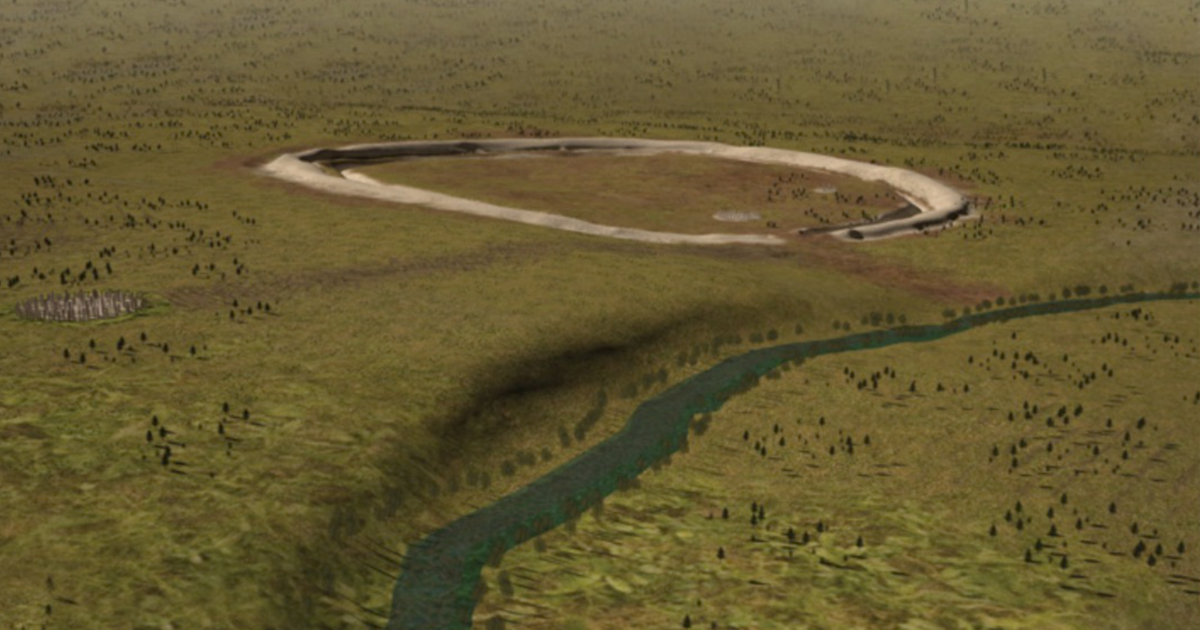
Archaeologists have uncovered a remarkable find at the Neolithic Durrington Walls henge, just north of the iconic Stonehenge monument.
A series of 16 uniformly shaped, massive pits, forming a circle over 1.25 miles wide, have been confirmed to be the work of ancient humans , likely all dug around the same time in 2480 B.C.E.
Since their discovery in 2020, research teams from various institutions have been studying the site extensively.
Vince Gaffney, professor and lead archaeologist from the University of Bradford, stated, “The recent work confirms that the circle of shafts surrounding Durrington Walls is without precedent within the UK.
“These features were not simply dug and abandoned—they were part of a structured, monumental landscape that speaks to the complexity and sophistication of Neolithic society.”
Advanced dating techniques reveal pits were dug in short time period
Using a combination of borehole coring, sediment analysis, geochemistry, optically stimulated luminescence dating, and environmental DNA, the team confirmed that the pits were human-dug and dated to the Late Neolithic period, around the same time Durrington Walls was constructed.
Tim Kinnaird of the School of Earth and Environmental Sciences Dating Laboratory at the University of St Andrews emphasized, “The new dating evidence, coupled with the remarkably consistent geochemical signature seen within the fills at the pits provides definitive evidence that they were constructed by people living at the site over a very short time period.”
The sheer scale and precision of the pits have left archaeologists in awe. Richard Bates, professor at St Andrews, remarked, “The skill and effort that must have been required not only to dig the pits, but also to place them so precisely within the landscape is a marvel. When you consider that the pits are spread over such a large distance, the fact they are located in a near perfect circular pattern is quite remarkable.”
Pits may have marked sacred boundary linked to ceremonial activity
Archaeologists believe the pits may have served as a sacred boundary linked to ceremonial activity at Durrington Walls, similar to what occurred at Stonehenge. The fine clay-silt layers now found in the pits suggest gradual infilling over time.
The study, published by Internet Archaeology, showcases the power of applying multiple geophysical and geochemical techniques to investigate a site. Bates noted, “It is rare to have the opportunity to apply so many geophysical and geochemical techniques together to investigate a site, but demonstrates the power of doing so when you do.”
This groundbreaking discovery at Durrington Walls henge sheds new light on the sophistication and complexity of Neolithic society, revealing the incredible feats of engineering and coordination achieved by ancient humans thousands of years ago.