AVELLINO, Italy (LifeSiteNews) — An Italian priest has argued that a “baby girl Jesus” should be introduced into Nativity scenes because God could have incarnated as a woman as well.
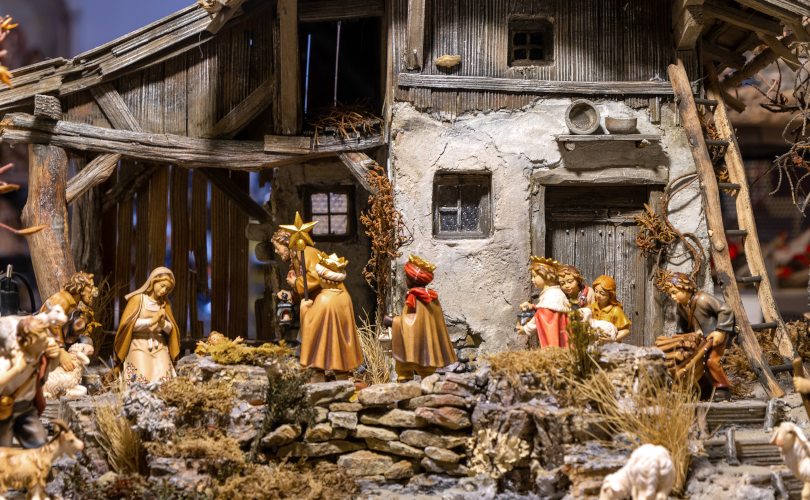
On December 3, Father Vitaliano Della Sala, pastor of Sts. Peter and Paul in Capocastello, Italy, during an interview with a local television station, sparked widespread debate in the national press with his proposal to place in the Nativity scene a figure of a “baby girl Jesus,” described by the priest himself as a provocation meant to stimulate reflection on the role of women in the Church and on women’s access to the priesthood, while also calling into question the traditional theological understanding of the Incarnation.
“If I need to send a message within the Church, there is a great injustice, namely that women cannot access the priesthood. I was thinking of having a baby girl Jesus born, to say that if Jesus was born male, this does not mean He privileged us men and excluded the possibility of women becoming deacons, priests and – why not? – even bishops,” Della Sala declared.
READ: Vatican will display first-ever pro-life nativity scene this Christmas
In the interview, the priest clarified that his proposal would be a way to “re-interpret” the Christian message in light of what he considers to be an unresolved issue in ecclesial life – namely, the impossibility for women to enter the ordained ministries. Placing a female figure in the manger was described by him as a deliberately symbolic act, intended to provoke reflection and debate.
The priest also stated that he has received numerous criticisms from other clergymen, who strongly condemned his initiative: “They are priests who envy me! The provocation is positive, I don’t get anything from it,” he said.
During the interview, the priest added another element bound to spark further reactions: he explained that the “baby girl Jesus” figure could be “torn to pieces” as a symbolic gesture of closeness to children who are victims of violence and massacres around the world, such as in Gaza and Ukraine. This statement, too, was presented by the parish priest as a way – according to his own words – to recall the suffering of the little ones in the contemporary international landscape, linking it to the Christmas narrative.
The controversy is not Fr. Della Sala’s first regarding Nativity scenes. In 2023, the Italian priest presented a display in which two mothers were present at the side of the manger, one of whom donned a rainbow-colored veil. Della Sala told the press at the time that he “wanted to show with this scene that families are no longer just the traditional ones … [In] our parishes, we see more and more children from the new types of families that exist and are part of our society, children of separated and divorced people, gay couples, single people, young mothers.”
In the public debate that has arisen from his latest interview, the cleric’s decision has been compared to other recent European initiatives that stirred controversy, such as the “faceless” Nativity scene reported in Brussels, apparently intended to allow a “multicultural” interpretation of the image. Della Sala, however, insisted on defining his choice as a personal gesture aimed at prompting discussion on issues internal to the Church.
The case unfolds within the broader ecclesial debate on the role of women and their potential access to Holy Orders, particularly the diaconate.
READ: Vatican refuses to form ‘definitive judgment’ on women deacons
On December 4, Pope Leo XIV published the Summary of the Study Commission on the role of women in the Church. The document confirmed the current rule: the diaconate is reserved to men only. The debate, however, continues because two interpretations of the diaconate currently dominate in the Church: as a service within the community, in which women could also participate; or as the first step toward sacramental priesthood, which according to Tradition and doctrine remains reserved to men.
In recent years, certain communities and ecclesial movements have advocated for greater recognition of women’s contributions to the life of the Church, while the papal Magisterium has repeatedly reaffirmed the impossibility of priestly ordination for women. The last infallible pronouncement came from Pope John Paul II with the apostolic letter Ordinatio Sacerdotalis of May 22, 1994.
Within this context, symbolic initiatives – sometimes emerging from local ecclesial environments – have fueled the ongoing discussion, often provoking sharply contrasting reactions. Recently, again in Italy, another priest, Luca Favarin, although previously laicized and dispensed from the obligation of celibacy by Pope Francis, had reignited debate on another controversial topic: the introduction of married men to the priesthood.