ANDREW MALKINSON stood trial in 2004 accused of rape. He had an unmarked face, although the victim had gouged a deep scratch down her attacker’s cheek, and Malkinson had tattoos on his arms where the attacker was said to have none. No hard evidence linked him to the scene of the crime, let alone to the crime itself. A jury convicted him of rape by ten votes to two.
Oliver Campbell stood trial in 1993 accused of murder. After being named by another suspect, he was dragged in by the police and co-opted into confessing. He was left-handed, when the attacker was alleged to be right-handed, a towering six foot four, compared with the murderer’s slim five foot nine, and with learning disabilities that would make it difficult to commit the crime of which he had been accused. All that linked him to the scene was a baseball cap that was similar to one that he had owned, which had hairs in it that did not match his DNA. A jury unanimously convicted him of murder.
Mr Malkinson was found not guilty two years ago, after the Court of Appeal set aside his conviction on the second time of asking. Just over a year later, Mr Campbell, who had already served his sentence and been released, had his conviction quashed.
Both of these innocent men had their defences put before a jury, and, on both occasions, the jurors wrongly found them wanting. They lost decades of their lives. Nor are cases like these exceptional: institutes and organisations such as the University of Exeter’s Evidence Based Justice Lab and Appeal intervene in hundreds of miscarriages of justice
Jury trials are no guarantee of justice; nor is it obvious that they are even a better guarantee of justice. Instead, juries often function as a shield for the Government and its underfunded prosecution service to hide behind. Ministers asked to account for grievous wrongs such as Mr Malkinson’s incarceration can pass the buck, pointing to the fact that defendants are given a fair trial before a jury of their peers, and that it is not for them to question the verdict of the people.
THE Government’s plans to abolish jury trials for a wider range of criminal cases, put forward by the Justice Secretary, David Lammy, in Parliament last week (News, 5 December), could have been a pragmatic reflection of this reality.
The proposals do not eulogise juries, harking back to their ostensible Magna Carta roots in some pastiche of British exceptionalism. Instead, they acknowledge that juries are a longstanding element of our justice system, but not necessarily one immune to reform. Limiting jury trials to those where the defendant is likely to be sentenced to more than three years in prison will not devastate the justice system.
Where the proposals are ruinous, however, is dispensing with lay participation in criminal trials wholesale. In Sir Brian Leveson’s independent review of the criminal courts, juries were to be replaced with a lay-bench model, akin to Germany’s. A Crown Court judge would sit alongside two magistrates, and they would come collectively to a verdict set out in a written judgment.
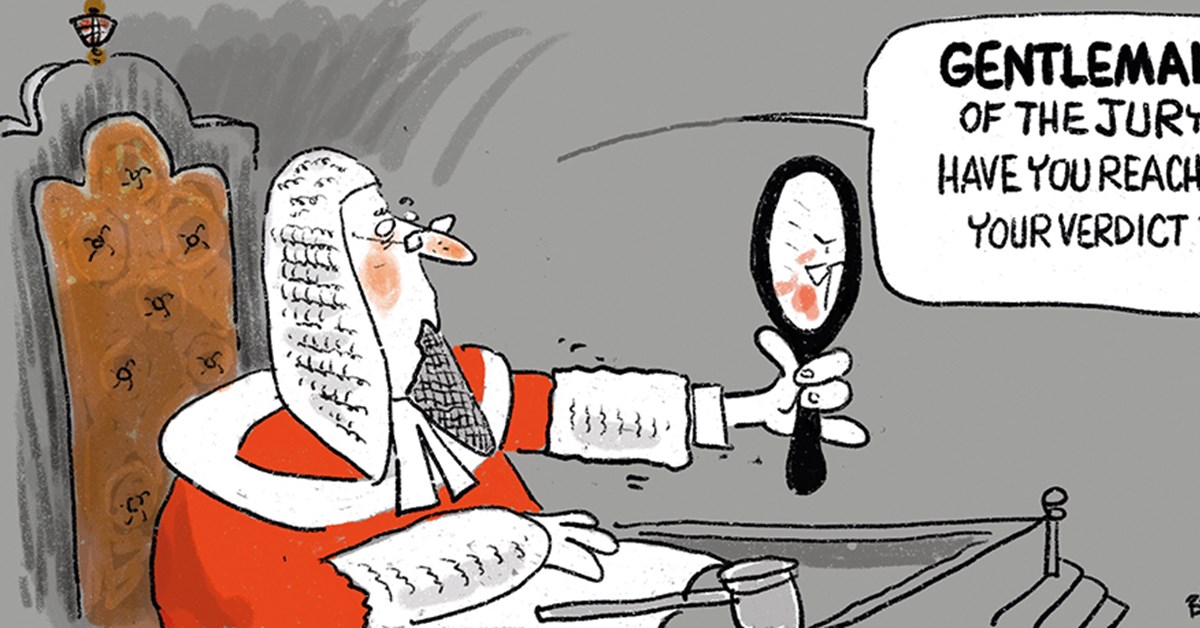
Mr Lammy’s “swift courts”, on the other hand, would be better named after Jonathan Swift’s satires of the Establishment than for the speed of the justice that they are intended to dole out. Empowering a single person, bedecked in a wig and gown, to sit as judge and jury over a defendant, before then handing down a sentence, is constitutionally flawed and politically naïve.
No matter how fair and independent a judge might be, the abstract image alone is devastating. Furthermore, it is likely that judges will gain reputations (deservedly or not) for being hard-line and austere, or for being tolerant and genial, or for being bigoted and prejudiced; and so verdicts and sentences will come down with a patina of scepticism already on them.
NOR do the proposals grapple with the fact that it is not juries causing delays in the criminal-justice system, which is how Mr Lammy seeks to justify curtailing them, but decades of immiseration. In his appearance before the House of Commons last week, he said repeatedly that the reforms “will take time”.
Yet the current proposals do little to address the systemic faults, such as that trials are persistently delayed in morning starts because defendants are brought late from prison (and you cannot have a trial without a defendant), or that the Government is still enforcing limits on the number of days a Crown Court can sit. As has become emblematic of this Government’s rule, the reforms just fiddle with the edges of a fraying state.
Cases such as Mr Malkinson’s and Mr Campbell’s show that juries are no panacea. The cries to maintain the status quo from some quarters are hyperbolic. Fears that they will lead to a collapse of faith in the justice system are being expressed even though juries already hear vanishingly few criminal prosecutions in England and Wales: fewer than one per cent, by some counts.
Juries are vital in only some cases, particularly those that go to the public interest, such as the recent Extinction Rebellion prosecutions. But what is vital is a fully functioning criminal-justice system, with a competent police force, diligent prosecutors, and well-funded legal aid. Nothing in Labour’s mooted reforms suggests that we should have any hope of a transformation like this.
Nicholas Reed Langen is a writer on legal and constitutional affairs, and editor of the LSE Public Policy Review.