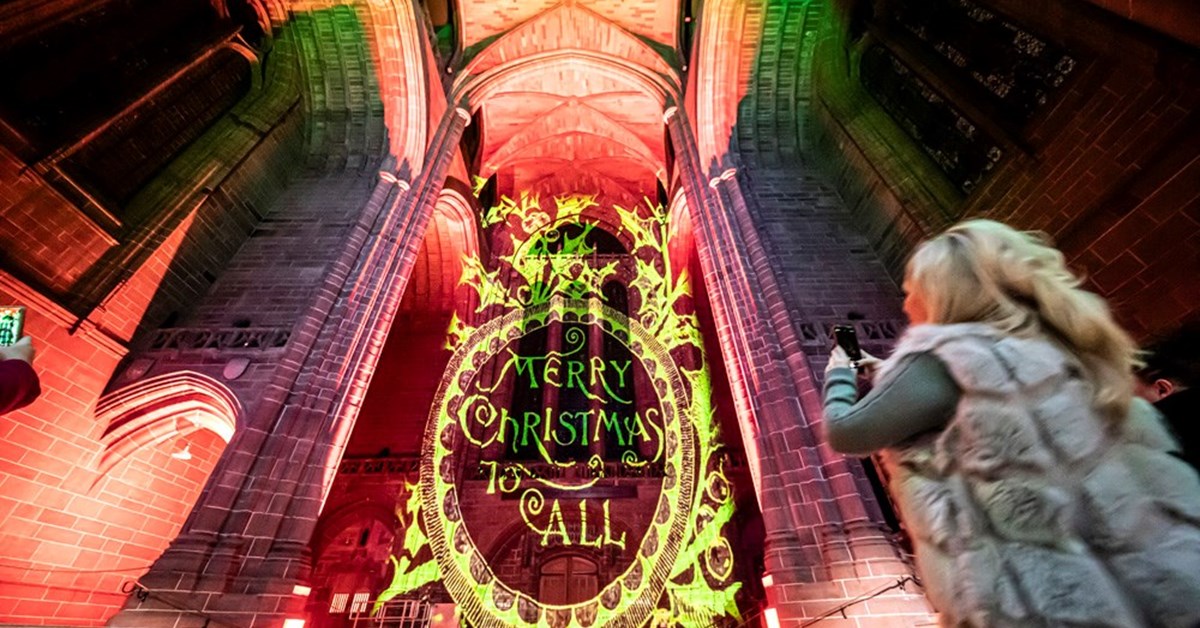
CATHEDRAL installations are becoming commonplace these days, probably causing delight and dismay in equal measure. For some, they are, at best, tacky distractions, and, at worst, desecrations of sacred spaces; for others, they are crucial in getting people through the door and into spaces that are common ground between the Church and wider society.
The ways in which “sacred space and common ground” are being utilised raise crucial questions. Are efforts to bring in tourists and visitors by events, installations, and exhibitions simply ways of replenishing dwindling coffers, or might they also be instruments of mission and church growth?
These are the kinds of question that Liverpool Cathedral has been addressing through its Knowledge Transfer Partnership (KTP) with Lincoln Bishop University. This partnership brings the knowledge and skills of academic researchers into conversation with a cathedral that wants to understand the impact of what it does on those who come through the doors.
This particular group of academics has much experience in surveying people in church contexts. Questionnaires are ubiquitous these days, and we can become cynical about them. St Paul said (to paraphrase Romans 10.14), “How can people believe if they have not heard?”, to which we might add: “How do we know what they have heard and believe unless we ask them?”
LISTENING to those who visit Christmastide installations in Liverpool Cathedral is one way of finding out whether such events actually make a difference to people, as well as to the cathedral’s budget. Luxmuralis’s pre-Christmas son et lumière has been held in each of the past four years, each with a slightly different focus from the nativity story. Is there any sense in which these installations could be seen as mission rather than simply entertainment?
With a Christian presence in every community, part of the mission of the Church of England is to serve and nourish those communities, as Jesus fed the five thousand. Participants attending these son et lumières were asked to assess the effect of the experience on their psychological well-being and on their spiritual health, using recognised measures of perceived change.
Our results to date suggest that there is no doubt that they were nourished by the experience. But what about the more radical call to discipleship? Is there any evidence that going to one of these events might actually change people’s faith or attendance at church?
Participants attending the 2023 son et lumière were specifically asked whether the experience made them more likely to want to attend a Christmas service in the cathedral: 39 per cent said that they were more likely to attend a carol service, and 18 per cent were more likely to attend on Christmas Eve or Day (see “Evaluating the missional impact of an Advent son et lumière in Liverpool Cathedral” by Leslie J. Francis in Theology, 127(3), 169-178; 2025).
By coincidence, the attendance of 4749 at the Christmas Eve carol services was a 21-per-cent increase on 2019; the attendance at midnight mass of 1232 was a 73-per-cent cent increase on 2019; and the attendance of 910 at the Christmas Day choral eucharist was a 26-per-cent increase on 2019. While these two sets of figures cannot be causally linked, the coincidence is worth noting, especially because attendance that year across cathedrals in general was lower than in 2019.
In 2024, we also asked those who attended the son et lumière whether the experience made them likelier to attend a Christmas service in their local church; and 21 per cent said that they were more likely to attend a carol service, and 19 per cent, a Christmas service.
COULD it be that these sorts of event may actually be catalysts to change in the lives of some of those who come just for the light show? This year, we will be asking people who have come at least once over the past four years; so we will be in a position to see whether there are any for whom coming in the past really has had a lasting effect on their faith.
It is not an easy question to ask, and perhaps one to which we may not get the answer that we would like. None the less, asking it as carefully as we can seems to be a worthwhile exercise, and one that the KTP should be addressing.
These are early days for this sort of sustained and detailed inquiry in relation to cathedral installations of this sort. Like it or not, this way of using these extraordinary buildings is going to be with us for some time.
There is a lot more that we need to know and understand — not least about how such events affect both regular worshippers and those who rarely, if ever, enter a church or cathedral.
Many visitors to the Liverpool installations are regular churchgoers, but non-churchgoers seem to be the ones who are most likely to be moved by the experience. Perhaps investment in cathedrals could lead to a good return. The key could be ensuring strong links between the events, installations, and exhibitions (that soften the threshold) and the liturgical life of the cathedral and diocese (which signals the migration from common ground to sacred space).
The Revd Andrew Village is Professor Emeritus, and Canon Leslie J. Francis is Visiting Professor, at York St John University.