MUSIC has always played a part in the life of Graham Kendrick, the singer-songwriter, who turned 75 this year. Over the decades, he has written some of the best-known modern worship songs. His work has cut through to the mainstream, with the popularity of “Shine, Jesus, shine” and “The Servant King”, and has been celebrated in the recent wave of nostalgia for school-assembly “bangers”.
Born in 1950 in Blisworth, where his father, a Baptist minister, was in one of his first pastorates, Kendrick remembers being part of a village that was warm and welcoming. “I was brought up in that little chapel. It was a very neighbourly community; so I always felt safe and loved,” he says.
As a son of the manse, Graham was used to visitors, particularly on Sundays, after the evening service. “Sometimes, the living room was crowded with lots of people,” he recalls. “They would pull the piano out into the middle of the room; my dad would take the panels off to get more volume out of it. My brother and sister and I would sit crossed-legged on the floor, just hearing all this wonderful sound of singing and people shouting out their favourites. Quite recently, I wrote [the album] Salvation Songs about it; it simply describes that scene.”
His first commitment to Christianity came when he was five, when his mother read him and his siblings “Christie’s Old Organ”, an 1874 story about a homeless orphan taken in by an elderly organ-grinder, and his journey to faith.
“We came to a chapter where Christie decided to put his trust in Jesus and pray a prayer. My mother asked if any of us wanted to do the same. I thought that sounded like a really good idea,” he says. “Very wisely, my mother said, ‘Why don’t each of you find a corner and go and pray your own prayer?’ I don’t know what I said, but it was like something exploded in my chest, and I just knew that prayer had been heard.”
FAST-FORWARD a decade, and churches were launching coffee bars with free drinks and bands as a response to the cultural revolution, Merseybeat, and rock ’n’ roll. Christian bands would play everything from folk to progressive rock, and the links between churches would mean that there would be invitations to perform.
By this point, the Kendricks had moved to London. He recalls: “My father turned the church’s basement into an improvised coffee bar. The band would be the attraction, because live music was not easily available.”
Graham, his brother and sister, and two friends toured London and the south with their band, and it was here that he started writing songs. “It was out of necessity,” he says. “We had to find our own style and our own songs. When one or two people say, ‘Did you write that song? That’s quite good,’ you swell up with confidence. I was no good at sports, but here was something I was getting affirmation for.
“When I was around 15, I remember telling my mother I wanted to be a songwriter. I’m sure she gave me a very sensible maternal answer.”
One challenge was not being able to read music. “I was the young, competitive third child trying to keep up. It didn’t go that well, and, after a while, the teacher gave me up. I could hear the notes, I could copy the little exercises and the sounds and memorise them, but I wasn’t relating to the dots on the page: I pretended,” he says.
Since then, he has got by. “I depend on having a good chord-chart in front of me,” he confesses. “You can’t believe how intimidating it is to be a singer-songwriter who doesn’t read music, and be standing in the middle of a 40-piece orchestra — all these people who, at the wave of a baton, can immediately sound amazing. I’m thinking ‘What am I doing here?’ but folks need songs to play, arrange, and conduct. That’s been my little niche: to shape a lyric and a melody.”
Back then, he was an “introverted poetic singer-songwriter”, creating songs at a time when people were poring over the content of lyrics looking for hidden meanings: “Intuitively, I gravitated to Bible stories. The Bible is full of narratives, and I wove them into songs. If I’m singing in a folk club, you can hear it as just another folk song, telling a story and setting a mood, but, after a while, you realise, if you know anything about the Bible’s stories, it’s about a biblical character. It helps the audience step into the story. I found that worked really well, because our passion was evangelism.”
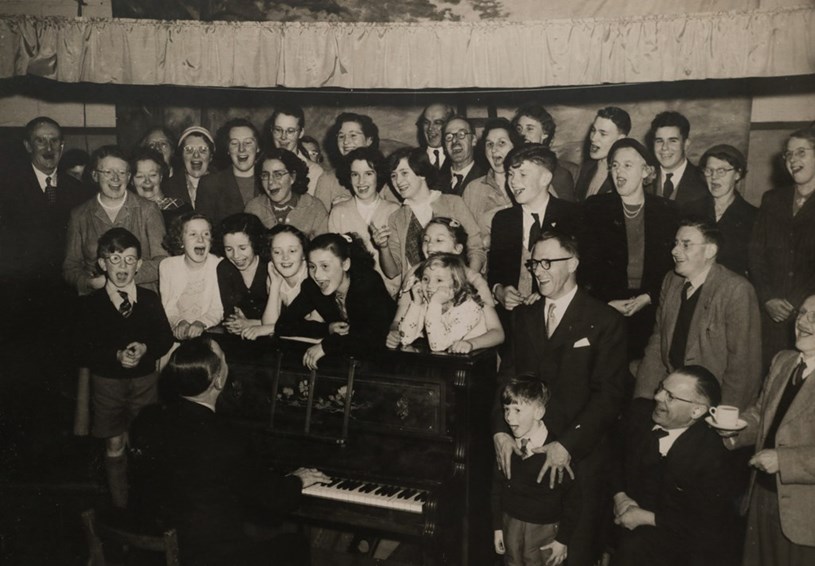 Kendrick familyGraham Kendrick, in 1957, at Laindon Baptist Church, Essex. The pianist is his father, the Baptist pastor M. D. Kendrick. Graham stands to the right of the piano. His mother and siblings are at the opposite end. The image was used in his recent album Salvation Songs
The band enjoyed several years of success before he went to college for teacher training. At about this time, he met Pete Meadows, David Payne, and Geoff Shearn, from Musical Gospel Outreach, whom he praises for organising tours and booking significant venues, including the Royal Albert Hall.
He joined a tour, and sang his songs to his fellow musicians as they travelled to different venues. This led to an album with Key Records, and, from there, a burgeoning ministry that, over the years, has included Spring Harvest, March For Jesus, and appearances on Songs of Praise.
His focus developed — “all part of the journey” — to writing songs for the Church. “Through the ’70s, I was affected by the spiritual renewal movement, little fires breaking out and people getting filled with the Spirit. Having my own journey of seeking more of the Holy Spirit, and having that experience, was key,” he recalls. “For many years, I was still pursuing the singer-songwriter role, but, on the side, I would write songs that were more communal.”
A new generation of Christian songs were being written by Dave Bilbrough, Dave Fellingham, Chris Bowater, and others. Kingsway Publishing brought them together in the Songs of Fellowship series, and also published Jesus Stand Among Us, an album of Kendrick’s worship songs.
“In those days, new worship songs travelled by word of mouth,” he says. “My job was to lead congregational singing, and there was such a hunger for new songs which express what God was doing at this time. There were only a handful. I intentionally began to write for the Church, and I had to make an adjustment. I was used to writing songs I could sing and perform. . . What does it take to write one that people can sing together?
“When I write songs, there comes a point where it is an embryonic state, and I think ‘What is this? Is it a solo song I might perform, or is it a Sunday-morning song? Then you start to shape it towards what you think it should be, but you never know what is going to take off and what is going to die. Far more songs die than take off.”
ONE song in Kendrick’s oeuvre has taken on a life beyond church: “Shine, Jesus, shine”. A staple of school assemblies from the late 1980s onwards, it featured in a recent Glastonbury Festival, sung enthusiastically by adults reliving their childhoods as part of a “Primary School Bangers” singalong session.
Its origins could not be more different: just three verses, and based on the preaching of Roger Forster, the founder of Ichthus Christian Fellowship, which Kendrick attended at the time. An underwhelming initial response meant that it was shelved. “It became obvious it needed a chorus,” he says. “Some weeks or months later, I got the unfinished-songs file, and there it was. The chorus came together quite quickly. The song grew legs of its own. I certainly didn’t foresee that, and had no inkling it would end up in schools and become established in the way it has.
“The reality is that the majority of songs have a fairly short life, especially in the present season. There are hundreds and thousands of other songs competing for attention. There are very few songs that actually survive — and most of mine have had their moment. Perhaps there are one, two, or three, that might survive, but only time will tell.”
Despite immersion in Christian life from birth, Kendrick admits that his spiritual journey has been anything but calm. “There are always questions of faith,” he says. “When I was a student in college, I had a bit of a crisis of faith, simply because I felt that what we call Christianity is so small and so limited it can be explained away culturally and sociologically. That set me off on a trail of searching for the Holy Spirit.
“One of the key things, which I think grew in me in the 1970s after I was filled with the Spirit, was this recognition that there is a battle to be fought, and you have to contend for the Kingdom of God. . . I had to learn how to pray biblically and with authority and with persistence to maintain a life of prayer, and to live out the scriptures, because that’s the only way for anyone who is serious about the faith. When you’ve begun to learn that, then you have got something more to say and impart to others.”
Kendrick has no plans to stop at present, saying that he still feels that God can work through him, especially as he enjoys good health, and is still active and busy. “I have so many things I still want to do, and many things come my way. I’d like to write more songs. Most of my attempts falter and fail, but now and again. . . I often pray, ‘Well, God, you know I’d love to write a song about this, but if I can’t do it, then transfer all this energy to someone else, let someone else write it,’ because I feel there should be a song about this.
“I don’t want to just carry on out of a need to be on a platform, or to teach. I know I need to find contentment in my relationship with Christ.
“For anyone in ministry, there is temptation to find your whole identity in your role. If you can no longer do what you do, you feel useless. The key is to invest in your relationship with Christ, so that you know who you are in God, you know you are loved and valued from your heavenly Father.”