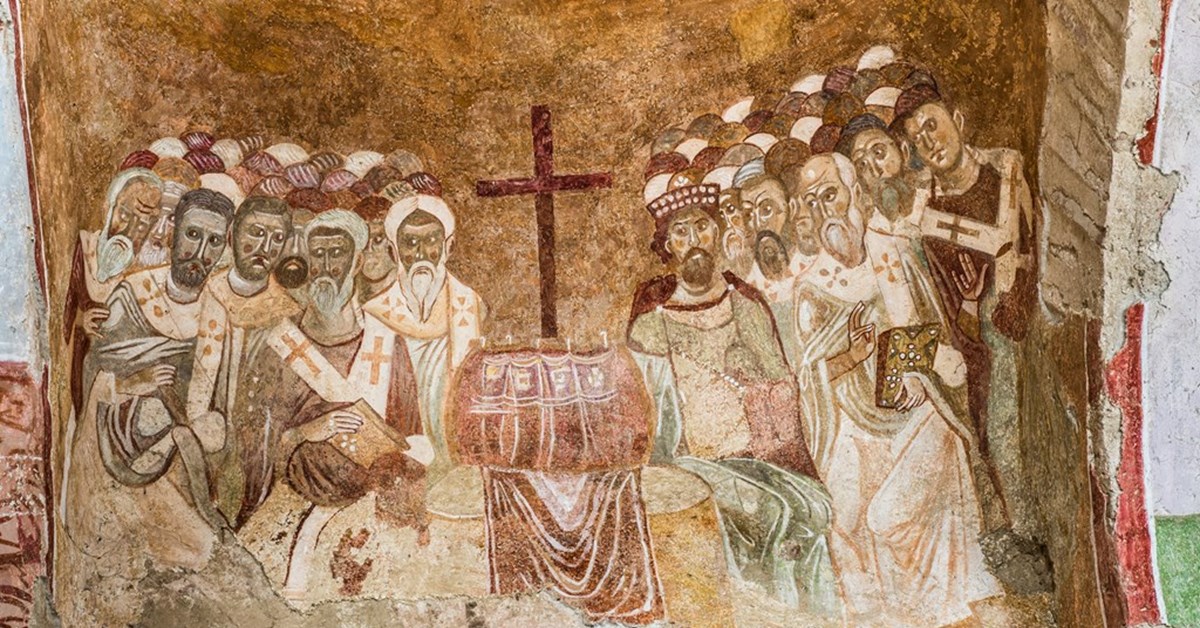
OUR Christmas celebrations, if we had them at all, would have been very different had it not been for the Council of Nicaea in 325.
This was the Council of more than 300 bishops which produced the Nicene Creed, commemorated this year. Nicaea defined the nature of Jesus Christ as being “of one substance” with God the Father. It was a controversial definition, because it contradicted what most people in the ancient world took for granted, which was that God was fundamentally unknowable.
In Alexandria, in Egypt, a popular Bible teacher, Arius, wrote a poetic apologia, Thalia, which emphasised the difference between the timeless reality of God and Christ, who, as he put it, “had a beginning”. Arius even composed little rhymes and doctrinal sea shanties, which sailors are said to have sung in the Egyptian port.
The Nicene Council was convened by the Emperor Constantine, who, having ended the persecution of Christians, hoped that Christianity could help to unify the empire. It is unlikely that he had much grasp of the theological issues at stake.
But others did, including a young deacon, Athanasius, who was later to become Bishop of Alexandria, and a defender of what became Nicene orthodoxy. His De Incarnatione Verbi was an impassioned argument for Christ’s full divinity, insisting that without his being fully God our damaged human nature could not be restored.
The outcome of the Council was the incorporation into the Creed of the word homoousios (“of one substance”), to describe Christ’s relationship with the Father. For many at the time, and in the following decades, this was an alien and unbiblical term. Most would have been happier with homoiousios (“of like substance with the Father”).
It has often been observed that Nicene orthodoxy rests on the omission of a single Greek letter, an iota, that would have defined Christ as being like but less than the Father. This probably represented what most of the bishops actually believed and many argued for between Nicaea and the final version of the Creed as it was defined in Constantinople in 381.
This Christmas, when we sing “Word of the Father, begotten, not created”, we are echoing the faith of the Nicene Council. But the Arian alternative has never quite gone away. It was adopted by many of those who converted to Christianity in the last days of the Roman Empire; it was taken up by some in the age of Reformation; it was espoused by John Milton and Isaac Newton; and it has probably been the quiet preference of thousands of liberal-minded Christians who cannot quite believe in the full divinity of Jesus Christ.
Arianism might offer a more believable faith. Yet, when I hear the Christmas Gospel, “and the Word was made flesh and dwelt among us . . . full of grace and truth,” I know whose side I am on.