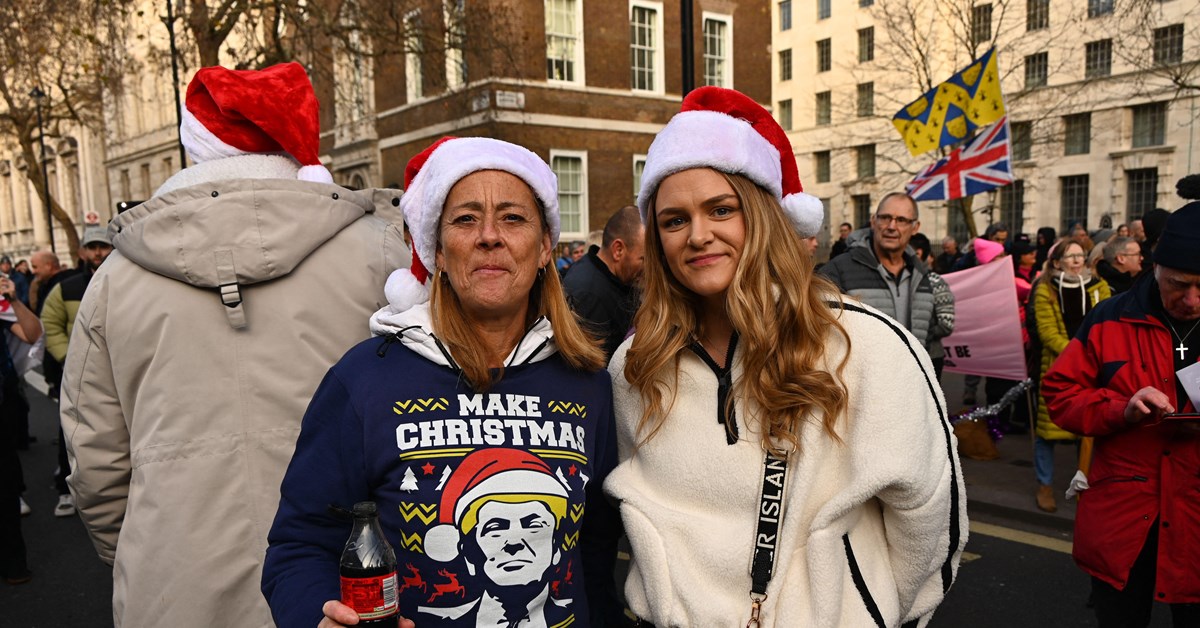
IT IS almost a pity that Tommy Robinson’s carol service fizzled out, with, at most, 2000 in the congregation. Among the nationals, only the Daily Mail published a report from the scene. The reporter found a wonderful quote: “Ian Gregson, 54, from Southwark, attended with his family, and said the event was ‘boring’.
“He said: ‘I thought we’d be talking about the invasion of the country. But it’s all been Christianity.’”
It did provoke a thoughtful piece from Lord Williams in The New Statesman: “The St George’s Cross, instead of being both a deeply uncomfortable rebuke to self-satisfied political and racial systems and a sign of promise for those who have been cruelly forgotten by their societies, becomes a totem for a racial and political identity, and a sign of menace to those who do not share it. The identity it proclaims is not so much a moral or spiritual community as a merely inherited and local one.”
I am not sure that the opposition that he implies will do the work that he wants. It is difficult even to imagine a moral or spiritual community that is neither inherited nor local; more difficult still to form or maintain one. Still, here we are with a former Archbishop, writing in a political weekly, about the meanings of Christianity on merit rather than on the strength of the hat that he used to wear; and this is a sign of a wider change.
This was the year in which Christianity became politically salient in a way that has not been true since the Thatcher years. Much of this was the result of American influence. The terrifying excesses of MAGA Christianity might not transfer over here, but Christianity of a sort looms large in the imagination of some of the world’s nastiest, even when not Naziest, billionaires.
In Silicon Valley, the apocalyptic fantasies around AI have merged with Christian apocalypticism. Peter Thiel, who bankrolled J. D. Vance, has delivered lectures on the Antichrist to an invited audience, in which he speculated whether it would be Greta Thunberg or Bill Gates who was the likeliest candidate. It is notable that the bogey figures for these men, who are among the most powerful in the world, and who can buy almost any government in the world, are all “globalists” or advocates of “world government”.
IN A perfectly extraordinary 8000-word essay published in First Things, Mr Thiel discussed his philosophy of history, which ranges from Thucydides to manga: “A Thucydidean might compare the rising Athens threatening the established Sparta to Wilhelmine Germany and Great Britain at the turn of the twentieth century, or to China and America today. A Christian, however, would recognize the prophet Daniel as the first true historian. Daniel spoke of one-time and world-historical events. He envisioned history as a succession of four kingdoms, ending with the Roman Empire. A Danielic historian would observe that neither Athens nor Sparta possessed nuclear weapons, and would discourage equating their conflicts with those of 2025. And if Daniel was the first historian, was the God of the New Testament not the first progressive?”
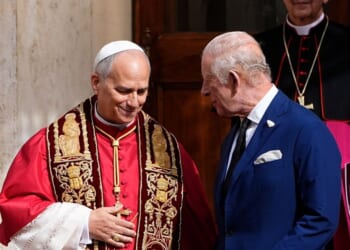
First Things is the house organ of American nationalist Roman Catholic intellectuals; it was hostile to Pope Francis and hoped for better times from his successor. Pope Leo must have come as a terrible shock. In fact, Mr Thiel is also reported to have described Pope Leo as another possible Antichrist; for, where Francis could be dismissed as a Jesuit and an Argentinian, Leo is a thoroughly American Augustinian, a man who will happily pose with a baseball bat on the papal plane. He has united the US Conference of Catholic Bishops in a really strong statement of the rights of immigrants, and his opposition to President Trump’s foreign policy is also explicit: he has spoken up for Ukraine, for the European Union, and against what seems to be a planned war in Venezuela.
It might seem that the Church of England had nothing to offer by comparison. There has been no Archbishop of Canterbury all year, and I cannot remember anything that any bishop has said on a matter of public interest.
But the strength of religious bodies comes from believers, not leaders — not even from lead bishops. Miriam Cates, Danny Kruger, and James Orr have not Christianised Reform UK. If anything, their Christianity has been deformed by it. Leaving immigration aside, they now find themselves members of a party in favour of abortion and assisted suicide. Still, there is no future for a Church of England which repudiates Christian nationalism: the task is for its parishes to find more Christian ways of rebuilding the nation, and for the leaders to follow them.