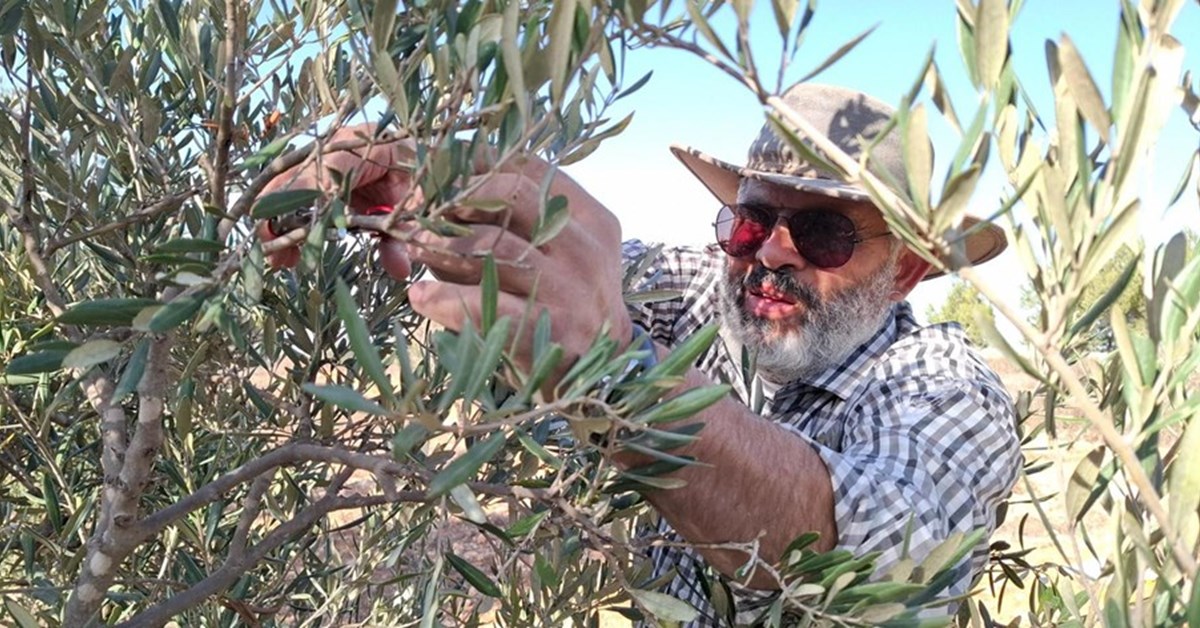
FOR four generations, members of the Nassar family have worked their farm. Sitting on a hilltop in the West Bank of Palestine, the farm — known as Daher’s Vineyard, after the family patriarch who first bought the land in 1916 — lies south-west of Bethlehem. Almost 1000 metres above sea level, the Nassars eke out a living from the dusty dry earth.
They grow olives, almonds, grapes, and some fruit trees that don’t mind having hardly any rain. Unusually within the Palestinian arable tradition, the family have always also lived on the farm, beginning in a cave. Today, Daoud Nassar is in charge. He divides his time between the farm and Bethlehem, and his son has already promised to continue the tradition when his time comes. “My family wanted not only a physical connection, but also a spiritual connection, with the land,” he says.
But whether the farm will survive to a fifth generation is under threat. For more than 30 years, the family has been locked in a battle with the Israeli authorities, who want to requisition the land to build settlements on it.
In 1991, the military who govern this part of the West Bank declared that the farm was state-owned land. Mr Nassar says that this was a pretext to enable Jewish settlements near by to expand: the farm is now enveloped on all sides by a series of large developments. Deemed illegal under international law, these settlements are growing fast. The largest is now home to more than 65,000 people.
Unlike most Palestinians who have found it impossible to prove their historic ownership of land and resist Israeli encroachment, however, the Nassars had a trump card. Daher, the patriarch, had taken the time to register his ownership with the Ottoman rulers of Palestine more than a century ago. The family claim a chain of documentation down through the era of the British Mandate, and then Jordanian control, and from 1948 all the way to Israeli occupation after the Six-Day War of 1967.
And so, since 1991, the Nassars have fought their way through the Israeli courts to prove their ownership and stop the military from claiming their land. “We did not accept this unjust situation,” Mr Nassar said. At huge expense, the family have tried to meet the ever-changing hurdles imposed by the Israelis: busing in witnesses to testify to their century of continuous ownership, hiring surveyors to dig out evidence from archives in London and Istanbul, and patiently enduring endless delays and postponements.
 Tent of NationsThe view through the fence at Tent of Nations looking at the neighbouring settlement
The struggle goes on today: Israel’s Supreme Court ruled that the land was private, but had to be re-registered back in 2006, and the Nassars have still not yet been allowed to complete this registration: “We are still struggling in this process and hoping for justice to prevail.”
Amid the legal battle was a less rarefied one on the ground. Settlers, sometimes protected by the Israeli army, have repeatedly broken into the farm and razed orchards of trees to the ground. Access roads have been blocked, fences cut down, water tanks damaged, and new roads linking settlements carved through the farm. Mr Nassar says that there has even been violent intimidation: men from the neighbouring settlements armed with machine guns have openly trespassed in Daher’s vineyard and harassed the family there.
Just beyond the boundary, a Jewish religious school has been established, which has raised fresh fears for the Nassars. “Religions are being sometimes used as an instrument for political purposes; so we are afraid that this school might be visited by radical settlers who come with the ideology ‘This is the land that God gave to us,’” Mr Nassar says.
“This is intimidation, and we feel threatened. But always, when they damage trees, we replanted,” he says. “It is a difficult situation, but still we are not giving up.” On a stone at the entrance to the farm is painted the family’s motto, their guiding principle ever since Bishara Nassar, Daher’s son, first convinced his family to remain on the farm and not join the Palestinian Christian exodus after the 1948 war, which established Israel as a state. “We refuse to be enemies.”
WHENEVER a people are provoked by violence, and pushed into a corner without hope for the future, there are three normal responses, Mr Nassar muses. One is to meet violence with violence. But the Nassars decided long ago, inspired by their Lutheran faith, to make a commitment to non-violent resistance. “We said ‘This is not our way.’”
Another response is to give in, to “accept this injustice and sit down and wait for a saviour to come and help”, he says. But, again, along with “We refuse to be enemies,” the other watchword of the family is “We refuse to be victims.” The third and easiest solution was to run away. This was common in Palestine, Mr Nassar laments, particularly among its Christian minority. Under British rule, when Daher’s Vineyard was first founded, about ten per cent of Palestinians were Christians. Today, the figure is thought to be as low as one per cent.
 Tent of NationsTent of Nations
“When we talk about Palestinian Christians today in the Holy Land, in the homeland of Christianity, we are talking about maybe less than one per cent of the population,” Mr Nassar says. One day soon, the Holy Land will become like a “museum”, visited by Christian pilgrims from overseas, but without any “living stones”, he fears.
Refusing to join this exodus, the Nassars have stubbornly remained. “We are called to become a witness,” Mr Nassar explains: to challenge the unjust situation in another way, a way of action, and yet always without violence. Despite generations of intimidation and oppression by their Israeli neighbours and authorities, the family have clung to these principles. Yes, it is easier said than done, Mr Nassar admits, but they still believed that everyone, even gun-toting Jewish extremists trying to force them from their ancestral lands, was made in the image of God.
“In every human being, there is something good and something bad. The good thing we want to respect, but the bad thing we don’t want to accept. We stand up for our rights and ask for justice. We try to invest our frustration in a constructive way. This is our therapy.” And this commitment to non-violent resistance was not chosen because it made for good strategy: it flowed from Christian hope: “Although the way for justice is too difficult, one day we believe that the sun of justice will rise again.”
TO FURTHER their cause and spread the message of non-violent principled resistance, the farm was turned into an international peace project, the Tent of Nations. The usual rhythms of planting and harvest continued, but all around this the farm has become a base for action.
Visitors from around the world are invited to witness to their struggle, to plant trees in a small act of stubborn hopeful rebellion, and to raise awareness of the injustices of the Israeli occupation. Trees must constantly be planted to replace those bulldozed by settlers, but also as a prophetic act, Mr Nassar explains.
 Tent of NationsAn olive tree on the Tent of Nations site
“When we plant a tree, we believe in the future. We make the land productive. We care for the environment, but also we learn that peace should grow from the ground up, like an olive tree, and peace will never come without justice.”
The Tent of Nations also hosts summer camps for children, especially those who are traumatised by the conflict. The children are taught creative writing and attend art workshops, to learn to express themselves and to discover their gifts.
And the constant presence of international volunteers, who come for short stints of a week to three months, also gives the Nassars a “protective presence”: they feel that the Israeli army and settlers are less likely to provoke confrontation or attack when there are foreign observers close by.
But, like many Palestinians, the family have been worn down by decades of seemingly fruitless resistance, culminating in a horrific and bloody war in Gaza over the past two years. It was getting harder and harder to continue encouraging his countrymen and women towards non-violence, Mr Nassar says, when so many felt that nothing they did made any difference to the ever-expanding Israeli occupation.
As Christians, they feel that they had no alternative but to continue walking this path: “We have to do it as a way of life without any expectation that the situation might change tomorrow.” As disciples, their job was to continue cultivating the soil, planting “seeds of hope” without worrying about the results. “I believe we are called to do our part, and then let God do his part. The work will bear fruit. Maybe not tomorrow, maybe not after tomorrow, but it will bear fruit.”
There is always a need for more witnesses to this slow, steady work, he says: more volunteers, more visitors, more people returning home from Daher’s Vineyard to spread the word. Prayer is wonderful, but it is incomplete unless accompanied by action. At points over the past two bruising years, Palestinian Christians have felt that their brothers and sisters overseas were brushing them off, Mr Nassar says.
“Sometimes we feel when people say ‘We are praying for you,’ sometimes they are using it as an excuse: ‘We are doing something.’ It’s good, of course: prayers are important for us. But more is asked, actually, from the Churches, from the church leaders: to stand up for justice and take actions. It’s not enough if the Church would preach about justice within closed doors. Justice must be practised.”
To find out more about the Tent of Nations, including how to volunteer, visit: tentofnations.com