“MY REASONS for marrying are, first, that I think it a right thing for every clergyman in easy circumstances (like myself) to set the example of matrimony in his parish. Secondly, that I am convinced it will add very greatly to my happiness; and thirdly — which perhaps I ought to have mentioned earlier, that it is the particular advice and recommendation of the very noble lady whom I have the honour of calling patroness.”
Mr Collins’s proposal of marriage to Elizabeth Bennet is one of the high points in that most delicious of Jane Austen’s novels, Pride and Prejudice. As so often, the character’s words, in a speech or a letter, reveal as much or more than the most nuanced authorial commentary. Austen knew perfectly well that her reader would expect Mr Collins’s third point to be an expression of his undying love for Elizabeth, and that such a statement would have been a hollow absurdity in itself.
When discussing Austen’s spirituality, the Revd Paula Hollingsworth, Chaplain at St Paul’s Cathedral and author of The Spirituality of Jane Austen, argues that her portrayal of Mr Collins conveys her implicit criticism of the Church, as an institution “that can allow such people to be in positions of power and influence as clergy and as patrons”. This comic character lacks the integrity needed to be a moral influence for good in his parish.
Now, a defence of Mr Collins might begin with a reference to the crippling effect of patronage in the Church in his day — as in the army and the navy, incidentally. But, as Ms Hollingsworth points out, his first harsh letter to Mr Bennet after Lydia’s elopement only confirms Austen’s concern that such a man could be ordained.
At a time when the gentry produced up to a dozen children, one or two of the boys often became clergymen, as in the Austen family. They were gentlemen, taking up a profession. The rural benefice to which they aspired might include not only a healthy stipend, but also a solid rectory with glebe land. Visits to their families, patrons, and senior colleagues were as important as visits to the poor of the parish, professionally.
Charm and society manners mattered, and nowhere more so than in Bath, where a lively wit could enhance a gentleman’s chances with the ladies. Enter young Henry Tilney, with his playful irony and teasing manner in conversation with Catherine Morland, the heroine of Northanger Abbey. Catherine is introduced to this “very gentlemanlike young man” by the master of ceremonies in the Pump Room, but at first there is no reference to his profession.
Instead, we hear of his interest in muslins, the “archness and pleasantry in his manner”, and his dancing. Austen defers the crucial information until the very last words of her third chapter: he is “a clergyman, and of a very respectable family in Gloucestershire”.
Later in the novel, Catherine enjoys a walk with Mr Tilney and his sister Eleanor round Beechen Cliff. They discuss their reading, and particularly Ann Radcliffe’s bestselling Gothic novel, The Mysteries of Udolpho. Eleanor chastises her brother for his impertinence towards Catherine on the subject: “He is treating you exactly as he does his sister,” she says.
Yet he respects the intelligence of women, which he considers to be underrated by his contemporaries. Having broadened the discussion to history and the picturesque — a clerical obsession at the time — they move on to politics, “and from politics, it was an easy step to silence”.
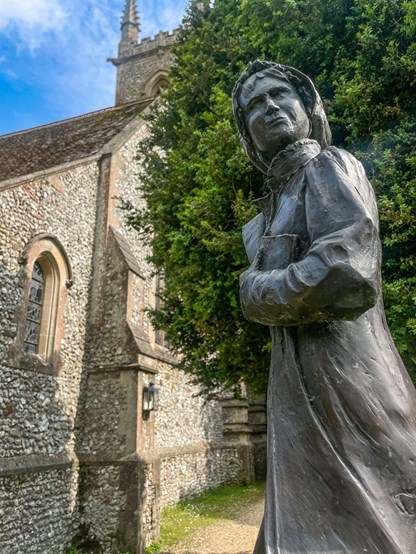 AlamyA bronze statue of Jane Austen in the churchyard of St Nicholas’s, Chawton, her former home in Hampshire
But Udolpho, and its impact on Catherine’s undeveloped sensibility, is to become one of the novel’s central themes, and a vehicle for Austen’s criticism of the Gothic novel. Austen took more pleasure in the pre-Romantic domestic sublime of William Cowper, hymn-writer as well as poet, than in the sublimities of Coleridge or Shelley. And her moderate Georgian Anglicanism sat uneasily with the extremes of Radcliffean sensationalism.
When Mr Tilney later gives Catherine an account of his mother’s death at the Abbey, he is horrified to learn of the young heroine’s suspicions concerning his father’s having either imprisoned or murdered her. He chastises her specifically for forgetting her Anglican heritage: “Dear Miss Morland, consider the dreadful nature of the suspicions you have entertained. What have you been judging from? Remember the country and the age in which we live. Remember that we are English, that we are Christians. Consult your own understanding, your own sense of the probable, your own observation of what is passing around you — does our education prepare us for such atrocities? Do our laws connive at them?”
Catherine runs off to her room, shedding “tears of shame”. The following chapter begins: “The visions of romance were over. Catherine was completely awakened.” Meanwhile, Mr Tilney’s serious side has been revealed, the side that makes him fit to be a clergyman and eventually to marry the heroine.
ORDINATION was later to be a central theme of Mansfield Park, that most serious and perhaps least popular of Austen’s novels, until its recent recasting as a novel about slavery. Although Austen was familiar with the society pulpits of Bath and London, she knew about the part played by the Church in rural England from the inside. As Edmund Bertram explains to Mary Crawford, in the wilderness at Sotherton, “We do not look in great cities for our best morality. It is not there, that respectable people of any denomination can do most good; and it certainly is not there, that the influence of the clergy can be most felt.”
Ordination, all too often a rather casual, private matter between a recent graduate of Oxford or Cambridge and his bishop, was taken much more seriously during the Evangelical revival, when a call to ministry was regarded as a gift of the Holy Spirit. Pluralism, absenteeism, and the hiring of poor curates to carry out the minimal duties of reading services on Sundays came under critical scrutiny.
In Mansfield Park, Sir Thomas Bertram comments on his son’s living. “Edmund might, in the common phrase, do the duty of Thornton,” he says. “That is, he might read prayers and preach, without giving up Mansfield Park; he might ride over, every Sunday, to a house nominally inhabited, and go through divine service; he might be the clergyman of Thornton Lacey every seventh day, for three or four hours, if that would content him.
“But it will not. He knows that human nature needs more lessons than a weekly sermon can convey, and that if he does not live among his parishioners and prove himself by constant attention their well-wisher and friend, he does very little either for their good or his own.”
Edmund responds by saying that “Sir Thomas undoubtedly understands the duty of a parish priest. We must hope his son may prove that he knows it too.” This is Austen’s only use of the word “priest” in the published novels.
Earlier in this chapter, the novel’s other central theme, relating to property and “the improvement of the estate”, has focused on the parsonage at Thornton Lacey, which Henry Crawford believes to require “work for five summers at least” before it would be “live-able”. It should be “turned to front the east instead of the north”.
Edmund’s sensible answer echoes the author’s own position on the rage for Repton and “improvement”. “I think the house and premises may be made comfortable,” he says, “and given the air of a gentleman’s residence without any very heavy expense, and that must suffice me; and I hope may suffice all who care about me.” The epithets most often applied to Austen’s favourite houses were “comfortable” and “handsome”.
AUSTEN believed in providence and the workings of an omnipotent Creator. In her novels, she adopted the part of an omniscient narrator and moral judge, particularly in her endings. In Sense and Sensibility, for example, Elinor is at last rewarded for her steadfastness when she is married to Edward Ferrars in Barton Church.
“The first month after their marriage,” we are told, “was spent with their friend at the Mansion-house, from whence they could superintend the progress of the Parsonage, and direct everything as they liked on the spot; — could chuse papers, project shrubberies, and invent a sweep.” Virtue rewarded.
Regular public worship and the weekly sermon were fixtures in the lives of Austen and her family, who always attended morning prayer at Steventon, unless prevented from doing so by abominable weather. Churchgoing is habitual to her heroines, and leads naturally to social exchange after the service.
The sacred and the secular blend together organically in Austen’s life and work, in a way that was also celebrated by Coleridge, himself a clergyman’s son, in Aids to Reflection (1825), where he discusses the part played by the clergy as part of England’s “clerisy” of teachers and scholars. For Austen, it was perfectly natural for the young clergy in her novels to ensure that their parsonages reflect their future status in rural society, and have a carriage drive to accommodate their guests. But theirs was also a higher calling.
Professor Wheeler is the author of the chapter on religion in Jane Austen in Context, ed. Janet Todd (Cambridge University Press), and of Jane Austen and Winchester Cathedral (Winchester Cathedral).