FIVE days before Christmas, in 1986, all is not well in Hulme, a neighbourhood overshadowed by the largest and most infamous arrangement of flats in Europe, known as the Crescents. The darkening sky turns gunmetal grey. Distant police sirens ricochet off the looming crescents, on this cold day in Manchester.
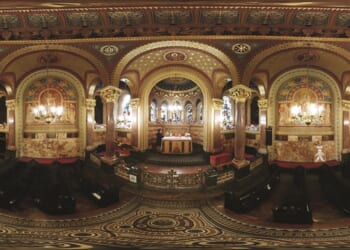
Those sirens will return, 760 days later, but now we stand before the beginning, far from the ending. The crescents silently sulk as they overlook a still-young church with its resplendent geometric roof, setting the stage for a pivotal moment.
If you allow your gaze to wander down, you will notice two groups in and around the church courtyard: one frozen in time, the other animated with purpose.
The first group, the Holy Family, are still. A nativity scene tells a story of a life under threat and a family in desperate need of shelter — deliberately staged to reflect the lives of the people in the parish: a mirror offering comfort.
The second group, shivering and rubbing their hands together, are warmed by their shared mission. Their tired feet and sore lungs recover after completing the weekly six-mile round trip to Manchester city centre. Regular as clockwork, Fridays mean marching as an army without fatigues, supporting a man without a visa.
This assortment of religious folk, Marxists, dropouts, students, anarchists, and protesters have their banners resting against the church walls, while remaining leaflets are bundled up and secured with elastic bands. They will rest, disperse, and next week do it all again. But there is confusion. Why did they stop here? The man they shout and stamp for is approaching the church. This person, whom they have been rooting for, pleading with the Home Office not to deport, now hovers near the doors. What is he doing?
FOCUS on the Holy Family for a moment. Mary needs a place for her son to be born, a son destined to topple the mighty from their thrones, uplift the lowly, and fill the hungry with good things. Her act of defiant hope, set against the backdrop of empire, positions her as a conduit for a new world, a host for an in-breaking reality. For a woman in her position, this is an extraordinary act of bravery.
Her son is preparing to transcend confinement, moving from the womb into the infinite expanse of earth, and eventually heaven, passing through hell along the way. Her womb is a shelter for a new, God-loved world, fragile and divine, in flesh and bone. The Holy Family quietly observe the crowd in the church courtyard.
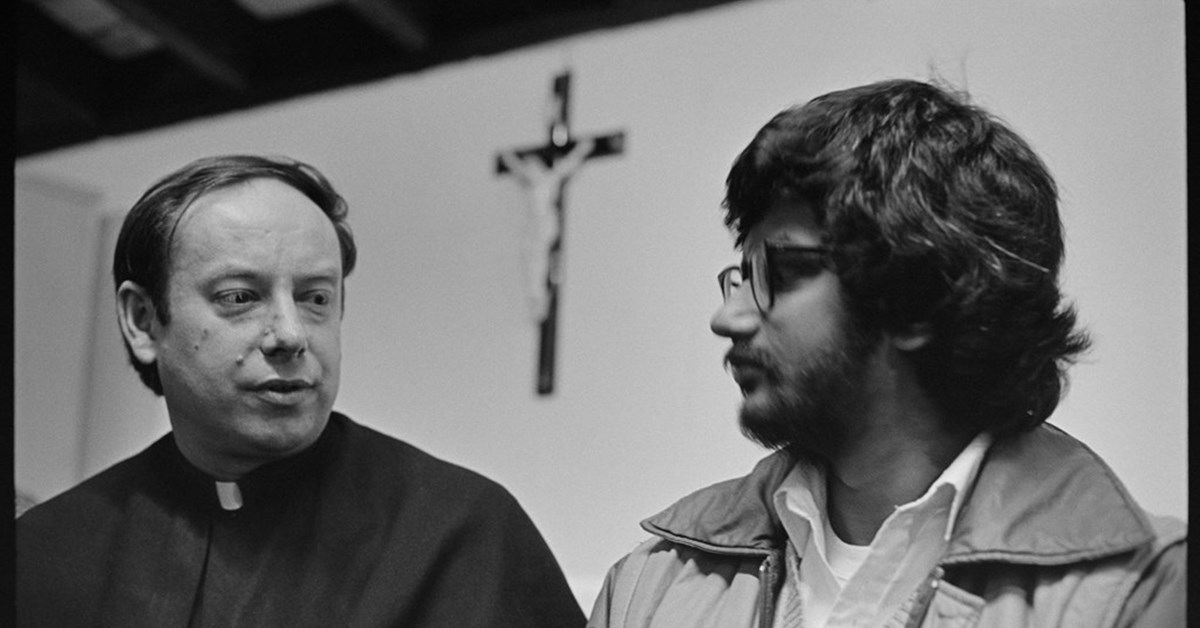
This second group are on the brink of being reborn. Their reluctant leader straightens up. He is a lanky, Sri Lankan man: a former student who has run out of money, and is now out of time. Shy, and with stuttering lips, he approaches the resolute man in the black cassock standing before him, in sandalled feet despite the weather.
This visitor, a communist and atheist, stands at the parish church’s threshold and makes a short speech declaring that he is going into the church. This is not to pray, but to stay. He asks the priest before him for “sanctuary”.
That humble request, and the open door and hand that answer it, set off a chain reaction, the first domino falling as Viraj Mendis sets foot inside the Church of the Ascension, together with the priest, the Revd John Methuen.
ON THAT day, the song that topped the British pop charts was the Housemartins’ rendition of “Caravan of Love”. Paul Heaton, the heart of the band, was, at that point, a left-wing Christian. The video featured the band members in the Union Chapel, Islington, in London, with the opening shot of a stained-glass window declaring “God is Love.” Heaton famously wrote on the back of their debut album: “Take Jesus, Take Marx, Take Hope.”
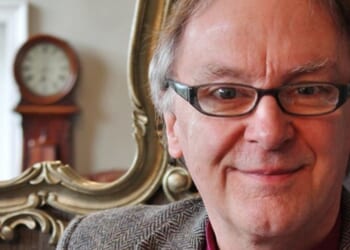
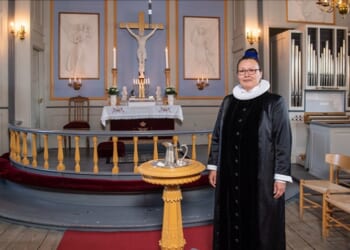
 BBC/Kaya BlackThe Revd Azariah France-Williams in the Ascension, Hulme
That song was the perfect accompaniment to this moment. The nativity scene depicted Jesus; Mendis and the campaign members brought Marx; and Fr John and the congregation offered hope. It was a potent formula: a revolutionary convergence of energies and ideologies which catalysed a movement. The church, the place of sanctuary, become the epicentre of much of what would take place.
Mendis was an outspoken critic of his nation’s government and their treatment of the Tamil peoples. He believed that returning home would mean death. Summoning the spirit of a long-lost law of sanctuary, he crossed from one world into another.
It was a reverse birth: he moved from the freedom of the outside world to the confines of the church’s walls. As the door of the church closed behind him and his delegation, he voluntarily relinquished his liberty in pursuit of the right to remain in a country that had deemed it time for him to leave. He sought a new base not only to continue his own campaign, but also to support the anti-deportation efforts of others.
As he ascended the stone steps to the vestry, that changing room would be the room to change him and all others who would come after. He had no idea that, 760 days later, he would be dragged back down those very stone steps by men under orders to take him away, then to send him back to Sri Lanka.
The crowd of people who had marched by his side were also being invited to cross a threshold. They would become the life-support system around him, feeding him, listening to him, keeping watch over him 24/7, and organising the campaign from this new base of operations — the church. They would become his “caravan of love”, and they would be called to stand up for him and with him to the bitter end.
WHAT of the priest in the cassock, Fr John, a member of the Establishment and tipped for high office? His membership of this rarefied club had an expiry date, and, unbeknownst to him, it was rapidly approaching. So, on that day, as white and brown hands were clasped in brotherhood, their union would defy expectation. Fr John had known of this plan. He knew the script and had learned his lines, just as he had many years before.
I was fortunate to learn from a peer of Fr John’s that, during his teenage years, Fr John had played the role of Thomas Becket, the man who was Lord Chancellor and later Archbishop of Canterbury, in T. S Eliot’s play Murder in the Cathedral, also set in December.
Becket took his position as Archbishop seriously, and fell out of the King’s good graces. He sought refuge in Canterbury Cathedral, only to have law enforcement, in the form of knights, burst in and take his life, on their interpretation of the King’s decree. Eliot puts these words into Becket’s mouth:
I am ready to die, but not for the sake of my own life,
or for the love of my country,
but for the glory of God,
for the sake of the Church,
for the sake of righteousness.
I must be true to myself and to my cause.
I will not betray my principles,
nor will I compromise my soul.
Fr John had played the role of Becket, the one seeking sanctuary as a boy, and, as a man, he was the one offering sanctuary to someone in need of shelter. Unlike Becket, Mendis would be taken alive, but the campaign that had sustained him would eventually scatter, save for a few dedicated souls who would continue their guard around the world, resourced and co-ordinated by Karen, a campaign member who would later become Mendis’s wife.
Back at the church, Mendis gone, Fr John and the PCC had done what they could. At times, people wondered, “Would Fr John capitulate?” As episcopal support dwindled, and his ambition to enter the episcopate was damaged, would he continue in what seemed to be a losing battle?
The remnant of the campaign continued until they couldn’t any more.
This story took place within the walls of the church where I now serve as Rector. Earlier this year, I was invited to create a podcast, In Detail. . . Sanctuary: An act of defiance, with the BBC. It was a profoundly moving experience to encounter these people so inextricably linked to the church’s past, speaking so clearly to our country’s present. The story causes me to ponder the question: “What might I have done if I were the priest back then?”
When I met Karen, Mendis’s widow, I learnt how the homeless and mentally unwell members of Hulme would turn up at the church regularly at all hours. Mendis had a 24-hour watch; so people in need were able to get a cup of tea and a biscuit from the volunteer force. Fr John might have fallen out of favour with his senior leadership, but he fell into a richer, deeper web of relationships which sustained him.
I was impressed that Archbishop Desmond Tutu had visited at one point. Karen challenged me, saying, “That’s OK, but I remember Leroy, a local Hulme lad who told Viraj, ‘If they come for you, you can stay at our house.’” That’s the spirit of sanctuary. That’s the “Caravan of Love”.
In Detail: . . Sanctuary: An act of defiance is available on BBC Sounds