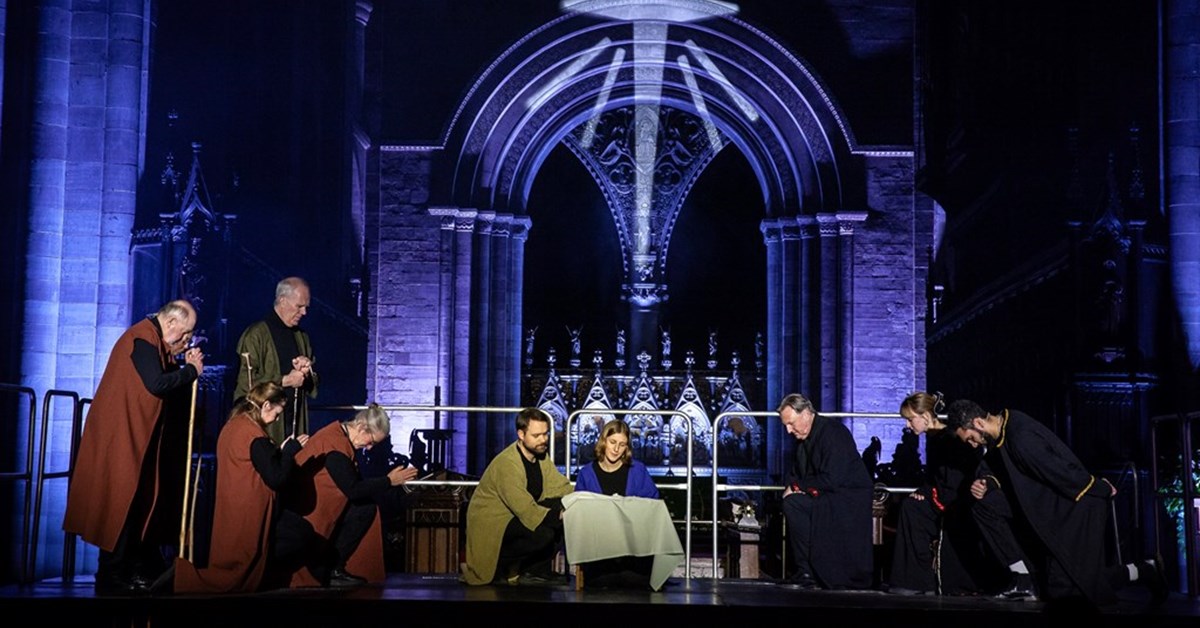
LIGHTS up on bare staging. A young woman stands with trepidation and defiance before her fiancé and parents. Her father speaks with simmering anger:
Joachim: Do you realise what you’ve done to us, Mary?
Mary: I haven’t done anything to you, Father.
Joachim: Then who? Who did this to you? Who has forced himself on you?
Mary: There was no one.
The scene is biblical Palestine, but the confrontation is timeless. Part of a new nativity production staged at Hereford Cathedral in November, the event combined a pared-down approach of historical scenes with raw human reactions.
“The first thing most people think of when they hear ‘nativity play’ is primary-school plays,” the Chancellor of Hereford Cathedral, Canon James Pacey, explains. “Our Nativity, however, is not that. It’s very much one that pulls the tinsel away from Christmas.”
A seasoned theatre director and producer before being called to the priesthood, Canon Pacey welcomed the opportunity to bring a “cinematic and stylised” perspective aimed at shaking audiences out of any complacency. This is intended to be the nativity in all its immediate, heart-jumping, ultimately transforming glory. It is docu-drama biblical theatre, employing minimal staging, vividly designed costumes, and a handful of symbolic props. Classical and modern musical and lighting elements are added to create atmosphere.
After the staging of Nativity, Hereford will host a season of religious dramas, all written and staged by Canon Pacey, and working with non-professional actors. He is keen to emphasise the project’s relevance: “These are not cosy re-enactments. They bring the story alive in an immediate and urgent way.”
They also fit within a longer-term project: to offer biblical plays with “the aim of providing fresh insights to those who already have faith, whilst perhaps offering something to those without faith who may find coming to church a daunting prospect”.
CHERISHED notions about such cultural staples as the nativity mean that the makers of plays taking a new approach walk a fine line. Canon Pacey says that he is “trying to honour the traditional Christmas story, whilst not shying away from its more challenging aspects”. He says: “I would love it if people left with a fresh understanding of faith, but, if people simply leave having had a good night, then that’s good, too.”
This sense of excitement is echoed by Emily Dodwell, who plays Mary in Nativity and is working as a chef during a gap year. “The process of seeing these classic characters become the real people that they were has been so powerful,” she says.
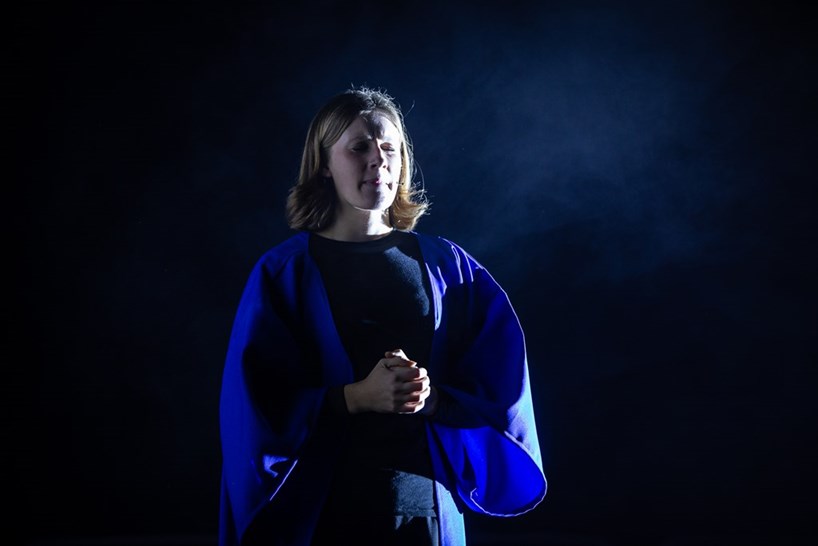 Caroline PotterMary, played by Emily Dodwell, in the nativity at Hereford Cathedral
The brevity of the Gospel nativity accounts has led to creative exploration. There is a combination of biblical narrative and imaginative development, in which scenes glancingly referred to in the Bible are brought directly on stage. These include the confrontation between Mary and her parents, as well as other confronting choices. “One of our final scenes is the massacre of the innocents. Whilst we do it very sensitively — and I am deeply mindful of the children being killed in the Holy Land today — it is an important part of the Gospel narrative that can’t be ignored,” he says.
This frank approach is one that Hereford Cathedral easily lends itself to. “When I first arrived at Hereford four years ago, I was very struck by the cathedral as a repository of stories: stone plaques and monuments, a mason’s mark, or a set of dates,” the Dean of Hereford, the Very Revd Sarah Brown, says.
The diocese is one of the oldest, Canon Pacey explains, and has reached a milestone. “It’s the 1350th anniversary, and it seemed the golden opportunity to not only celebrate the story of Christianity here, in the [Hereford] Marches, but also to explore faith in the 21st century.”
He has a deep appreciation of the cathedral’s physical presence. “The cathedral’s ancient history and beautiful architecture speak of the creative God who has been worshipped here for so long.” That means extending his stripped-back approach to the staging. “I’m keen to let the space speak for itself. It’s a cathedral, not a theatre, and should be used as such. Its sheer presence means there’s no need for elaborate set or distraction. At the same time, I want to help people see the space afresh: familiar, yet different.”
Canon Pacey’s previous theatrical career has been instrumental in the project. “When I first experienced my call to ordination, I had a very strong sense of God saying to me: ‘Just as you have sought to make theatre accessible to people, so, too, will you use those same skills for my glory.’ That moment helped me to understand that the instincts and craft I had honed in the theatre were not left behind when I was ordained, but, rather, carried forward into my priesthood.”
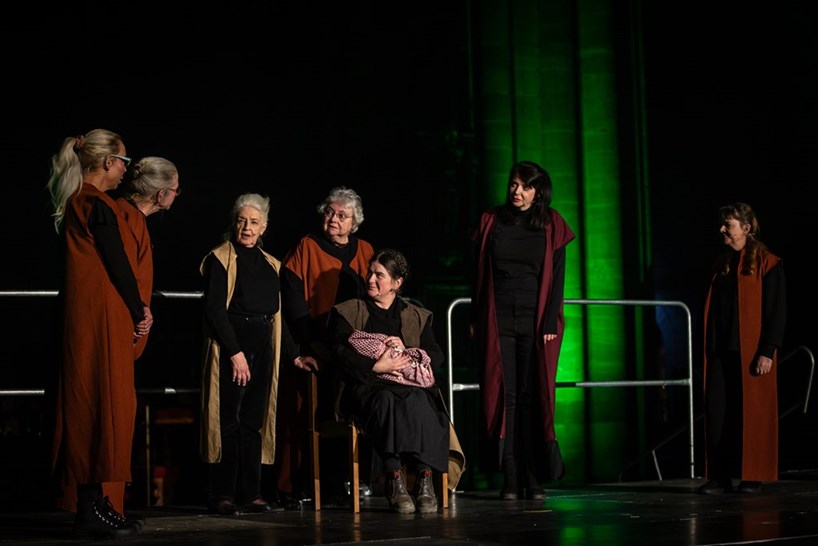 Caroline PotterA scene from the nativity at Hereford Cathedral
He took this interlocking sensibility with him through parish ministry and hospital chaplaincy before arriving in Hereford, where he notes “an overlap between the two roles [of chaplaincy and cathedral priesthood]. . . where the two ministries diverge is in the mode of communication. Chaplaincy is first and foremost about listening: holding another’s story without judgement or interruption.
“My present ministry, by contrast, is much more rooted in the telling of stories: finding language, image, and drama that can communicate faith afresh, whether in the classroom, the pulpit, or the theatre.” All are informed by the same belief, that “God meets us in the midst of our stories, and that the acts of listening or telling can be sacred.”
Canon Pacey’s collaborators agree. “I love how these projects bring together people of such varying ages, backgrounds, and beliefs, and allow us all to share our personal outlooks in a safe and nurturing environment,” says Sam Morrish, who plays Joseph in his free time from working as an engineer: “no ego, no arguing, just collaboration and support.”
“Performing in this forum humanises these classic tales in a way that I have never experienced before,” he continues. “It’s an incredibly profound experience to see these classic figures of religious significance as simple people.”
Ms Dodwell agrees. “I hope the audience will see this well-known story in a new light. Our depiction of how these events impacted Mary’s relationships with the people in her life through a more naturalistic lens has been a joy to work on.”
THE work supports a broader agenda, Dean Brown explains. “This storytelling initiative is part of a wider mission plan,” she says. “It attracts publicity, which is wonderful, but the small, quiet missional and pastoral activities are just as important.”
This story does not end with the staging of Nativity. This production is the starting point for Hereford diocese’s “Year of Storytelling”, when a series of productions — Nativity, Passion, and Mysteries — will be performed, culminating in autumn 2026, interweaving a variety of events at both the cathedral and across the diocese.
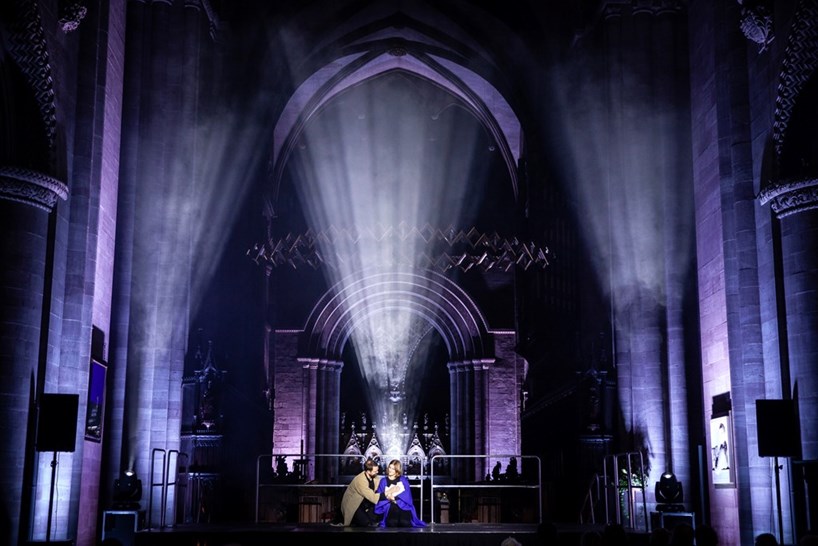 Caroline PotterMary, played by Emily Dodwell, and Joseph, played by Sam Morrish in the nativity at Hereford Cathedral
This wider project enthuses everyone: “The whole cathedral represents a pageant of characters, good, bad, and indifferent,” Dean Brown remarks. “But it isn’t just a repository of stories of people, but a record of their faith — a bigger story that ties them together into something far greater than the sum of its parts.”
This is a story crying out to be told, she believes, but new ways of telling are needed: “The old ways of teaching about God — long lectures or sermons — are not the favoured learning style in the TikTok [and] Netflix era. . . I want people to come for stories, and come back again for Jesus.”
Canon Pacey echoes this sentiment. “Here, at Hereford, I’m blessed with a fantastic team and a Dean who shares my vision for creative mission. After a previous production of the Passion she simply said to me, ‘The cathedral is yours to play with.’ I didn’t need to be told twice.”
Hereford’s “Year of Storytelling” culminates in October 2026 with the Hereford Mysteries. For further details, visit: herefordcathedral.org