January
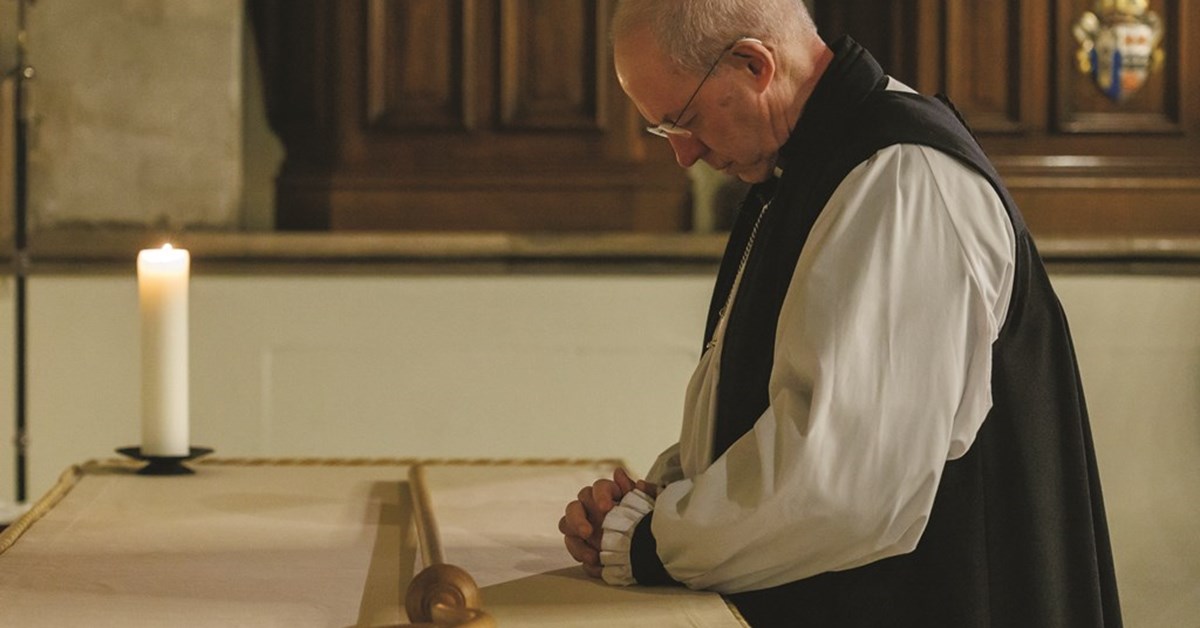
ARCHBISHOP WELBY, whose official duties ended at midnight on the Epiphany, spent his last day in office privately at Lambeth Palace. In the chapel that evening, he laid down his bishop’s crosier, marking the end of his ministry as Archbishop of Canterbury. The occasion fell on his 69th birthday. He had already signed an instrument of delegation, handing over his official functions mainly to the Archbishop of York, some to the Bishop of London, the Rt Revd Sarah Mullally, and his diocesan functions to the Bishop of Dover, the Rt Revd Rose Hudson-Wilkin.
An immediate ceasefire and hostage agreement was reached between Hamas and Israel. The Bishop of Chelmsford, Dr Guli Francis-Dehqani, who was in Jerusalem when the deal was agreed, said that the reception among those whom she met was mixed: relief and joy, combined with “a real understanding of how fragile this is”.
The Bishop of Washington, DC, the Rt Revd Mariann Edgar Budde, pleaded for the new US administration to be merciful to undocumented migrants and LGBT people. She was preaching before President Trump, his family, and Vice-President J. D. Vance at the traditional post-Inauguration service of prayer for the nation. President Trump rejected the sermon as “nasty in tone”.
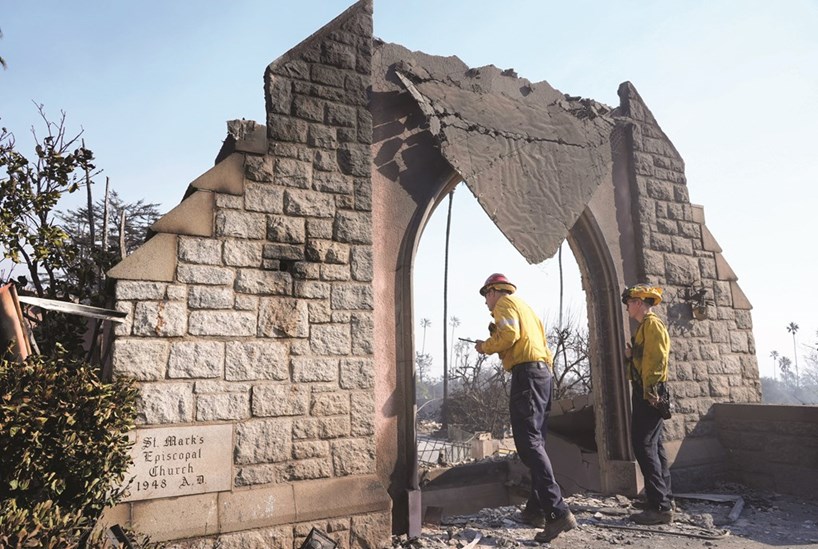 AlamyFirefighters study damage at St Mark’s, Altadena, California, after it was destroyed by the Eaton fire, in January
The President issued a slew of executive orders in the hours after his Inauguration. They were aimed at limiting illegal and legal migration, and included increasing deportations and allowing immigration raids in “sensitive” or “protected” areas, such as schools, hospitals, and places of worship.
The former Archbishop of Canterbury Lord Williams was among the signatories of a letter from faith leaders urging the Government to support the Climate and Nature Bill, which would enshrine in law a target to limit global warming to 1.5°C, and to take action to halt biodiversity loss.
Pope Francis, speaking to diplomats accredited to the Holy See, accused the world’s multilateral institutions of failing to uphold stability and peace, and called for a new “diplomacy of hope” to ensure truth, forgiveness, and justice. He also urged united efforts to resolve conflicts in Ukraine and Gaza.
At least 12,000 buildings — including churches, places of worship, rectories, and two church schools — were destroyed in wildfires that burned around Los Angeles.
The Bishop of Liverpool, Dr John Perumbalath, resigned after being accused of sexual harassment and sexual assault. “I have consistently maintained that I have not done anything wrong, and I continue to do so,” he wrote in a letter to the clergy.
February
THE General Synod stopped short of transferring all safeguarding functions to an external organisation, at least in the short term. The Synod was asked to choose between two models for independent safeguarding. After hours of discussion, all three Houses voted for an amendment moved by the Bishop of Blackburn, the Rt Revd Philip North, which pivoted the motion towards outsourcing the National Safeguarding Team while commissioning further work to explore how diocesan teams could be added later to this new independent body. The lead bishop for safeguarding, Dr Joanne Grenfell, the Bishop of Stepney, expressed disappointment with the result.
In his presidential address — after a motion to prevent his addressing the Synod was voted down — the Archbishop of York pleaded to be given more time to lead the Church of England out of its safeguarding crisis. “I know that I have made mistakes. But I am determined to do what I can with the time given to me to work with others,” he said.
The new Clergy Conduct Measure, to replace the much-criticised Clergy Discipline Measure 2003, received the Synod’s final approval. Members warmly welcomed the radical overhaul of clergy discipline, especially the new minor-grievance track and protections against vexatious complaints.
The Synod debated the final report and recommendations from the Archbishops’ Commission on Racial Justice, which had completed the work that it was mandated to do in 2020, after the Windrush debate. A motion was carried that affirmed the need for further efforts to deliver racial justice, and committed the Church to resourcing a new governance framework, including a Racial Justice Unit and the appointment of a lead bishop.
The Synod considered nine proposals relating to the membership, chairing, business, and procedures of the Crown Nominations Commission. The first five, which had been proposed collectively by the central members (those elected by the Synod), were all carried. The last four, however, had come from the House of Bishops, and were seen by several members as a “power grab”. One was carried, but three failed.
The person nominated to be the next Bishop of Durham withdrew. Who or why was not made public. The Durham CNC had agreed to reconvene “later in the year to continue the process of discernment”, a Church House statement said.
The Prime Minister’s decision to cut the international-aid budget from 0.5 to 0.3 per cent of GDP, to fund an increase in UK defence spending, was criticised by bishops and aid agencies. “Taking money from overseas aid is absolutely the wrong thing to do,” the Bishop of Leicester, the Rt Revd Martyn Snow, said.
One in three people displaced by the war in Ukraine remained in urgent need of humanitarian aid, charities warned on the third anniversary of the Russian invasion.
March
A REVIEW of Winchester Cathedral identified “significant failings in leadership and management”, the Bishop of Winchester, the Rt Revd Philip Mounstephen, said. The Dean, the Very Revd Catherine Ogle, announced that she would hand over leadership of the cathedral immediately, before her previously announced retirement on 1 May.
The US announced a sudden pause in aid to Ukraine, days after an explosive televised meeting in the White House between Presidents Trump and Zelensky. The Archbishop of York said that the Church of England stood with Ukraine’s people and churches “in their call for a just and lasting peace”.
 AlamyProtesters march in support of Ukraine in downtown Chicago, in March, the day after an acrimonious meeting in the White House between Presidents Trump and Zelensky
More than 700 clergy signed a letter to the Church Times calling for “urgent and decisive action on clergy pensions”. A restoration to pre-2011 levels was a “minimum” requirement, it said.
Christian groups condemned Israeli bombing of Gaza, two months after a ceasefire had been announced. The general secretary of the World Council of Churches, the Revd Professor Jerry Pillay, called for “an immediate cessation of hostilities and a renewed commitment to dialogue and diplomatic solutions”.
Religious leaders called on the Government to be “bold and ambitious” in its strategy to reduce poverty among children. In a letter, they said that, without new interventions, a further 400,000 children could fall into poverty over the next decade.
Further cuts welfare spending cuts and an increase in the defence budget were announced by the Chancellor, Rachel Reeves, in the Spring Statement. Church leaders and charities expressed concerns that the measures would push more people into poverty.
April
THE Terminally Ill Adults (End of Life) Bill, which seeks to legalise assisted dying, completed its Committee Stage. Eight bishops joined more than 100 women, of various faiths, in signing an open letter that said that the Bill “could create a new tool to harm vulnerable women”. The Bill returned to the House of Commons for the Report Stage later in the month.
Campaigners called for the Listed Places of Worship Grant (LPWG) Scheme to be continued and for the £25,000 cap on VAT exemption for repairs, announced in January, to be removed.
A report from the Bible Society, Quiet Revival, said that churchgoing among young people, particularly men, in England and Wales was growing, but not within the Church of England.
The diocese of Jerusalem condemned, “in the strongest terms”, Israel’s bombing of the Anglican-run Al-Ahli Hospital in Gaza, on Palm Sunday. It said that, 20 minutes before the attack, the Israeli army had ordered everyone to evacuate the premises, and that a child who had previously suffered a head injury “tragically died as a result of the rushed evacuation process”.
Also on Palm Sunday, a Russian missile attack on Ukrainian civilians in the north-eastern city of Sumy killed at least 35 people, and more than 100 were injured. Churches in Ukraine and abroad condemned the attack.
The Sudan conflict, which began two years ago, was “the world’s most severe humanitarian and displacement crisis”, the Catholic Agency for Overseas Development (CAFOD) said. The Foreign Secretary, David Lammy, hosted ministers from donor countries and the wider region at a conference in London to encourage a ceasefire.
Tributes were paid around the world after Pope Francis died on Easter Monday. His ecumenism, his championing of the poor and marginalised, and his “unstinting service” were remembered in messages of condolence. He was laid to rest, at his own request, in a side-nave niche in St Mary Major, after his televised open-air funeral, which was attended by 250,000 people, including the Prince of Wales and Sir Keir Starmer.
May
ON THE second day of voting in the Sistine Chapel, and on the fourth ballot, the American Cardinal Robert Prevost was elected by the cardinals as the new Pope. He chose the name Pope Leo XIV, and became the first pope from the United States. The Archbishop of York said that he “shared in the joy” of the Roman Catholic Church at the election.
During his first general audience in St Peter’s Square, Pope Leo called for humanitarian aid to be allowed into Gaza, and for an end to hostilities, after Israel had blocked aid deliveries to the territory for weeks. A joint statement by the UK, France, and Canada described the level of suffering in Gaza as “intolerable”, and the actions of the Israeli government as “egregious”.
The House of Bishops said in a statement later that month that the war in Gaza was “no longer a defensive war, but a war of aggression”, a “grave sin that violently assaults God-given human dignity”.
 AlamyPope Leo XIV at the central balcony of St Peter’s Basilica for his first Sunday blessing after his election in May
Bishops expressed concerns over a speech by the Prime Minister after the publication of the Government’s immigration White Paper, in which he said that the UK risked “becoming an island of strangers”. The Bishop of Chelmsford, Dr Guli Francis-Dehqani, said: “In the churches and different communities I am a part of, we are not an ‘island of strangers’. Migrants are not ‘strangers’ but friends who fully participate and contribute as we worship, serve, and live life together.”
June
THE Bishop of Leicester, the Rt Revd Martyn Snow, announced that he would step down as lead bishop for the Living in Love and Faith (LLF) process. “I hope it may yet be possible to reach such an agreement, but I don’t think that can happen under my leadership,” he said.
The Triennium Funding Working Group of the Church Commissioners announced that grants to be bid for by dioceses would remain a significant means of distributing funds. This was set to total £1.6 billion over the next three years.
A few weeks later, the Bishop of Hereford, the Rt Revd Richard Jackson, described distributing large sums of Commissioners’ money through the Strategic Investment in Mission and Ministry Board as a mistake. Bishops would prefer to have sufficient funds to prevent further cuts to stipendiary clergy posts and pastoral reorganisation, he said.
The Bill to legalise assisted dying was passed in the House of Commons by a slim majority of 23 votes. The Bishop of London, the Rt Revd Sarah Mullally, said that MPs had passed the Bill “in the face of mounting evidence that it is unworkable and unsafe and poses a risk to the most vulnerable people in our society”.
Nineteen bishops were among more than 250 Church of England clergy who signed a letter condemning a parliamentary move to decriminalise women who induce their own abortion as “a dangerous change”.
The Archbishop of Wales, the Most Revd Andrew John, announced his immediate retirement, four days after issuing an unqualified apology for his part in the debacle at Bangor Cathedral. Since the previous year, a total of six serious-incident reports had been sent to the Charity Commission relating to the cathedral.
July
IT WAS confirmed that no new lead bishop for the LLF process would be appointed “at this time”, after Bishop Snow stood down. An update posted on the C of E website said that the episcopal members of the LLF Programme Board would take “collective responsibility for leading the process”.
The Episcopal diocese of West Texas set up an emergency fund to support flood-relief efforts in Kerr County, where 27 children and counsellors at Camp Mystic, a Christian summer camp on the banks of the Guadeloupe River, died in flash floods.
Meeting in York, the General Synod voted almost unanimously to remove Issues in Human Sexuality from the ordination process. The Synod also voted to welcome a package designed to improve the clergy pension, to condemn the assisted-dying Bill, and were against redistributing a portion of the Church Commissioners’ funds. The Archbishop in Jerusalem, Dr Hosam Naoum, addressed the Synod about how Palestinian Christians were working out what it meant to be a Church in a time of war.
The Anglican and Roman Catholic bishops for prisons recommended that the Government should foster a culture of rehabilitation, rather than a system “focused on vengeance and punishment”, in a report, Picking up the Pieces.
An Israeli air strike hit Holy Family Church, Gaza’s only RC church, killing three people. The Israeli Prime Minister, Benjamin Netanyahu, expressed regret that “stray ammunition” had hit the church.
The Bishop of Monmouth, the Rt Revd Cherry Vann, became the new Archbishop of Wales, after securing a two-thirds majority in the Electoral College on the second day of its meeting. She thus became the first woman Primate in an Anglican Church in the UK.
August
THE former Prime Minister Gordon Brown urged the Government to fund a “war against child poverty” by taxing the gambling industry. His intervention was supported by faith leaders, including the former Archbishop of Canterbury Lord Williams. 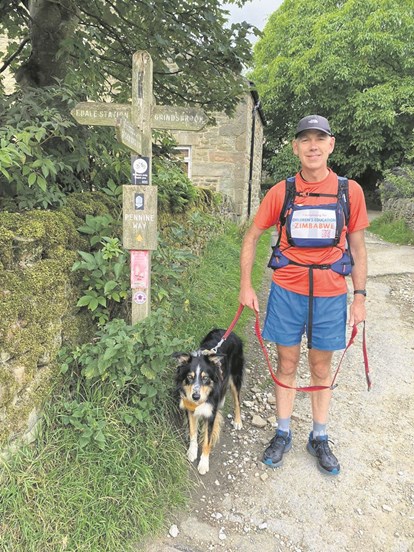 Diocese of SouthwarkThe Bishop of Kingston and his border collie, Jem, on the Pennine Way, which they ran for charity in August
Gaza was bombed by Israel, after the Israeli government announced plans to take control of the most populous city in the territory. The British Foreign Secretary,
David Lammy, and his counterparts in 25 other countries said that “humanitarian suffering in Gaza had reached unimaginable levels” and warned that “famine is unfolding before our eyes.”
More than 500 people, including a Baptist minister and a Roman Catholic priest, were arrested in Parliament Square after showing support for Palestine Action.
A cyber attack on software used by APCS, the company used by many dioceses to carry out Disclosure and Barring Service (DBS) checks, left hundreds of parishioners at risk of identity theft.
During the same week, the data security of abuse survivors was breached by Kennedys Law LLP, the law firm responsible for administering the Church of England’s Redress Scheme.
Church leaders past and present made public apologies after the conviction of Chris Brain, the founder of the Nine O’Clock Service in Sheffield, on charges of indecent assaults against nine women. The jury at Inner London Crown Court found him guilty on 17 charges of indecent assault, and not guilty on 15 further charges.
September
A DOCUMENT, Stop Crucifying Creation, sent to hundreds of individuals in the Church, warned that the natural world was being “crucified”, and called for radical nonviolent action in this existential emergency”.
Bishops criticised Reform UK’s mass deportation proposals, after Nigel Farage said that, if his party won the next election, it would deport 600,000 migrants during the
next five years.
A report published by the UN’s Independent International Commission of Inquiry on the Occupied Palestinian Territory concluded that Israel’s actions in Gaza met the definition of four out of five acts of genocide laid out in international law, and that Israeli politicians had demonstrated “direct evidence of genocidal intent”.
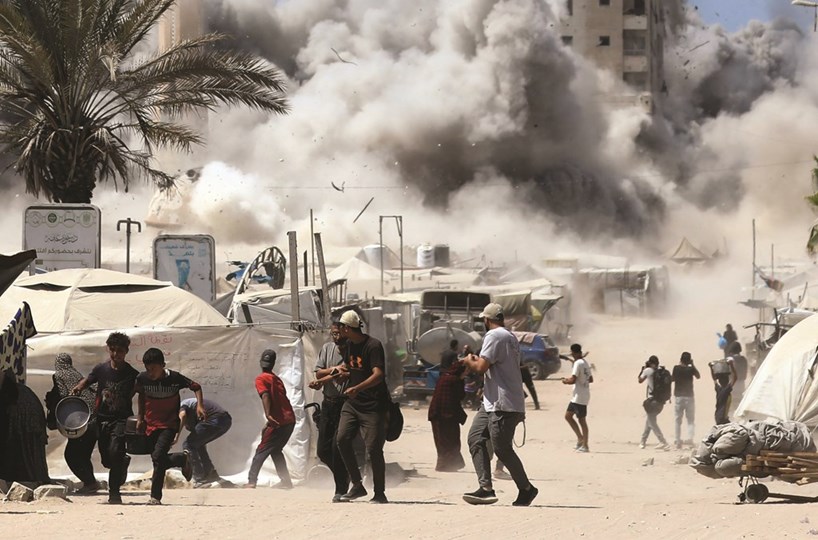 AlamyPalestinians run as smoke billows from
the Mushtaha Tower after an Israeli air
strike in September
Bishops decried the proposed legalisation of assisted dying, as the Terminally Ill Adults (End of Life) Bill came to the House of Lords. “If passed, this Bill will signal that we are a society that believes that some lives are not worth living,” Bishop Mullally said.
In the wake of the assassination of the right-wing activist Charlie Kirk, and of another school shooting, on the same day, religious leaders across the US condemned political violence and access to guns. Mr Kirk, 31, was killed with a single bullet while speaking in front of 3000 students at Utah Valley University.
Between 110,000 and 150,000 people attended the Unite the Kingdom march in London. Some of the “Unite the Kingdom” marchers carried banners bearing Christian messages and images of Christ. During the following week, a growing number of church leaders condemned the “misuse” of Christian symbols by “racist” and “far-Right” protesters.
October
DOWNING STREET announced that the Bishop of London, the Rt Revd Sarah Mullally, would become the 106th Archbishop of Canterbury: the first woman to hold the post. “In the apparent chaos which surrounds us, in the midst of such profound global uncertainty, the possibility of healing lies in acts of kindness and love,” the former nurse told an audience of church leaders, local schoolchildren, and journalists in Canterbury Cathedral, after her nomination was announced.
The Bishop of Manchester, Dr David Walker, urged communities to “draw closer to one another in love”, after a deadly attack on a synagogue in Manchester. Melvin Cravitz and Adrian Daulby were killed in the attack on the Heaton Park Hebrew Congregation synagogue. Three more men were seriously injured.
The Archbishop of York marked the second anniversary of the 7 October Hamas attacks on southern Israel with a prayer for healing, for the release of the remaining hostages, and for peace in the region.
The next day, President Trump announced that Israel and Hamas had agreed the
first phase of a peace plan put forward by the US. The deal was formally approved by the Israeli Cabinet the next day. Bishops in the Church of England welcomed the news, and said that a “fundamental shift in attitudes and behaviour” must now ensue.
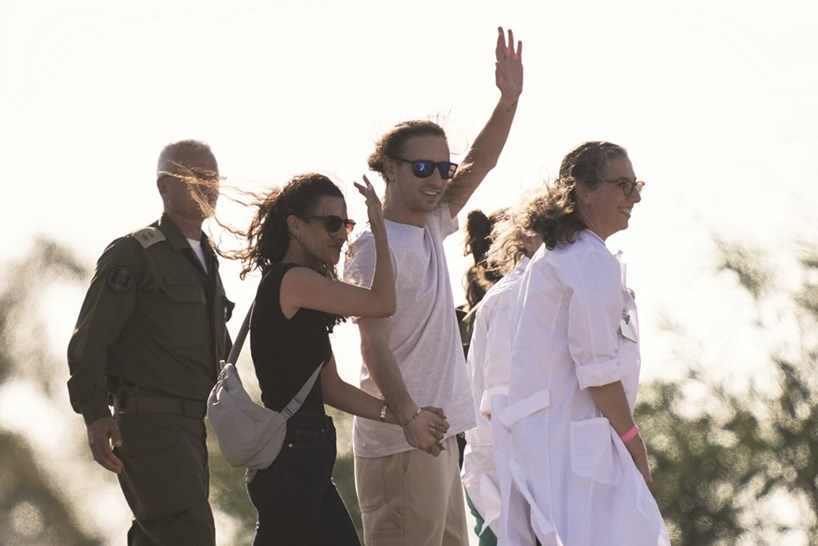 AlamyAriel Cunio, who was held hostage for two years in Gaza with his brother
Daniel, waves to the crowds on his release, at the Sheba Medical Center,
Ramat Gan, in October
The Pope urged Christians to rediscover the link between faith and commitment to the poor, in his first significant teaching document since taking office.
The House of Bishops decided that the approval of stand-alone services of blessing for same-sex couples should be subject to a Canon B2 process, which requires two-thirds majorities in all Houses of the General Synod — which would almost certainly prevent their coming into use. The Bishops also recommended that clergy be allowed to enter into same-sex marriage only if a Measure and an Amending Canon were carried by the General Synod.
Gafcon was “now the Global Anglican Communion”, the chairman of the group’s Primates Council, the Archbishop of Rwanda, Dr Laurent Mbanda, declared in a letter to supporters. Gafcon had rejected the four Instruments of Communion, and he encouraged provinces “to amend their constitution to remove any reference to being in communion with the See of Canterbury and the Church of England”. In response, the secretary-general of the Anglican Consultative Council (ACC), the Rt Revd Anthony Poggo, invited Churches “to shape the Instruments of Communion”.
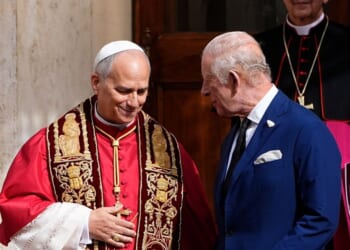
The King became the first Supreme Governor of the Church of England to pray in public with a pope when he and Pope Leo attended an ecumenical service of prayer in the Sistine Chapel in the Vatican with cardinals, and other church leaders. The Pope and the Archbishop of York presided.
The Gaza ceasefire appeared to break down amid accusations that both sides had violated the agreement. At least 104 people in Gaza were killed in Israeli air strikes.
In the wake of reports of summary executions, mass killings, rapes, and abductions in their country, the Bishops of the Episcopal Church of Sudan condemned the other countries “fuelling” the civil war. Four days earlier, the city of El Fasher in north Darfur fell to the Rapid Support Forces after a siege of more than 500 days.
November
ALL 27 recommendations of Keith Makin’s review of the abuse perpetrated by John Smyth, published a year previously, would be accepted by the Church of England — 24 in full, three “partially” — the group tasked with responding to the review announced in an interim report.
Eleven passengers were hospitalised after a mass stabbing attack on a train travelling from Doncaster to King’s Cross, which made an unscheduled stop at Huntingdon, in Cambridgeshire. The Bishop of Huntingdon, the Rt Revd Dagmar Winter, described said that prayers in churches across England would be focused on the “appalling violence” on the train.
On a five-day pastoral visit to the Holy Land, the Archbishop of York was forced to cut short a visit to a family in the South Hebron Hills, after Israeli police ordered the Church of England delegation to leave the area. He also met Patriarchs, Anglican congregations, and Palestinian schoolchildren, as well as the family of Layan Nasir, the young Anglican who was enduring a third spell in an Israeli prison. Preaching in St Andrew’s, Ramallah, in the West Bank, he apologised for the Church of England’s initial response to the bombardment of Gaza and to the escalation of hostilities in the West Bank.
On his return to the UK, Archbishop Cottrell said in an interview with the Church Times that Israel had committed “genocidal acts” in Gaza, and that the situation in the occupied West Bank amounted to “apartheid” and “ethnic cleansing”.
 ANDREA KROGMANN/THE OFFICE OF THE ARCHBISHOP OF YORKKhaled Mohammed, a community leader from Umm al-Khair, in the occupied West Bank, points to where his brother was shot and killed by an Israeli settler. Archbishop Cottrell (right) made a five-day visit in November
The devastation wrought in Jamaica by Hurricane Melissa became evident, with hundreds of churches believed to have been destroyed.
The Home Secretary, Shabana Mahmood, announced the biggest shake-up of policy on illegal migration “in modern times”. A policy paper proposed that the qualifying period for refugees to apply for permanent residence or indefinite leave to remain rise from five years to 20, and that the status of people granted leave to remain be reviewed after 30 months instead of five years. The Bishop of Chelmsford, Dr Guli Francis-Dehqani, said that the policy changes “appear to scapegoat refugees for the generally poor state of public finances and public services”.
Bishops and charities praised the removal of the two-child benefit cap, which was announced in the Autumn Budget by the Chancellor, Rachel Reeves. They said that it would lift hundreds of thousands of children out of poverty. No extension of the Listed Places of Worship Grant Scheme was announced in the Budget, despite Archbishop Cottrell’s having urged the Government to make it “permanent” and to “lift the cap on claims”.
The COP30 climate talks in Brazil ended with limited progress from governments which left vulnerable communities at risk, Christian observers at the summit said. They called for renewed efforts, outside the formal UN process, to accelerate the phasing out of fossil fuels.
John Henry Newman was declared a Doctor of the Church.
December
THE rights of the accused must not be forgotten in the Government’s proposals to reduce eligibility for trial by jury, the Bishop of Gloucester, the Rt Revd Rachel Treweek, warned.
Almost three-quarters of the clergy participating in a ten-year study agreed that they were fulfilling their sense of vocation, but 40 per cent said that they felt isolated.
The Church Commissioners were now able to invest in defence companies in certain countries, after a policy change was announced.
The Government published its Child Poverty Strategy, which, it said, would lift about 550,000 children out of poverty by 2030. The Bishop of Leicester, the Rt Revd Martyn Snow, said that it made “important steps”, but lacked ambition.
Bishops reproached Tommy Robinson after he announced plans for a carol service in London. Bishops of the diocese of Southwark said that they were “gravely concerned about the use of Christian symbols and rhetoric to apparently justify racism and anti-migrant rhetoric”.
The C of E’s Racial Justice Board expressed “deep concern and disquiet” about the Archbishops’ Council’s decision to reduce funding for racial-justice work.
Podcast: A round-up of some of the most significant stories the Church Times covered in 2025