THERE is something that everyone agrees about Thomas Becket: that he experienced a notable change upon becoming Archbishop of Canterbury. To those who looked back on his life as that of a saint, this was a moment of conversion, in which he was touched by the hand of God, and the old man was transformed into a new man. And even those more sceptical about Thomas’s sanctity could see that something remarkable had happened to change the King’s loyal servant into the headstrong champion of the Church’s liberties.
But if it is agreed that Thomas changed, there has always been disagreement about what this change meant. To his supporters, Thomas’s defence of the Church and apparently newfound spirituality uncovered something that had always been there but was hidden. To his critics, Thomas never succeeded in putting off the proud and worldly Chancellor.
We may never fully understand what caused Thomas to change on becoming Archbishop, and what exactly this change involved, but we can appreciate it better if we put the claims of Thomas’s biographers in the context of contemporary attitudes towards conversion.
This shows us that the conversion claimed for Thomas was not a single dramatic rupture with the past, but, rather, the beginning of a process of change that would be fulfilled in his death.
ANOTHER important point is that, although Thomas surprised many by the way in which he began to uphold zealously the rights of the Church, his actions were precipitated not only by his own, apparently new, attitude to ecclesiastical liberties, but by King Henry II’s actions in relation to the Church.
Although Thomas’s own actions are often the focus of attention, in many respects he was responding to the King’s initiative. The King was introducing measures that might have caused tensions with any archbishop. They demanded a response, and it is the nature of Thomas’s response that caused tensions to explode into a full-blown crisis.
THOMAS’s change of life is clearly presented as a conversion. The language used — touched by the “hand of God”, putting off the “old man” and putting on the “new man” — is biblical, and is commonly used in medieval saints’ Lives to depict a moment of conversion. But there are important aspects of Thomas’s transformation, as it is presented, that have caused people to question whether this constituted a true conversion.
First, in Thomas’s case, change appeared to be an entirely inward phenomenon, hidden from others, at least in his early years as Archbishop.
In fact, it seems that, in his early days as Archbishop, there were complaints that he had not changed sufficiently. There was some reluctance among the monks of Canterbury to appoint a non-monastic monk, and now Thomas faced complaints that he was entering the cathedral choir in clerical dress.
One of Thomas’s clerks reported to his master that a man of terrifying countenance had appeared to him in a dream, commanding him, “Go tell the Chancellor to change his garb straightaway, because if he fails to do so, I shall go against him all the days of his life.”
EDWARD Grim says that Thomas began to dwell on how he had squandered his life on transient worldly glories. He realised that, if he was to tend to the flock that had been committed to him, he must despise earthly things, and so he “declared war on himself”. That is, he decided to punish the body and to conform to the life of a monk — but inwardly, not outwardly.
Similarly, William of Canterbury writes that Thomas set out to renew the old man. Thinking about how high he had climbed, and how previously as a courtier he had neglected himself, he exerted himself to make up for lost time. So, “as if transformed into another man”, Thomas became more restrained, more watchful, more frequent in prayer, more attentive in preaching.
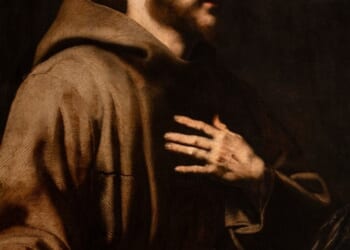
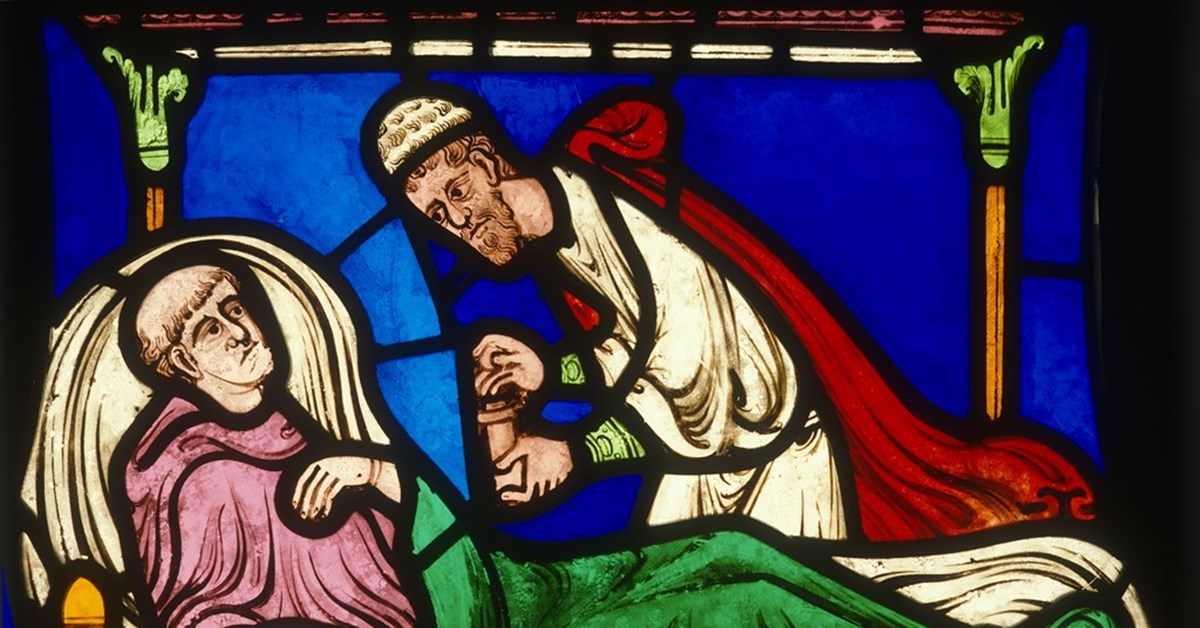
AS AN expression of this inward transformation, Thomas began to adopt a threefold manner of dress. On the outside, he continued to wear the garb of a canon and archbishop, thereby retaining to observers his apparent secularity and magnificence.
But, beneath that, he secretly adopted the monastic habit, so that he could conform to the life of his brothers, though without them knowing. Not only that, but underneath, close to his skin, Thomas began to wear a hairshirt of rough cloth that covered his body right down to his shins and swarmed with lice and vermin.
As William of Canterbury puts it, “within [Thomas] subdued the illicit stirrings of the flesh, suffering the hardships of the desert without being in the desert.” Quoting the words of the Roman writer Seneca, William Fitzstephen writes, “His outward visage was like that of ordinary men, but within all was different.” He was like St Sebastian who outwardly fought as a soldier in the Roman army, but inwardly fought as a soldier of Christ; or St Cecilia, who wore a hairshirt under her precious marriage dress.
This is one of the most famous images of Thomas: the outwardly magnificent Archbishop humbly subduing the flesh in a monastic habit and hairshirt. But is it believable? Many historians have considered it to be a posthumous fabrication, prompted by the lack of compelling evidence otherwise of an inner spirituality. Others have argued that Thomas may well have been wearing the monastic habit and hairshirt on the day that he died, but that this did not date back to his consecration.
THE wearing of a hairshirt was not unknown among medieval saints, and the biographers are unanimous in confidently attesting to it. Some writers cite witnesses to Thomas’s habit of concealing his true asceticism and piety. Alan of Tewkesbury describes how a monk laughed at the Archbishop for apparently putting on weight, not realising that it was the bulk of the hairshirt and habit that gave the false impression.
Fitzstephen cited the personal testimony of Thomas’s confessor, Robert of Merton, that he always remained chaste. On the other hand, this is the most difficult of all claims to verify: that Thomas had a spiritual purpose, but an important element of that purpose was its concealment. We know that to most of his contemporaries, including the monks of Christ Church, it remained successfully concealed throughout his life.
BUT there is another aspect of Thomas’s “conversion” that continues to raise questions. That is, that whatever change Thomas underwent on becoming Archbishop, it was not a definitive break with what had gone before; nor did it open a direct path to sanctity. Thomas’s life before his consecration, if worldly and undistinguished by obvious sanctity, was not that of an irreligious sinner.
To his enemies, he remained the proud Chancellor in a different and more dangerous guise, and Thomas himself later confessed that he did not always live up to the office of archbishop. As one modern historian has written, his was “not in the deepest sense a conversion”, nor “a transformation or rebirth of character”. He did not “pass at a definite moment with Paul, with Augustine, with Francis, into a new world of the spirit from the world of other men”.
But the fact is that, despite the biblical language, Thomas’s biographers do not claim that he experienced a conversion along the lines of St Paul. For them the change was indeed great and dramatic, but it was also just one especially significant step on his path to perfection. In fact, the language used of Thomas’s transformation was that commonly used in 12th-century England to describe those who entered upon a new vocation — those who adopted the monastic life, or joined a new religious order, or even those who took on a new responsibility, such as a bishop, archbishop, or abbot.
IT MAKES sense, then, that looking back on Thomas’s early days as Archbishop from the vantage point of his death, those monastic writers such as William of Canterbury should describe it in terms of the new life of a monk, emphasising his prayers and mortifications. But even the monks of Canterbury would have recognised that it was not enough for a successful archbishop to be pious.
The Archbishop had a range of duties which placed great demands on him, and it was customary for 12th-century prelates to bemoan the pressure of business and the lack of leisure for the things of God. He had specific liturgical duties: to confirm the faithful, to ordain priests, and to consecrate churches within his archdiocese.
He was a major landlord, with responsibility to protect the lands he had inherited against incursion, and to extend the wealth of his see where possible. This meant that he was a feudal overlord, with many tenants, and many obligations to them. He oversaw an extensive administrative machine, geared towards the running of the secular and spiritual obligations of office. He was a judge, presiding in court over disputes within the archdiocese, and the leader of the English Church, holding synodal gatherings of prelates and abbot.
He was also one of the principal vassals of the King — a “tenant-in-chief” — owing the provision of troops to the King and attendance at his court. Inevitably, the Archbishop of Canterbury was consulted on matters of state, and acted as a conduit between the demands of the English hierarchy, the King and the Pope.
NOT surprisingly, some archbishops were not up to the task. Some, such as the rapaciously ambitious Stigand in the 11th century, found themselves so engaged in worldly business that the position of archbishop became a travesty. Anselm, who held the office at the turn of the 12th century, was one of the most gifted and saintly Archbishops of Canterbury but was considered a failure by many on account of his aversion to worldly affairs.
To his biographers, Thomas succeeded in perfectly balancing the dual nature of the position. Citing the standard biblical examples of the contemplative and active lives, they say he was like Mary of Bethany who sat at the feet of Jesus, feasting on the bread of angels, he who had previously starved now being filled; but he did not neglect the work of Mary’s sister Martha, busy about many things. John of Salisbury tells us that whatever time Thomas could withdraw from pressing business he almost always gave to prayer and reading.
At the same time, the reverence he showed in celebrating mass also informed the faith and morals of those around him, and in his preaching he acted as teacher and pastor. Even in precious clothes he was a pauper in spirit; with a happy face he maintained a contrite heart. He was mild and gentle to the meek and the poor, but freely condemned the vices of the powerful.
This is an edited extract from Thomas Becket and his world by Michael Staunton, published by Reaktion Books at £16.95 (Church Times Bookshop £15.25); 978-1-5261-1268-2.