WHO is the patron saint of bursars?* Colleges, cathedrals and conventual houses all need bursars, but Jesus’s teaching (Matthew 24.24) does not recommend an obvious CV. None in the echelons of paradise came to mind. As one of the Twelve, Judas Iscariot is not a great role model.
I puzzled over this when I went to see the recently restored Passion Cycle that Mariotto di Nardo di Cione (c.1360-1424) frescoed for the former chapel of San Niccoló, in the heart of Florence, which later became the sacristy of the Officina Profumo-Farmaceutica di Santa Maria Novella.
Expensive perfumes and exotic scents are still being sold there, but I had the feeling that the tourists, marshalled impeccably by suited and booted men in black suits with earpieces, behind a crimson cordon on the street, had not come to see the frescoes nor the David Hockney installation in the sacristy. They would be more at home in a Chinese airport or an outlet shopping mall such as Bicester Village.
Judas is featured three times on the east wall; at the Last Supper, as he is caught dipping bread (Mark 14.20), and at table, witnessing the foot-washing (John 23.11). In both, he has a distinctive black halo. In the unusual narrative scene above, we see Jesus dispatching two of his Apostles to prepare for the Passover meal, while Judas, again with his black halo, is negotiating terms and conditions with the Chief Priests. Mafia-like, they all look shifty; if he had not first taken his own life, they would certainly have come after him.
For this space, the doyen of British artists has loaned his 2017 Annunciation II after Fra Angelico from his “Brass Tacks” triptych that he created for his 80th-birthday retrospective at the Pompidou Centre, in Paris. It heralds the exhibitions staged elsewhere in Florence of a remarkable Tuscan artist (c.1395-1455).
Hockney inverts Fra Angelico’s altarpiece in San Marco, using reverse perspective. A rectangular canvas has been cut back to a hexagon, widening the picture so that the floorboards rise to meet us. He also reimagines Fra Angelico’s softer palette with his fuchsia pinks, brittle oranges, and Aegean blues. It is not (and is not intended to be) a work for contemplation. It is, rather, a challenge. What do we think of an artist, long called “Beato” because of the sheer beauty of composition?
Born, it is said, in a hamlet north of the city, Guido di Piero was already recorded as an artist in Florence by the age of 22. Within a few years, he had entered the Dominican convent on the road out to Fiesole, training for the novitiate at Cortona with Fra Antonio Pierozzi, the future Sant’ Antonino (canonised in 1536). Back in Fiesole, Angelico became the bursar of the small community house. It is still there, opposite the turn off for the Badia Fiesolana; tourists largely ignore both.
It was not until October 1982 that Fra Angelico was formally beatified by the Roman Catholic Church, but there are so many miracles on display here (in both venues) that public acclaim (which is all that was needed in the medieval Church) ought to have exalted him to the greater company of witnesses long ago.
Where to start?
The exhibition at San Marco concentrates on earlier works, from c.1415 to c.1430, bringing together book illuminations and humanist manuscripts in the library that is considered to be the first public library of the Renaissance in Europe. Designed to house the codices and manuscripts collected by one Niccolò Niccoli (d. 1437), it held more than 1700 titles by the end of the 15th century. Necessarily, it became a sanctuary for scholars, whether or not they were members of the Observant Dominican community, and it was bankrolled by the Medici.
The library opened in 1444 while Fra Angelico was decorating the cells for the brethren, and he clearly drew on what he could read here for inspiration; for instance, he would have read of the lives and martyrdoms of Saints Cosmas and Damian, patrons of medics and, therefore, often included in altarpieces for the local ruling house, in the copy of The Golden Legend by Jacopo de Voragine which Cosimo de’ Medici bequeathed to the library.
First built in 1299 for the Sylvestrines, on land earlier occupied by a Vallombrosan monastery, the site, on the city outskirts, was granted to the Dominicans of Fiesole in 1436 by Pope Eugenius IV. Initially, only nine friars from Fiesole came into the city. But the church and the community house were rapidly refurbished, rebuilt, and enlarged by Michelozzo (1437-52), and Fra Angelico lived and painted here for ten years.
As early as November 1421, the Medici brothers had financial dealings with the Dominican order, both in Bologna and in Florence. The Florentine site itself stands on the road out of the city to Mugello, near where Angelico grew up and where the Medici had great estates. To this day, the community house is a welcome quiet haven in a busy metropolitan centre; the bare walls of the cells, with a single devotional image, invite us to slow down, to reflect, and to pray.
In cell 7, we are enticed into silence as we find St Dominic sitting, quietly reading. His chin rests on his right hand while he turns a page. He looks almost baffled by the text in front of him. In the north corridor of the dormitory, he is seen grasping the foot of the cross, looking up at his Saviour (c.1443). Further along the corridor, we come to a scene of the annunciation.
Angelico was not always painting on his own — many detect the increasing presence of assistants in the decoration of the novices’ cells 15 to 21. But, of those of us who fumble with chopsticks or even wielding a pen, who would know? This is a world of silence (as the clausura would have been) in which, nearly six centuries later, we feel like trespassers, even though we are very welcome guests.
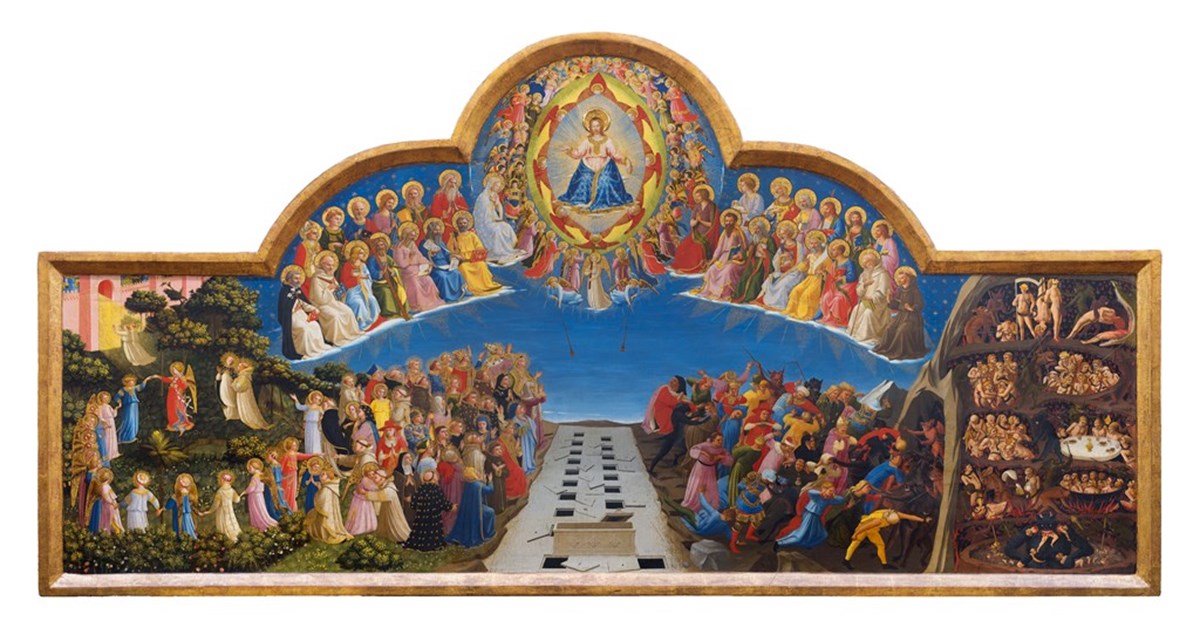
In the fortress-like Palazzo Strozzi, begun in 1490, which takes up a single city block, the exhibition is largely chronological. In awe and wonder, we watch as Fra Angelico abandons the traditional gold ground that had swept the 14th century and, using contemporary statuary as models for artistic invention, displays what we see as a new sense of realism, with an early understanding of perspective, which is why the Hockney response is so vital.
The earlier works are shown at San Marco, including the Fiesole altarpiece of 1420-23, in part here reconstructed with the inclusion of missing roundels such as the figures of a grumpy-looking Sant’ Alessandro (from New York) and the National Gallery’s quietly reticent St Romuald, as well as two saints detached from their niches. The first altarpiece shown in the Palazzo Strozzi is, fittingly, that of the Deposition painted for the sacristy of the Santa Trinità church near by. It was begun by another artist, Lorenzo Monaco, c.1421 and completed after his death (1424) by Angelico.
On a wall near by is one of his few surviving drawings, the Dead Christ from the Fitzwilliam Museum in Cambridge, which captures the all-too-real pose of Christ’s body, lowered from the Cross. The bystanders, and there are many of them from all walks of life in 15th-century Tuscany, stand in a landscape recognisable to this day. It is the drawing of the detached body of the lifeless Lord of Life which commands our attention.
The muted grief of the women around the Virgin and the suppliant (possibly a family member who had made the grade — the Blessed Alessio Strozzi) invite our contemplation. It has been suggested that the scriptural texts on the altarpiece indicate that the Vallombrosan monks at Santa Trinità, who possessed a relic of the True Cross, may have used the sacristy liturgically on Good Friday and Holy Saturday. Today, the lavish colours draw us to look more closely.
Originally, this was in the main chapel next to one that housed the much more widely known (if only from Christmas cards) Gentile da Fabriano Adoration of the Kings (1423), a composition that is almost too busy and too noisy to serve. For Angelico, the colourful concourse around the cross wait patiently and prayerfully as Jesus is taken down. The silence is deafening.
I have never been to Hildesheim. The cathedral museum there has loaned a triptych that contains fragmentary relief carvings of the Life of Christ carved by the Embriachi workshop in the early 15th century. Angelico was later tasked to paint the outside doors (1440-5) and portrayed the annunciation on the outside wings and the Man of Sorrows on the reverse.
As in several of the cells at San Marco (nos. 7, 27, and 39), Angelico painted detached symbols of the Passion on a stark black background around the head of Christ; a serving girl’s face and her admonitory finger, and the head of St Peter; Pilate’s hands being washed over a bowl; Christ blindfolded and mocked by unseen hands and a single jeering face; the hands of soldiers throwing dice and Judas dipping his in to the bowl.
In the same gallery room, one wall develops the theme of the Volto Santo, the Face of Christ. His tearful, red-rimmed-eyed portrayal from Livorno Cathedral (1447-50) informed similar works by Dieric Bouts in Haarlem and Benozzo Gozzoli locally in Tuscany. Missing only is the extraordinary processional banner that he painted for a confraternity of the Blessed Sacrament in Pisa (1440-45), in which an unperturbable Christ offers a blessing while lifting a chalice and paten in his left hand. That work alone demands a detour downstream on the Arno to the Museo Nazionale di San Matteo in Pisa.
In Florence, I came across several other priests leading parish groups around this show and a former nun with her birth sister marvelling at the painted reliquary tabernacles, holy men and women of our own day engaging with the spiritual experience of an earlier age. Angelico was painting at a time when Florence hosted an Ecumenical Council intended to end the Great Schism between the East and the West. These exhibitions are timely.
Everything comes with a price; you may need to pay extra baggage allowance for the weighty catalogue (€80), and there is no combined ticket for both exhibitions, a complaint that I raised earlier with the two-centre show of Donatello (Arts,15 July 2022). The Hockney appetiser is free and not to be missed.
“Beato Angelico” is at the Palazzo Strozzi and Museo di San Marco, Florence (phone 00 39 055 2645155), and “David Hockney: Beato Angelico” is at the Officina Profumo-Farmaceutica di Santa Maria Novella, Florence, until 25 January.
palazzostrozzi.org; uk.smnovella.com; museitoscana.cultura.gov.it
*The answer, I find, is St Joseph.