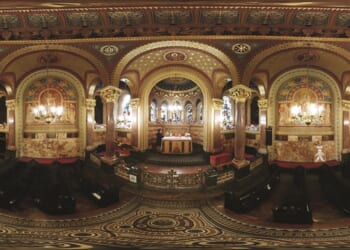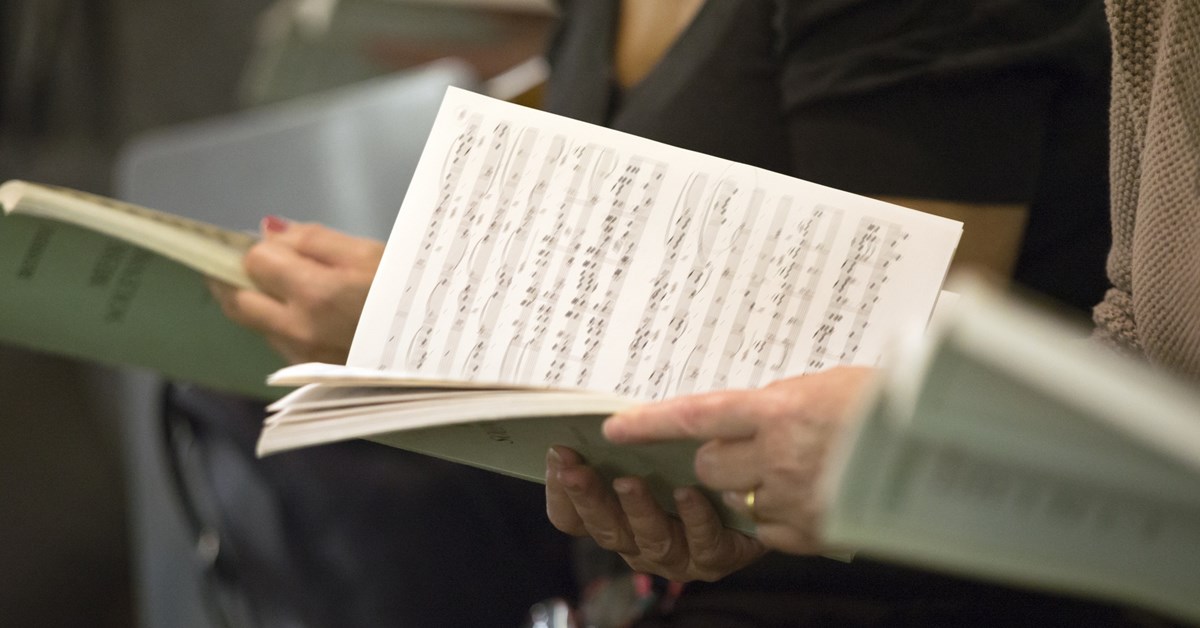
SINGING without a conductor, as ever, the 12 members of Stile Antico delivered “A Spanish Nativity” at St Martin-in-the-Fields, London, in December. It was a programme of unaccompanied Christmas choral music written during Spain’s Siglo de Oro, the 16th- and 17th-century Golden Age of Spanish culture.
The music divided neatly into two types. Villancicos, religious songs with a verse and refrain, by Cristóbal de Morales and Mateo Flecha el Viejo mingled with Tomas Luis de Victoria’s Ne timeas Maria (Be not afraid, Mary), and his Mass O magnum mysterium, based on his motet of the same name.
Victoria’s motet for four voices sets a text from the Christmas matins awestruck at the animals’ presence at Christ’s nativity and using Elizabeth’s greeting to Mary. It is set to long note values descending and ascending in leaps of a fifth, creating a sense of vastness, and the sense of wonder is heightened by the use of bare fifths. The music changes to a lilting triple time at the end as the choir sings “Alleluia!”, like a host of angels bursting into song.
The 1592 Mass has the same four-part scoring, reducing to three in the quiet Benedictus and splitting the sopranos in the Agnus Dei, creating a beautiful unison canon. Here, as throughout, Stile Antico caressed the counterpoint into a smooth ribbon of precisely phrased sound, showing an almost telepathic rapport as the singers made eye contact, emphasising the structure by tiny, distinct pauses marking important cadences.
A more robust but no less sincere spirituality illuminated the villanicos, Fernando de las Infantas’s Angelus ad pastores ait, Pedro Rimonte’s De la piel de sus ovejas. and Francisco Guerrero’s A un niño llorando. The singers brought out the bouncing jollity of Flecha el Viejo’s Ríu Ríu Chíu, with five excellent male soloists in the verses, and his reverent but amusing El Jubilate, in which the Virgin addresses Original Sin as “Poltrón françoy” (French fool). Morales’s lengthy setting of Matthew’s account of Christ’s birth, Cum natus esset, was never allowed to drag, and the careful interplay between the voices added a sense of narrative urgency to the familiar story.
The singers even showed off their sound grasp of Nahautl, the native language of Mexico, in Hernando Franco’s Sancta Maria, e un il huicac (Holy Mary, Queen of Heaven).
MEMBERS of the Manchester Collective and four singers from the Marian Consort, the soprano Caroline Halls, the countertenor Rory McCleery, the tenor Will Wright, and the bass Jon Stainsby, joined forces in an eclectic and wintry programme of vocal music at the Wigmore Hall last month.
Music by Orlande de Lassus and Andrzej Panufnik’s Hymn to the Virgin bookended two of David Lang’s National Anthems and the world première of Samantha Fernando’s Wintering, six song settings exploring the tension between quiet introspection and the ever-present hum of the outside world
In his 1600 Prophetiae Sibyllarum, Lassus sets the 12 anonymous medieval Latin Sybilline Prophecies, each from a different prophetess foretelling the coming of Christ, as six-line motets. The “Carmina Chromatico” Prologue shifts keys so rapidly that the listener loses all sense of tonality, gaining instead a sense of unreality. The ensemble’s dynamic shading, perfect intonation, and skilful use of pauses showed off the composer’s strange chromatic harmonies to full effect in four of the 12, Persica, Cumana, Europaea, and Agrippa. Stringed instruments, two violins, viola, and cello added a gentle Renaissance glow.
In his 1964 setting of an anonymous medieval Latin prayer from Poland, Andrzej Panufnik set out to “evoke the adoration, warmth and pure faith of the Polish peasant”. The song opens with soprano and mezzo-soprano only, singing pianissimo “Tu luna pulchior, tu stellis purior, tu sole clarior, Maria!” (Thou art more beautiful than the moon, purer than the stars, brighter than the sun, Mary!), in a melody that draws stylistically on plainchant and Polish folk music. The other voices gradually join in, slowly swelling into a warm fortissimo climax.
In the middle part, the voices intone pianissimo, with emphasis on the rhythm of the words, evoking a peasant congregation in a country church. In the third part, the prayer becomes more urgent, in a crescendo to the final ecstatic shouts of “Maria”. Despite moments when the instruments threatened to overwhelm the voices, this was a polished and impressive performance of a sincere and deeply felt work.