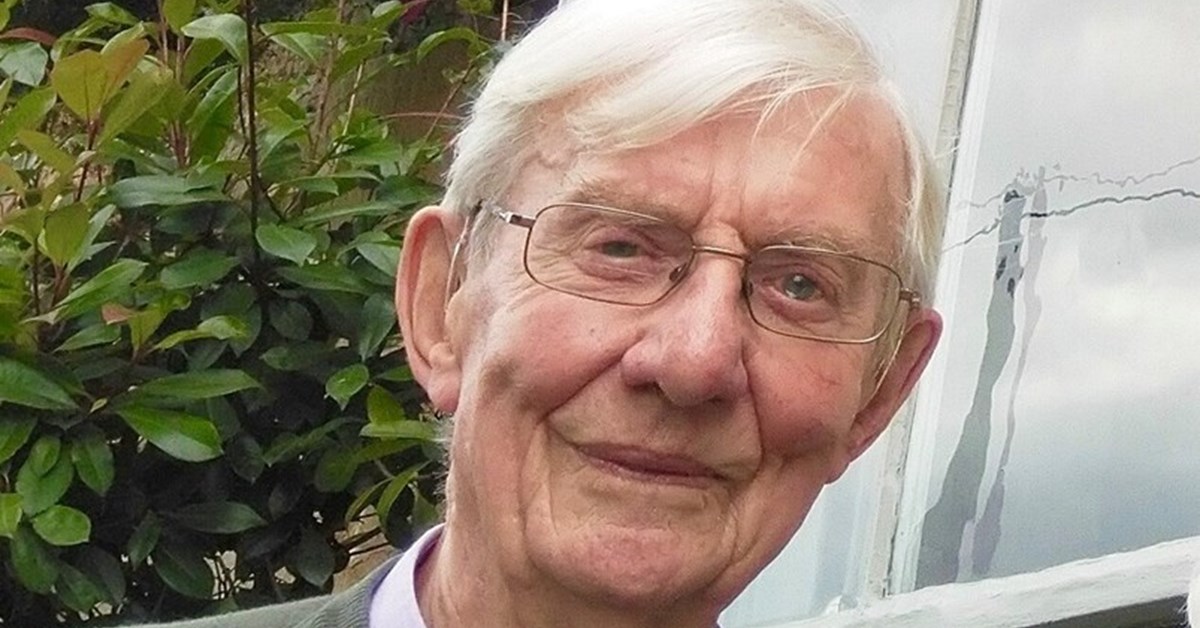
Andrew Nethsingha writes:
ANTHONY CROSSLAND was born in Nottingham, where he attended the High Pavement School. He showed an early aptitude for music, starting piano lessons at the age of six, followed by organ lessons eight years later.
As a young man, he was as passionate about the sciences as he was about the arts: after leaving school he spent seven years in the scientific department of the National Coal Board. He simultaneously maintained a private study of music, and soon became organist and choirmaster of a local church. Upon obtaining the FRCO diploma, he became determined to pursue music full-time, and, at the age of 26, enrolled at Christ Church, Oxford, subsequently completing both the Bachelor of Arts and Bachelor of Music degrees. Sydney Watson, then Organist at Christ Church, held Tony in such high regard that he appointed him to the post of Assistant Organist in 1957.
While at Oxford, Tony met Barbara Pullar-Strecker, who worked as secretary to the Regius Professor of Medicine. They married in Christ Church Cathedral in 1960 and remained devoted to one another for 65 years.
In 1961, they moved to Wells, where Tony was to spend ten years as Assistant Organist and then 25 years as Organist and Master of the Choristers. Their three children, Nicholas, Caroline, and Victoria, were born in Wells. Six grandchildren followed. Tony was enormously proud of the whole family.
Tony was a fine wordsmith: a great letter-writer with an enviably quick wit and beautiful handwriting. His love of language was equally evident when listening to his choir and its diction. Two of the most important attributes of a choir are its treble tone and its psalm-singing; Wells Cathedral Choir excelled in both respects under Tony’s direction. His choristers’ sound was wonderfully natural and unforced; yet still beautifully focused.
His leadership never sought attention, always serving the liturgy and music. His standards remained inspiringly high until the day he retired. I remember recording with the choir for Priory Records in the 1990s: once the three days were over, I realised that we hadn’t needed to stop once because of a treble error. During his leadership of the Wells Cathedral Oratorio Society, Tony staged numerous memorable performances of works such as Walton’s Belshazzar’s Feast, Britten’s War Requiem, and Elgar’s The Apostles.
One might expect musical quality to plateau during a 35-year tenure at a cathedral. And yet, in Tony’s case — miraculously — the opposite was true. One of his masterstrokes was creating a system of gap-year choral scholarships for students pre- or post-university, including several from the United States. Thus, future musical superstars including James Gilchrist and David Watkin came to sing in the choir for a year. Choirs in university towns had admitted choral scholars before, but it was visionary to implement such scholarships away from universities.
Tony’s initiative was subsequently adopted by many other cathedrals, often transforming the standard almost overnight with a steady stream of talented young choral scholars working alongside the professional adult singers. The more experienced vocalists passed their expertise onto the next generation, planting seeds to nurture the future of our British choral tradition.
Under Tony’s leadership, Wells Cathedral Choir also became one of the first choirs of its kind to introduce girl choristers. He mentored a succession of organ scholars and assistant organists, of whom I was privileged to be one. He was generous and encouraging. As well as for his music-making, he is remembered for his kindness and for the twinkle in his eye.
Tony complemented his cathedral duties with examining work at both O and A levels, and practical and theory examining for the ABRSM. He especially enjoyed his examining trips to the Far East. I once visited him in Hong Kong during such a trip and was impressed by his knowledge of the local haunts. Perhaps these tours were one of his secrets to staying so fresh in his cathedral work.
In 1996, two years after being awarded a Lambeth doctorate in music by the Archbishop of Canterbury, Tony retired from Wells. He and Barbara moved to Bradford-on-Avon, where they renovated their newly acquired 17th-century home, carrying out much of the work themselves. Here, they continued the generous hospitality for which they had been renowned in Wells.
Tony was heavily involved in local music-making in Wiltshire, while also serving as chief theory moderator of the ABRSM. This greatly loved and admired cathedral musician finally retired from marking music-theory papers at the age of 93.
Dr Anthony Crossland died on 3 August, aged 93.