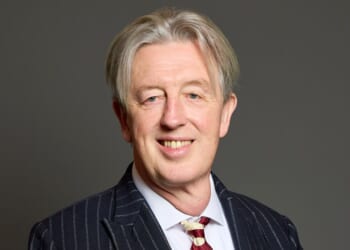
(LifeSiteNews) — Pope Leo XIV on Monday named Monsignor James A. Misko, the vicar general of the Diocese of Austin, Texas, as the next bishop of Tucson, Arizona.
Bishop-elect Misko will be consecrated and installed as the eighth bishop of Tucson on February 20, 2026, the diocese announced December 22.
As vicar general of Austin, Misko enforced the suppression of multiple Traditional Latin Masses (TLM) and the ban on Communion kneelers, while also urging the faithful to get the abortion-tainted COVID jab.
Misko, 55, will succeed Archbishop Edward Weisenburger, now the archbishop of Detroit, who has also suppressed the Latin Mass and was one of the strongest supporters of the COVID jab.
Pope Leo XIV has appointed Reverend James A. Misko, a priest of the Diocese of Austin, as the Bishop of Tucson. Father Misko currently serves as vicar general and moderator of the curia for the Diocese of Austin. The appointment was publicized in Washington, D.C. on December 22,… pic.twitter.com/JUByWVgkMO
— U.S. Conference of Catholic Bishops (@USCCB) December 22, 2025
Misko’s background
Misko was ordained to the priesthood in 2007 in the Diocese of Austin, where he would serve at various parishes. Since 2019, he has served as vicar general and moderator of the curia for the diocese, and served as the diocesan administrator from March to September 2025, following Bishop Joe Vásquez’s appointment as the bishop of Galveston-Houston until his successor Bishop Daniel Garcia officially replaced him.
Misko holds a bachelor’s degree in communications from St. Edward University in Austin, as well as a Master of Arts in theological studies, a Master of Divinity, and a Bachelor of Sacred Theology from the University of St. Thomas and St. Mary’s Seminary in Houston. Between 1991 and 2000, prior to his time in seminary, Misko worked in the restaurant industry.
TLM suppression and Communion kneeler ban
Misko has long shown an apparent disdain for traditional liturgical practices. In 2024, the Austin diocese under Bishop Vásquez, during Misko’s tenure as vicar general, shut down the well-attended Latin Masses that had been celebrated at St. Mary’s Cathedral, citing Traditionis Custodes and guidance from the Dicastery for Divine Worship (DDW). The two Sunday TLMs were replaced with Latin Novus Ordo celebrated ad orientem (facing east) with Gregorian chant.
In September of this year, just as Bishop Garcia officially took over the diocese, a scheduled Latin Mass at Texas A&M University was abruptly canceled.
READ: Diocese of Austin shuts down planned Latin Mass for students at Texas A&M University
In November, under Garcia’s direction, Misko signed a memorandum asking pastors to no longer use kneelers for the reception of Holy Communion, emphasizing that standing to receive the Eucharist is considered the “norm” in the U.S. as determined by the United States Conference of Catholic Bishops (USCCB).
READ: New bishop of Austin directs priests to remove kneelers for Communion: ‘Wicked and cruel’
The use of kneelers (prie-dieus) during Holy Communion “could confuse the faithful” about this norm, while communicating that kneeling to receive the Eucharist is “more appropriate,” Misko wrote in the directive.
Setting out a kneeler near the distribution of the Eucharist could also allegedly “could put undue pressure on the communicant” to receive kneeling, the directive added.
From the Diocese of Austin, a sinister memorandum regulating and discouraging the practice of kneeling for Holy Communion: pic.twitter.com/Mlk75eClfO
— Damian Thompson (@holysmoke) November 14, 2025
Misko further instructed pastors to explain to communicants who have difficulty getting up without a rail after kneeling that “they are not offending God by not kneeling” and that the priest recommends they receive standing.
“At the same time, it is important to catechize the faithful that one can receive Holy Communion with the same reverence standing and that there should not be an emphasis on kneeling for Holy Communion by priests, deacons, and lay liturgical leaders,” he wrote.
The tradition of the Catholic Church, unbroken until after the Second Vatican Council, is that the lay faithful receive the Blessed Sacrament, administered by a priest, his hands having been consecrated for the handling of the sacred Eucharist, on the tongue while kneeling.
Furthermore, the Code of Canon Law, which binds all bishops and priests in the Roman Rite, is very clear that the faithful’s choice to kneel to receive Communion is not a sufficient reason for them to be denied the sacrament:
Sacred ministers cannot deny the sacraments to those who seek them at appropriate times, are properly disposed, and are not prohibited by law from receiving them. (Can. 843 §1.)
Any baptized person not prohibited by law can and must be admitted to Holy Communion. (Can. 912)
Championing of abortion-tainted COVID shots and migrants
Misko also championed the COVID jab, urging the faithful to get vaccinated as soon as the experimental shots were available. The monsignor even dismissed Catholics’ concerns about taking some of the abortion-tainted shots in an interview with a local media outlet.
“The good that can come from using these vaccines so far outweighs the remote evil that the person would be participating in,” Misko said.
Several Catholic prelates have refuted the idea that the supposed good from the COVID shots outweighs the remote evil cooperation that recipients participate in by taking the abortion-tainted jabs.
In a seminal intervention of December 12, 2020, around the same time Misko urged the faithful to get their shots, Bishop Athanasius Schneider – along with co-signers Cardinal Janis Pujats, Bishop Joseph Strickland, and Archbishops Tomash Peta and Jan Pawel Lenga – expressed their strong conviction that any use of a vaccine-tainted with the “unspeakable crime” of abortion, under any circumstances, “cannot be acceptable for Catholics.”
Like many of Pope Leo’s bishop appointments, Misko is also staunchly pro-migrant. The monsignor, along with leaders from the Church of the Latter Day Saints, had helped to create “welcome centers” for migrants, one of which was hosted by Catholic Charities of Central Texas. It’s unclear whether these “welcome centers” provided aid to only legal immigrants in need or illegal aliens as well.
Catholic Charities has been sharply criticized, including by Catholics, for its alleged aiding of illegal immigration. Catholic Charities manages the day-to-day care for many unaccompanied alien children (UACs) and, along with the USCCB, has received $449 million from the U.S. government to shelter and transport unaccompanied immigrant children over the years.
Similarities to previous bishop of Tucson
Misko’s predecessor, Archbishop Weisenburger, has been involved with similar restrictions on the TLM and traditional liturgical practices in his new archdiocese of Detroit. In June, the archbishop officially suppressed most celebrations of the Tridentine Mass in the archdiocese and even banned the ad orientem posture for Novus Ordo Masses.
READ: Detroit archbishop shuts down most Latin Masses, bans ad orientem worship
While serving as bishop of Tucson, Arizona, Weisenburger was also among the most stringent in the country in applying restrictions on the faithful during the COVID crisis, closing churches and implementing mask mandates in the spring of 2020 while encouraging Catholics to take the abortion-tainted shots and instructing all priests within his diocese not to issue religious exemptions for the jab or mask mandates.