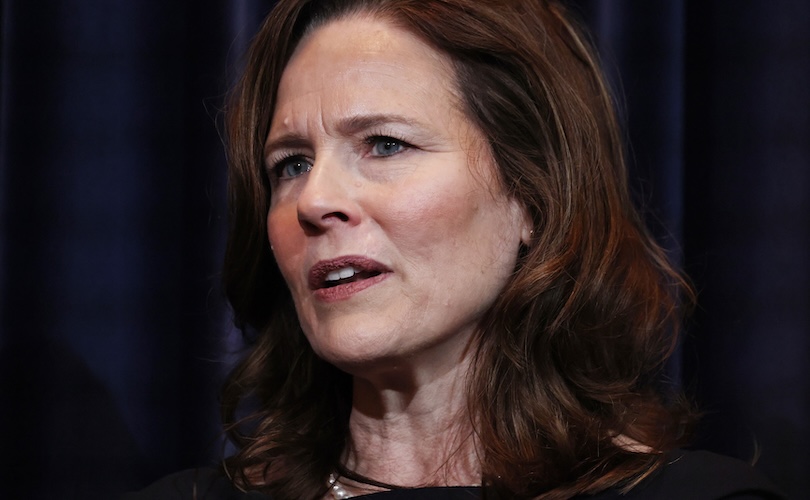
(LifeSiteNews) — U.S. Supreme Court Justice Amy Coney Barrett presented a succinct, constitutional case against Roe v. Wade in a new interview, three years after her role in the fateful reversal of that longstanding precedent sparked a flood of left-wing hate and violence.
Barrett, a Catholic jurist who President Donald Trump nominated in his first term to succeed the late left-wing Justice Ruth Bader Ginsburg, sat down with Bishop Robert Barron for a wide-ranging discussion on his “Conversations at the Crossroads” series, published December 21. The conversation eventually turned to Roe, the notorious Supreme Court precedent that forbade the states and the federal government from banning most abortions. In June 2022, Barrett was one of five votes to overturn Roe in Dobbs v. Jackson Women’s Health Organization.
“The trouble with Roe was, what we were just talking about living constitutionalism, I mean there’s nothing in the Constitution, certainly that speaks to abortion, that speaks to medical procedures,” the justice told the bishop. “The whole thing was grounded–I mean, actually, Roe itself didn’t even make this quite explicit, but the best defense of Roe, the commonly-though defense of Roe, was it was grounded in the word ‘liberty’ in the Due Process Clause, you know, that we protect life, liberty, and property, it can’t be taken away without due process of law.”
“Well, that word ‘liberty’ can’t be an open vessel or an empty vessel in which judges can just read into it whatever rights they want, because otherwise we lose the democracy in our democratic society,” she continued. “And so the problem, to my mind, with Roe is that it was a free-floating, free-wheeling decision that read into the Constitution–the Constitution, the reason why it’s difficult to amend is that it reflects a supermajority consensus.”
“And the rights that are protected in the Constitution as well as the structural guarantees that are made in that Constitution are not of my making, you know, they are ones that Americans have agreed to, and Roe told Americans what they should agree to, rather than what they have already agreed to in the Constitution,” Barrett concluded.
Must Watch: Justice Amy Coney Barrett on the problem with Roe v. Wade’s precedent:
“It was a free-floating, free-wheeling decision that read into the Constitution…Roe told Americans what they should agree to, rather than what they have already agreed to in the Constitution.” pic.twitter.com/wl6HfkFU4n
— Carrie Severino (@JCNSeverino) December 23, 2025
The fall of Roe restored states’ prerogative to fully determine their own abortion policies for the first time in nearly half a century. As a result, thirteen states currently ban all or most abortions, with a wide range of lesser restrictions also in effect. In this new normal, the abortion lobby works feverishly to preserve abortion “access” via deregulated interstate distribution of abortion pills, legal protection and financial support of interstate abortion travel, constructing new abortion facilities near borders shared by pro-life and pro-abortion states, making liberal states sanctuaries for those who want to evade or violate the laws of more pro-life neighbors, and embedding abortion “rights” in state constitutions.
While pro-life Americans are immensely grateful to the Dobbs majority for delivering one of the pro-life movement’s top long-term objectives, it is not strictly accurate that “nothing in the Constitution […] speaks to abortion.”
While the procedure is not specifically addressed, the 14th Amendment to the Constitution expressly forbids any state from “deny[ing] to any person within its jurisdiction the equal protection of the laws,” which “Congress shall have the power to enforce, by appropriate legislation.” The historical record shows that the Amendment’s original framers expressly intended it to apply to “any human being,” and therefore to the preborn.
During her tenure, Barrett has often been more moderate than conservative colleagues Clarence Thomas and Samuel Alito. But the fact that she joined the conservative majority in Dobbs was all it took for pro-abortion activists to make her a target.
When a leaked draft indicated the court’s decision on Roe a month ahead of its official release, a pro-abortion group calling itself Ruth Sent Us organized “walk-by protests” at the “homes of the six extremist justices” (Chief Justice John Roberts had been a sixth vote to uphold the Mississippi law at issue in the case, but opposed overturning Roe) and published a map containing those homes. The protests, which included chants like “no uterus, no opinion” (despite Barrett being female), violated federal law against “picketing or parading” with the “intent of influencing any judge” in or near “a building or residence occupied or used by such judge.”
The Biden administration refused to condemn the choice of private homes as protest sites, and then-Democrat House Speaker Nancy Pelosi went so far as to praise the “righteous anger” of the protesters.
The leak and subsequent ruling were also followed by numerous acts of violence, vandalism, and intimidation against churches and pro-life pregnancy centers and, most alarmingly, California man Nicholas John Roske taking a gun and ammunition to the home of Barrett’s fellow Justice and Trump appointee Brett Kavanaugh, with the intent to kill him.
Last year, during a speech to the 10th Circuit Bench & Bar Conference, Barrett touched on the personal toll of such dangers, saying that overall her family had adjusted “beautifully” to her current role but that she finds its security demands challenging, such as having to regularly travel with U.S. Marshals.
She recalled an anecdote in which her 13-year-old son came across the discarded bulletproof vest she had worn home and how his initial innocent reaction of “that’s so cool! Can I try it on?” soon gave way to concern as to why his mother had it in the first place.