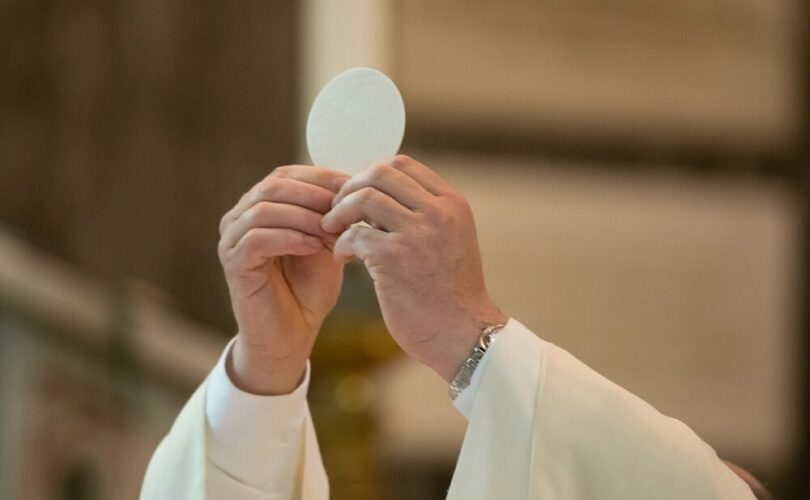
(LifeSiteNews) — Perhaps the most beautiful thing about the scene of the Nativity is its expression of Christ’s desire to give Himself to us as divine food. I remember being astonished to learn, not until after Catholic school, that mangers are where animals fed, and that Christ intentionally chose this resting place to foreshadow the Eucharist.
Simply put, Christ was laid in a manger – a word derived from the Old French “mangier,” meaning “to eat” – to show that He wanted to be our own food in the Eucharist!
To emphasize that He wished to be our “daily bread” after becoming Incarnate, Christ chose to be born in Bethlehem, which means “House of Bread.”
I was already gravitating toward writing on this subject for Christmas, and the importance of receiving the Eucharist often, when a friend of mine wrote to me out of the blue pointing out that Jesus Christ told us in the Our Father to receive Holy Communion daily.
We all know that we pray “Give us this day our daily bread” in the Our Father. But, while people perhaps more often think of this as meaning, “give us what we need to physically survive” – which it does – it has a deeper and even more important meaning.
“If bread = Eucharist, and it does, according to the missal, then Jesus told us to be daily communicants,” my friend pointed out.
There it is – we could not have a more authoritative counsel to seek daily Holy Communion than from our Lord Himself!
We can receive this first as a consoling confirmation from our Lord of His immense love for us. A love so profound, He comes to us, totally vulnerable, under the appearance of a wafer of bread in order to be physically united with us, even daily, despite our sinfulness.
This fact, once processed, becomes an anchor of our peace and joy. Jesus wants to be that close to me! He wants to be my closest friend and confidant. He wants to sustain me and nourish me, in every way. And He wants to bless me with abundant graces to strengthen my soul in virtue, to grow closer to Him every day, so that eventually my will and soul will be entirely united with Him.
If we are lacking in the desire to receive Him daily, it may be because we have let our worldly concerns overshadow God in our life. Just taking the action of going to Mass and receiving Our Lord, and in doing so overcoming an attachment to some other activity that we would otherwise be engaged in, can help scrub the barnacles of the world from our soul and reawaken our thirst for God.
When we prioritize God and subordinate everything else to Him, our heart will begin to follow. Being united with Him in Holy Communion and spending time with Him thereafter becomes the greatest joy of our life, beyond words.
Now, some of you Latin Mass-goers may be thinking: “But I have no daily Latin Mass nearby.” You may not want to go to a Novus Ordo Mass, or you may think it is impermissible to go. If you have a choice between the two, it is clear that the Traditional Latin Mass is preferable, since it is more reverent to God, it gives emphatic witness to the Mass’ essence as the Sacrifice of Christ, it properly forms the dispositions of the soul, and it procures more graces.
But is it true that we should avoid the Novus Ordo entirely even if we have no other options?
The powerful sign that this should not be our approach is the ongoing phenomenon of Eucharistic miracles, which overwhelmingly take place at Novus Ordo Masses. Our Lord is reminding us that this is still the Sacrifice of the Mass, that His Body, Blood, Soul, and Divinity is present, to be adored and received by those attending. It is true that belief in the Real Presence is much less prevalent at Novus Ordo Masses than at Latin Masses. Perhaps this is in part why Christ physically manifests the reality of His True Presence there. But we may also reasonably conclude that He would not manifest Himself in Eucharistic miracles at Novus Ordo Masses if they were in and of themselves an offense to God!
Priests of the Society of St. Pius X (SSPX) – which I hold in the highest esteem and firmly believe preserves the fullness of the Catholic faith – will sometimes argue, as Father Paul Franks has, that the new Mass signals an “implicit denial of the Catholic faith.” This is a very slippery, and ultimately untenable claim.
We may justifiably question the motives and intentions of those responsible for the new Mass, but the new Mass cannot be avoided when there are no TLM alternatives merely because of the intentions of its creators. If its creators intended to obscure the truths of the faith, obscure the Mass’ sacrificial nature, and decrease reverence toward God, then they are indeed guilty of an offense toward Him.
But the new Mass, in and of itself, must be assessed for what it is, objectively. And objectively speaking, it is the Sacrifice of the Mass, the Sacrifice of Christ to God the Father, which is of infinite precious value. And in fact, it explicitly gives witness to its nature as sacrifice.
As an example of this: The Orate Fratres is virtually the same. In the new Mass, the priest prays. “Pray, brethren (brothers and sisters), that my sacrifice and yours may be acceptable to God, the almighty Father. And the faithful respond: “May the Lord accept the sacrifice at your hands for the praise and glory of His name, for our good and the good of all His holy Church.”
The new Mass also, notably, does not inherently contain anything blasphemous, sacrilegious, or heretical (although a priest may make it so, and that is another question). That is, it is still a Catholic Mass which does not dishonor God in and of itself. I have not yet been able to find an SSPX priest who can point to any “red line” drawn in the Novus Ordo that renders it an offense to God. In other words, they cannot explain what precisely needs to be added or taken away from it in order to render it permissible to attend.
This is not even to say the Novus Ordo should not be replaced by the Traditional Latin Mass entirely. I believe the Church urgently needs a full return to the TLM. This is only to say that a lack of traditional Masses in our area should not prevent us from attending the Holy Sacrifice of the Mass and receiving our Lord in the Eucharist.
There are ample stories of people, including those I know personally, who even overcame serious sins by attending the Novus Ordo Mass and receiving the Eucharist there as often as possible. As St. Ignatius of Loyola said:
One of the most admirable effects of Holy Communion is to preserve the soul from sin, and to help those who fall through weakness to rise again. It is much more profitable, then, to approach this divine Sacrament with love, respect, and confidence, than to remain away through an excess of fear and scrupulosity.
At the end of our life, when its true value will come into focus, we will regret ever having missed the chance to receive our Lord in the Eucharist. It is so important, Christ showed as soon as He was born that He wishes to be our daily Bread. So let’s seize every opportunity for Holy Communion we have from this moment forward. He awaits us with abundant treasures to bestow on our soul.