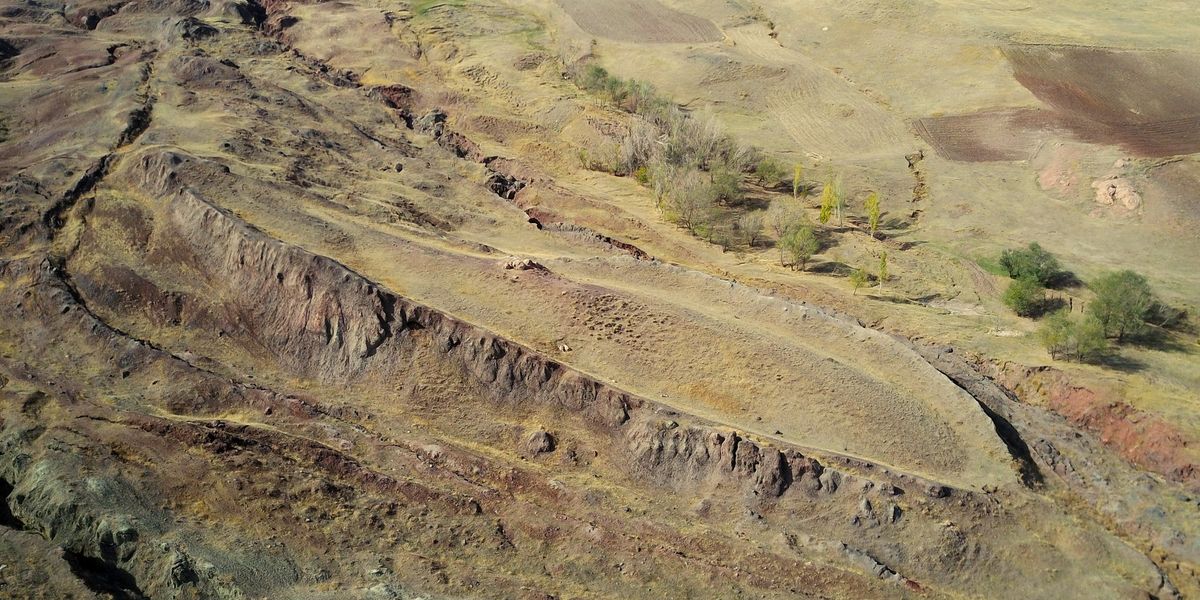
Ceramic fragments unearthed close to a geological formation on Turkey’s Mount Ararat may indicate human presence during the Chalcolithic era, according to researchers investigating the site’s possible links to Noah’s Ark.
Prof Dr Faruk Kaya of Agri Ibrahim Cecen University stated the pottery pieces were recovered near the Durupinar Formation in Agri province during recent road construction work.
The boat-shaped structure has attracted speculation about biblical connections for decades.
Academics examining the material believe it demonstrates human activity in the area between approximately 5500 BC and 3000 BC.
Prof Dr Kaya said: “The ceramic fragments show that there was human activity in this region during the Chalcolithic period, between 5500 and 3000 BC.”
He added: “This period roughly coincides with the time in which Prophet Noah is believed to have lived.”
The Durupinar Formation was initially spotted from the air on September 11, 1959 by Captain Ilhan Durupinar, a Turkish military surveying engineer conducting mapping operations over eastern Anatolia.
Subsequent rainfall and seismic activity gradually exposed more of the structure’s distinctive outline.

a geological formation on Turkey’s Mount Ararat has attracted speculation about biblical connections for decades
|
GETTY
Its proximity to Turkey’s tallest peak has fuelled centuries of speculation, with Christian tradition long associating Mount Ararat with the Ark’s final resting place.
The Book of Genesis describes the vessel coming to rest upon the “mountains of Ararat” following a deluge that covered the Earth for 150 days.
Biblical accounts specify the Ark measured 300 cubits in length, 50 cubits in width and 30 cubits in height.
Some investigators contend these ancient measurements correspond broadly to the dimensions of the Durupinar site.
A formal research initiative was launched in 2022 through a partnership between Agri Ibrahim Cecen University and Istanbul Technical University, assembling specialists in geophysics, chemistry and geoarchaeology.
Rock and soil specimens gathered from the formation underwent laboratory testing at Istanbul Technical University.
Prof Dr Kaya described the site as unparalleled globally, stating: “There is no other structure like this identified anywhere else in the world.”
The researcher has voiced alarm over damage caused by visitors removing stones and marked fragments as mementos.
MORE INCREDIBLE DISCOVERIES

The Book of Genesis describes the vessel coming to rest upon the “mountains of Ararat” following a deluge that covered the Earth for 150 days
|
GETTY
Prof Dr Kaya said: “This formation and its surroundings must be protected, and the removal of stones, rocks or similar material from the site must be prevented.”
Seasonal landslides, particularly during spring rainfall, are also eroding both flanks of the formation.
He has proposed establishing a dedicated Noah’s Ark museum or research facility near the mountain.
However, numerous scholars and archaeologists remain unconvinced by claims linking the site to the biblical narrative.
Nicholas Purcell, a lecturer in ancient history at Oxford University, dismissed such assertions as “the usual nonsense”.
He questioned how floodwaters supposedly covering Eurasia to depths of 12,000 feet in 2800 BC could have left established Egyptian and Mesopotamian civilisations entirely unaffected.
British archaeologist Mike Pitt has similarly challenged the lack of supporting physical evidence.
He said: “If there had been a flood capable of lifting a huge ship 2.5 miles up the side of a mountain 4,800 years ago, I think there would be substantial geological evidence for this flood around the world. And there isn’t.”