I’m beginning to think this occasional series has become one of my bad habits, but as those with a bad habit frequently say, I can kick it any time. “I don’t need no doctor.” Let’s live it up in the here and now.
Yesterday vocalist Tracy Nelson turned 81. I would like to celebrate her birthday. I had wanted to see Tracy perform live since I was a college freshman, and I came close. Having bought tickets to see her group Mother Earth in Boston, I waited patiently in the theater for her to take the stage. Some time after the appointed hour, howevver, Tracy came out to announce that the band’s instruments hadn’t made it from San Francisco. I was incredibly disappointed, as I have had time to recall over the decades since then. Seeing her perform live became a bucket list item for me.
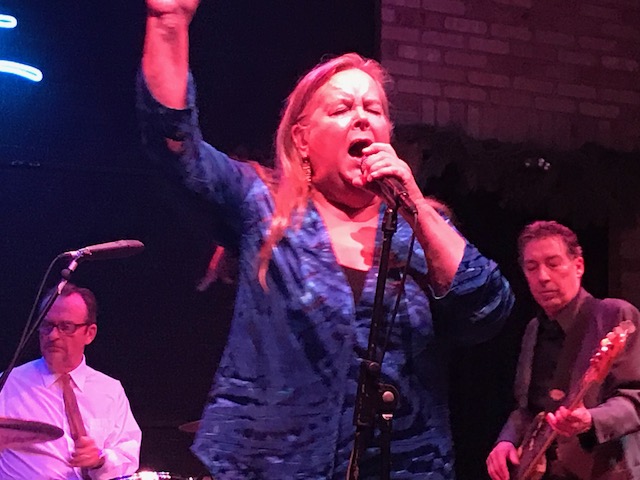 I finally got a chance to see Tracy at the Dakota Jazz Club and Restaurant in downtown Minneapolis in January 2018. I caught Tracy in mid-flight in the photo at right that I snapped from our table.
The show was worth waiting for. Tracy was backed by an excellent three-piece band (the Bel-Airs) that opened for her. The two brothers at the heart of the band reminded me of the Louvin Brothers, but (unlike the Louvins) they seemed to get along.
Tracy has fashioned herself as a blues singer, though she is equally adept in rock, country, soul, rhythm and blues, and gospel. Her voice seemed to me to have remained as powerful and expressive as it ever was. Sitting about six feet from her, I found the effect an emotional experience. She is something like a force of nature
The Dakota gave this brief summary of her background:
Nelson’s education began in the early 1960s when, while growing up in Madison, Wisconsin, she immersed herself in the R&B she heard beamed into her bedroom from Nashville’s WLAC-AM. As an undergrad at the University of Wisconsin, she combined her musical passions singing blues and folk at coffeehouses and R&B at frat parties as one of three singers fronting a band (including keyboardist Ben Sidran) called the Fabulous Imitations. A short time later, Tracy moved to San Francisco and, in the midst of that era’s psychedelic explosion, formed Mother Earth, a group that was named after the fatalistic Memphis Slim song (which she sang at his 1988 funeral). Mother Earth the group, true to its origin more grounded than freaky, was nonetheless a major attraction at the Fillmore, where they shared stages with Janis Joplin, Jimi Hendrix and Eric Burdon.
Nelson continued to record throughout the ’70s as a solo artist on various labels. In 1974, she garnered her first Grammy nomination for “After the Fire Is Gone,” a hit duet with Willie Nelson. She continues to tour and record, making music that is as deeply felt as anything she has recorded in her exceptional career; she is a soul survivor.
Deep Are the Roots has long been out of print, but the whole thing has been uploaded to YouTube. Tracy was a 20-year-old student at the University of Wisconsin Madison when she recorded it on a trip to Chicago. Charlie Musselwhite backed her on harmonica on several of the album’s tracks. Below is Ma Rainey’s “Trust No Man,” the album’s closing number. This is where she came in.
Back in the days of her work with Mother Earth Tracy cut a country album in Nashville with the town’s great session musicians. My favorite cut on the expanded compact disc version of the album and one of my favorite of her recordings, period, is the Hank Williams classic “You Win Again.” It was originally released on the Mother Earth album Make a Joyful Noise (1968).
The Mother Earth album Satisfied (1970) opened with the title track by country gospel artist Martha Carson. We are told that Carson wrote the song in response to her fans’ disapproval of her divorce. We weren’t hearing many songs like this from rock groups in 1970.
One of Tracy’s idols is the New Orleans soul singer Irma Thomas. Together with Marcia Ball, Tracy recorded the Grammy-nominated collection Sing It! (1998) with Irma Thomas as a sort of dream come true. With Mother Earth Tracy took the Irma Thomas ballad “Ruler of My Heart” (written by the great Allen Toussaint) and turned it into what sounds to me like a personal anthem.
The gospel-flavored Bring Me Home (1971) may be the best Mother Earth album. The Eric Kaz number “Temptation Took Control of Me And I Fell” is certainly one of the album’s many highlights. There is a life lesson in there as well.
After she went solo Tracy had a brief moment of national recognition in 1974 with “After the Fire Is Gone,” her duet with Willie Nelson. It appeared on her self-titled album that year. I thought the world might be catching up with her, but the world moved on.
Moving into the current century, Tracy recorded Live From Cell Block D (2003). The video below gives Tracy rescuing the old Bessie Smith song “Send Me to the ‘Lectric Chair” from the archives. Bessie Smith lives! When we saw her at the Dakota, Tracy introduced the song as a study in personal responsibility.
Unlike, say, Taylor Swift, Tracy is not exactly a household name. I was therefore surprised to see Barry Mazor doing in the Wall Street Journal what I was trying to do with Tracy on Power Line. Mazor looked back fondly on Tracy’s long career in his June 2023 review of Tracy’s recording of that year, Life Don’t Miss Nobody. It was her first in 10 years. This is Mazor’s introductory look back:
For a singer who has accumulated so many musical friends, Tracy Nelson stands alone.
There’s the longevity: Her first LP, the folk-blues album “Deep Are the Roots,” was released 58 years ago. There’s the versatility, demonstrated consistently across multiple roots-music styles: As an R&B shouter fronting the San Francisco band Mother Earth in the late ’60s, in the tradition of Etta James, she was seen as serious competition for Janis Joplin, with astonishing tracks like “Down So Low,” her original that became a standard, and her thrilling, melancholy-busting take on Boz Scaggs’s “I’ll Be Long Gone.” She immediately turned around and recorded an album in Nashville of the latest country music of the time, backed by much of Elvis Presley’s band; she would be Grammy nominated for a country duet with Willie Nelson in the mid-’70s. She’d later form a terrific and atypical working R&B trio with Marcia Ball and Irma Thomas, and return to outright blues in the quartet the Blues Broads. There have been jazz and gospel and rock ’n’ roll takes as well.
Through all of those turns, the sheer power of her voice, the way she can reach down to the lower end of contralto and belt, has been most remarked on. But more important, Ms. Nelson has brought an extraordinary level of vocal elegance, emotional depth and control to all of those roots sub-genres, even when the fashion was for over-the-top, showy displays.
Who can resist a group with the name The Blues Broads? In the video below, Tracy performs “Walk Away” live in 2016. It’s an old favorite of hers written by Oliver Sain. She first recorded it for her album Come See About Me (1980). Here is backed by her fellow Broads (Dorothy Morrison, Angela Strehli, and Annie Sampson). Ladies and gentlemen, please give it up for Tracy Nelson.
Life Don’t Miss Nobody was the occasion of Mazor’s Wall Street Journal column and remains Tracy’s most recent album. The world moved on after Tracy’s duet with Willie Nelson in 1974, but Willie returned to join Tracy on Hank Williams’s classic “Honky Tonkin’.” That’s Willie’s long-time Family member Mickey Raphael backing on harmonica.
Marcia Ball and Irma Thomas rejoined Tracy on Chuck Berry’s “Brown Eyed Handsome Man.” Let’s go out on this rousing note.