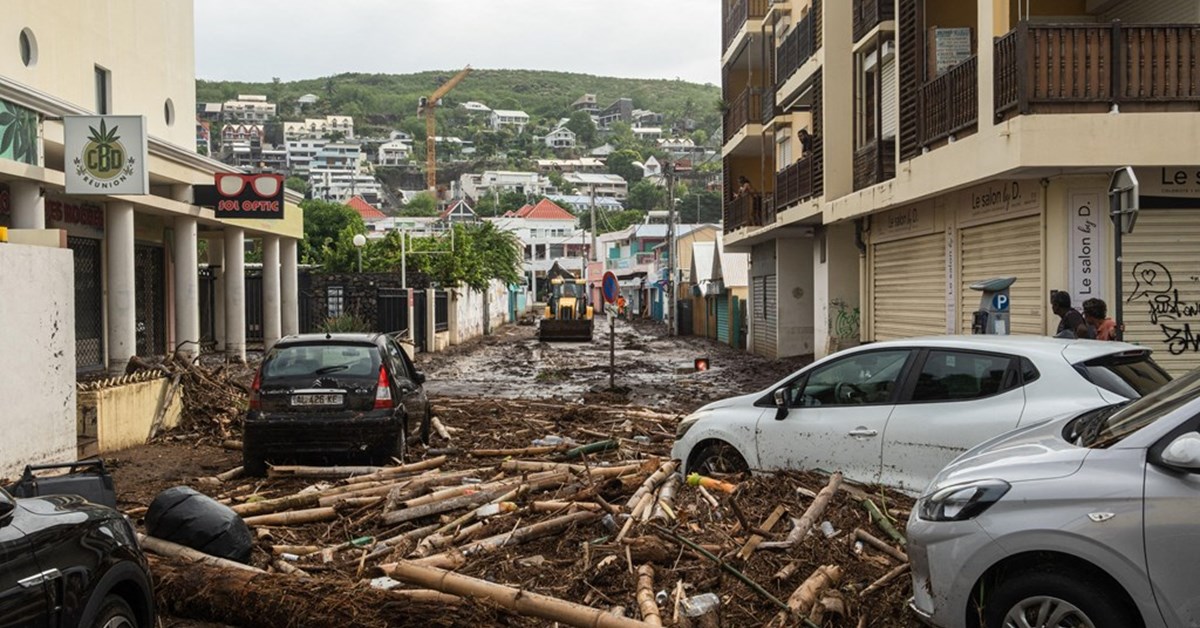
CLIMATE disasters cost the world more than $US120 billion in 2025 and affected the poorest communities first and worst, says a Christian Aid report identifying the ten costliest extreme events influenced by climate change.
Fossil-fuel companies are playing a central part in driving it, the report, Counting the Cost 2025, says. Theese are not “natural” disasters, the report says, but, in the words of Emeritus Professor Joanna Haigh of Imperial College London, “the predictable result of continued fossil-fuel expansion and political delay”.
The wildfires around Los Angeles topped the list (which gives costs in US dollars throughout), with an economic cost of $60 billion and deaths counted at more than 430. Cyclones, extreme monsoon rainfall, and flooding in South and South-East Asia came next, at $25 billion, with more than 1750 fatalities; followed by extreme rainfall and flooding in China, at a cost of $11.7 billion and more than 30 lives.
The death count from Hurricane Melissa, in Jamaica, Cuba, and the Bahamas, is not yet finalised, but the economic cost was $8 billion, the report says. More than 1860 people died in the floods in India and Pakistan, which cost $6 billion; “hundreds” lost their lives in the typhoons in the Philippines, which cost $5 billion; and numbers could not be specified in the drought that hit Brazil and cost $4.7 billion.
Tropical cyclones — Alfred in Australia, and Garance in East Africa — killed one and five respectively, but the economic costs were $1.2 billion and $1.05 billion. Loss of life in the Texan floods was an estimated at more than 135, and the cost was $1 billion.
“These climate disasters are a warning of what lies ahead if we do not accelerate the transition away from fossil fuels,” Christian Aid’s chief executive, Patrick Watt, says. “They also underline the urgent need for adaptation, particularly in the global South, where resources are stretched and people are especially vulnerable to climate shocks.”
The good news, he writes in the foreword, is that the transition to clean energy is gathering pace, renewables remain the cheapest form of new electricity, and the roll-out of solar power continues to exceed expectations. “Despite a political backlash in some settings, public support for climate action remains strong, and the consequences of inaction are becoming ever clearer — in lost lives, destroyed homes and livelihoods, and growing economic losses.”
But the report describes the scale of climate breakdown as “alarming”, and warns: “As we witness cities drying up, uncontrollable fires destroying homes, and tornadoes wiping out entire communities, the consequences of inaction are undeniable. With every year of delayed action, the losses continued to grow.”
The large-scale US wildfires that topped the 2025 list became the most destructive and expensive wildfire event in US history. The report says: “The extreme dryness, heat and high winds which enabled the fires to be so devastating has become at least 35 per cent more likely in today’s climate, compared to a world without human-induced climate change.”
The monsoons in India and Pakistan were exceptionally heavy in 2025. Entire communities were displaced, and the human cost was severe: in Pakistan alone, nearly seven million people were affected by floods, the report says.
An unprecedented series of wildfires in the UK, driven by prolonged dry conditions and record-breaking heat, is also noted.
The report recommends “far more rapid carbon emissions cuts from rich, polluting nations”, calls for the funding gaps faced by lower-income countries to be bridged, and describes as “critically low” the level of commitment to the new fund for responding to loss and damage, which stands at $USS1 billion. It is important, the report says, for governments to invest in effective social protection, “through debt relief, fairer international tax rules, mobilising international climate finance, and development aid”.
The director of the Nairobi-based energy and climate think tank, Power Shift Africa, Mohamed Adow, concludes: “In 2026, governments must stop burying their heads in the sand and start responding with real support for the people on the front lines through scaled up finance for those in need and faster emissions reductions.”