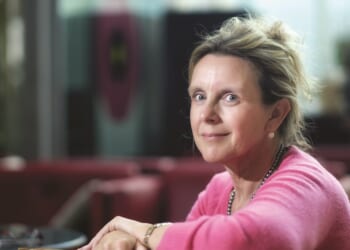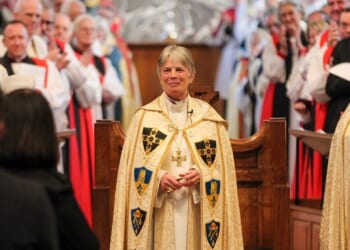
THE Archbishop of Canterbury-elect, the Rt Revd Sarah Mullally, has paid tribute to overworked NHS staff in a New Year message which celebrates the connections between the NHS and Christian faith.
“As a former nurse, good healthcare is incredibly important to me,” she said. “It goes hand in hand with my Christian faith, inspired by Jesus’ call for us to love and care deeply for one another.”
Her message, due to be broadcast on BBC1 at 1.30 p.m. on New Year’s Day, was partly filmed at St Thomas’s hospital, where she first trained as a nurse in the 1980s. The hospital is situated on the same road as Lambeth Palace. Its chapel was “a place of sanctuary for staff and patients, away from the busy wards”, she said, with a multi-faith chaplaincy team on hand “to listen, pray, or simply sit with those going through life’s most difficult and painful moments”.
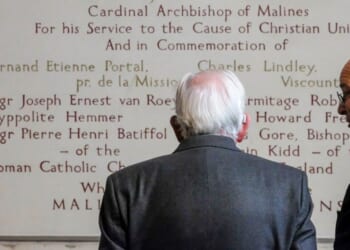
The chapel has a memorial to Florence Nightingale, who established the Nightingale School of Nursing in 1860. She had been “driven by her deep Christian faith and commitment to care”, Bishop Mullally said (Books, 23 April 2010).
“More than 160 years on, I see that same care for patients in the porters, nurses, doctors, healthcare assistants and many others who work in our hospitals. At bedsides and in wards and theatres across our country, they work to bring healing, alongside countless other acts of kindness.”
Bishop Mullally’s message also features footage from a visit to the Evelina London Children’s Hospital, where she paid tribute to staff who specialise in play therapy “softening the anxiety of a hospital stay, and speeding up recovery”.
She said: “While places like this provide excellent care, we know that our hospitals are under increasing pressure, with social and palliative services stretched, long waiting times and severe strain on overworked NHS staff.”
This could be “eased” through community support, she suggested, which could help deal with the root causes of many admissions. “I see this in my own diocese in London, where people are delivering holistic support in different settings.”
She gave the example of St John’s, Hackney, which holds regular lunches, “understanding that for many of us, a place to go where food is provided and there are people to talk to, can be as important as medical intervention for our physical and mental health.
“Here, people from all over the world, from many different backgrounds, experience a warm welcome, a health check-up if they need it — and importantly, the love of Jesus Christ, who showed us how to wash the feet of others.”
Throughout her ordained life, Bishop Mullally has drawn parallels between her vocation as a nurse, and her priestly ministry. In her first address after being nominated as the next Archbishop of Canterbury, she said that “washing feet has shaped my Christian vocation: as a nurse, then a priest, then a bishop.”
In her message for 2026, she spoke of striving “to carry the care and compassion that shaped my vocation as a nurse into everything that I do. As I look to the New Year, and my new role as Archbishop of Canterbury, I do so in this same spirit of service, promising to uphold and support those in need, from all walks of life.
“The role of the church should be a healing presence in our nation, bringing people together at times of often intense division, caring deeply for those who need our help. Happy New Year.”
The former Chief Nursing Officer’s message was delivered during challenging times for the NHS, with public satisfaction with the service at a record low.
The Prime Minister described a strike by junior doctors last month as ”dangerous and utterly irresponsible”, while the Times reported this week that the Royal College of Emergency Medicine had estimated that there were more than 16,600 patient deaths linked to long waits in A & E for a hospital bed in 2025 — roughly 320 deaths per week.
A review carried out by Lord Darzi in 2024 for the new Labour government warned that the NHS was in “serious trouble”, having been “starved of capital”, with people struggling to see a GP, and long waits for mental health services “normalised”.
Echoing Bishop Mullally’s analysis, Lord Darzi warned: “too many people end up in hospital, because too little is spent in the community.”