When the Socialist Federal Republic of Yugoslavia dissolved in January 1990, it was broken up into five successor states: Bosnia and Herzegovina, Croatia, Macedonia, Slovenia and the Federal Republic of Yugoslavia (later Serbia and Montenegro). However, Croatia emerged victorious in the battle for the Adriatic Sea coastline, claiming just over 1,100 miles and effectively blocking many other nations from accessing the sea.
Slovenia gained a short but significant coastline, just 29 miles long and wedged between Italy and Croatia, now often referred to as the “Slovene Riviera”. But another nation managed to claim an even smaller stretch, one spanning just 12 miles. Bosnia and Herzegovina was given a 12-mile section of sea access, surrounding the city of Neum. However, in doing so, this tiny town became a big problem for its neighbour, Croatia.
The Neum corridor effectively cut Croatia in half, with Dubrovnik on one side and Split on the other. This arrangement became more of an issue as the country’s tourism industry boomed, as those wanting to visit the iconic walled city made famous by HBO’s Game of Thrones by land were forced to cross two international borders within just 5.6 miles.
In the late 1990s, Bosnia and Herzegovina and Croatia signed the Neum Agreement, granting Croatia passage through Neum. However, the agreement was never ratified.
At this point, this wasn’t really an issue. For many years, security was lax, with tour buses able to pass through Neum without stopping. However, in 2013, Croatia joined the European Union, bringing with it tighter border security and, consequently, longer traffic jams during the summer. It then joined the Schengen Area in 2023, meaning checks would become even more stringent and time-consuming due to necessary checks on both ends, not just upon exiting.
Under these rules, someone travelling from Dubrovnik to mainland Croatia through Neum would undergo three distinct border checks: a Croatian (Schengen) exit check, a Bosnian-Herzegovinian entry check and then a Croatian (Schengen) entry check.
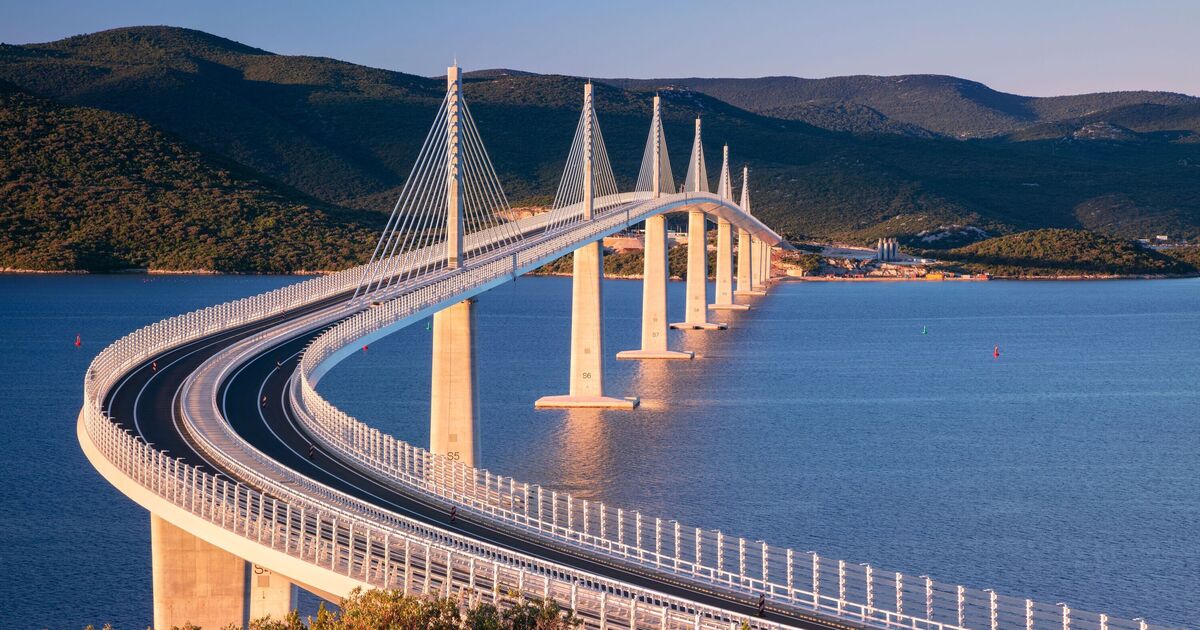
This change proved too much for Croatia to bear. As a result, the nation decided to build a nearly 7,900-foot bridge stretching from Komarna on the northern mainland across to the southeastern semi-exclave of the Peljesac peninsula. This project bypasses Neum entirely, meaning those who use it avoid any international border crossings.
Construction of the Pelješac Bridge began in 2007, but stalled due to the global financial crisis. For a long time, only a few concrete footings were in place. Then, in June 2017, the European Commission pledged €357 million (£297 million) to build the bridge and its supporting infrastructure. This would amount to 85% of the total construction costs, bringing benefits such as increased tourism and trade, among others.
In January 2018, the China Road and Bridge Corporation (CRBC), which had offered €278 million (approximately £232 million) for the bridge construction tender, won the bid. Construction restarted a few months later, with the bridge connected almost exactly three years later. Pelješac Bridge and its access roads opened for traffic another year later, on July 26, 2022.
The Ston bypass road then opened in April 2023, allowing buses, heavy trucks and those carrying hazardous loads to use the bridge.
The original 2007 design had a main span of 1,864 feet, but this design was modified, and the bridge was constructed as a multi-span cable-stayed bridge with a total length of 7,887 feet. It consists of 13 spans, of which seven are cable-stayed, five central 285-metre spans and two outer 668-foot spans.
By July 2025, over seven million vehicles had crossed since its opening, with significant usage during the peak tourist months. In its first year, it saw over 2.3 million vehicles by July 2023, with August alone recording nearly 467,000 crossings.