(Complicit Clergy) — In December, we reported that Bishop Ronald Hicks’ diocesan chancellor, Robert Salvato, was “married” to another man. Salvato was appointed chancellor by Hicks in 2021. As chancellor, Salvato was responsible for advising Hicks on issues related to canon law and recording ecclesiastical acts, decrees, and dispensations issued by the bishop.
As if the diocesan chancellor getting “married” to his boyfriend was not enough of a scandal, we now have reports that Father Richard Smith, the vicar general for the diocese of Joliet, attended the “ceremony.”
READ: The heresy of Modernism continues to grow. None of our Church leaders seem to care
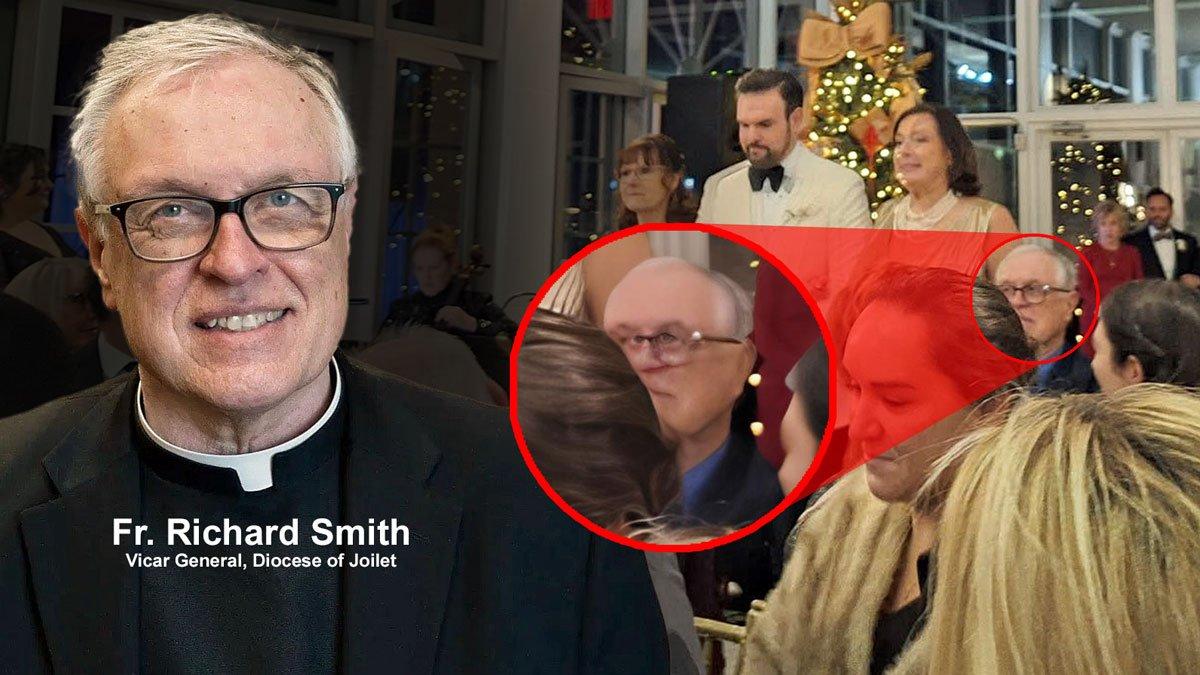
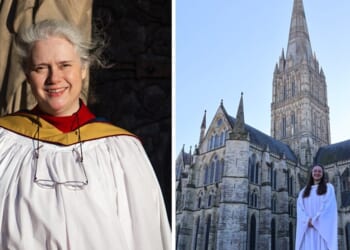
An eyewitness has told us that Smith was definitely in attendance. Additionally, two other sources positively identified Smith as the man featured in the above photo from the “wedding” (additional photos of the event available here). We contacted Fr. Smith on December 28, 2025, asking him to comment on these allegations but have not received a response.
This is an especially explosive allegation because, as vicar general, Smith is basically Hicks’ right-hand man in the diocese. Bishop Ronald Hicks appointed Fr. Richard Smith as vicar general of the diocese of Joliet on December 1, 2020. Hicks is scheduled to be installed as the new archbishop of New York in February.
What is a vicar general?
In the Catholic Church, a vicar general is the principal deputy of the diocesan bishop (or archbishop) and serves as the highest-ranking official in a diocese after the bishop himself. The role is mandatory in every diocese according to the 1983 Code of Canon Law (Canons 475–481), which describes it as the most important office in the diocesan curia.
A diocesan bishop freely appoints (and can freely remove) the vicar general. He must be a priest at least 30 years old, of sound doctrine, integrity, prudence, and expertise in canon law and theology (Canon 478 §1). Typically, there is one vicar general, though larger dioceses may appoint more if pastoral needs require it (Canon 475 §2).
The vicar general possesses ordinary executive power over the entire diocese, equivalent to the bishop’s own executive authority (Canon 479 §1). This means he can perform virtually all administrative acts in the bishop’s name. Responsibilities typically include:
- Assisting the bishop in the overall administration and pastoral care of the diocese.
- Overseeing the diocesan curia (the chancery offices and staff).
- Handling routine canonical and administrative matters, such as issuing decrees, managing clergy assignments, responding to requests from priests, and overseeing aspects like permanent deacons or religious life (depending on the diocese).
- Representing the bishop or diocese in various internal and external contexts, acting in the bishop’s absence, and serving as a mediator between the bishop, clergy, religious, and laity.
- Advising the bishop on a wide range of issues and reporting on important matters (both pending and completed); he must always act in harmony with the bishop’s mind and will and never contrary to it (Canon 480).
- Serving ex officio on key bodies such as the presbyteral council, council of consultors, and diocesan finance council in many dioceses.
- Managing day-to-day operations so the bishop can focus more on pastoral presence among the people, sacramental ministry, and teaching.
Who is Fr. Richard Smith?
Born in 1951, Smith was raised in the Chicago area. He entered seminary at age 15 as one of the first seminarians under Bishop Martin McNamara, the diocese’s founding bishop in 1948. Ordained in 1976 by Bishop Romeo Blanchette, Smith has served the Diocese of Joliet under all six of its bishops.
His career includes assignments as an associate pastor, pastor at parishes such as St. Elizabeth Seton in Naperville (appointed 2010), St. Anthony in Frankfort, and Holy Spirit Catholic Community in Naperville (where he currently serves as parochial vicar). He spent 12 years working full-time in the diocesan Marriage Tribunal under Bishop Joseph Imesch, handling annulment cases.
In 2018, Bishop R. Daniel Conlon appointed him interim vicar general following Bishop Joseph Siegel’s departure. In 2020, Bishop Ronald Hicks appointed Smith as full-time vicar general while allowing him to remain at Holy Spirit.
READ: Pope Leo responds to Maduro’s capture, urges peace, respect for Venezuela’s sovereignty
What should happen now?
U.S. bishops must recognize that the actions of their staff can cause grave public scandal and that the appropriate disciplinary actions must be taken in situations that publicly contradict Catholic teaching.
Bishop Hicks needs to confront Fr. Smith and confirm his attendance at the Salvato/Aguilar “wedding.” If Smith attended, Hicks must immediately remove him as vicar general. Hicks should also determine whether there were any other diocesan employees in attendance at the “wedding.” If so, these people’s employment should also be terminated. Finally, Hicks needs to come clean and publicly address this public scandal. A recent poll showed that 92 percent of Catholics agree.
Give recent developments, we believe Pope Leo should re-evaluate if Hicks is qualified to lead the archdiocese of New York. Why did Hicks’ chancellor “marry” another man? Why did Hicks’ vicar general attend the “wedding”? Who else in the chancery is in league with this degree of sexual corruption? Does Hicks know the whereabouts of his diocesan priest who is avoiding arrest for sexual abuse? We believe these stories represent a massive red flag for Hicks as a leader.
TAKE ACTION: Contact Bishop Hicks at [email protected] or call 815.221.6100. Ask him to come clean and answer questions about the Salvato scandal. Below is a list of questions that we believe Hicks should publicly address.
Questions for Bishop Hicks:
- When did Hicks learn that Salvato was an active homosexual? Did he know (or even suspect this fact) when Salvato was initially hired in 2021? If so, why did Hicks proceed in hiring Salvato?
- Is Hicks concerned about the eternal salvation of Salvato’s soul? What spiritual counseling (if any) did Hicks offer to try to have Salvato turn away from his mortal sin?
- Has Salvato’s employment been formally terminated by the Diocese of Joliet?
- Did Salvato voluntarily leave his position as chancellor or did Hicks ask him to resign?
- Did Salvato have a “wedding” ceremony in a Catholic Church?
- Did a Catholic priest participate in any way, including “blessing” the couple?
- Did Hicks have prior knowledge that Fr. Smith was planning to attend the “wedding?”
- Did any other diocesan employees attention the event?
- Has Salvato been barred from receiving Holy Communion in the diocese?
- How many other active homosexuals are now employed by the diocese (including diocesan schools) and what is Hicks’ strategy for dealing with these individuals?
Reprinted with permission from Complicit Clergy.