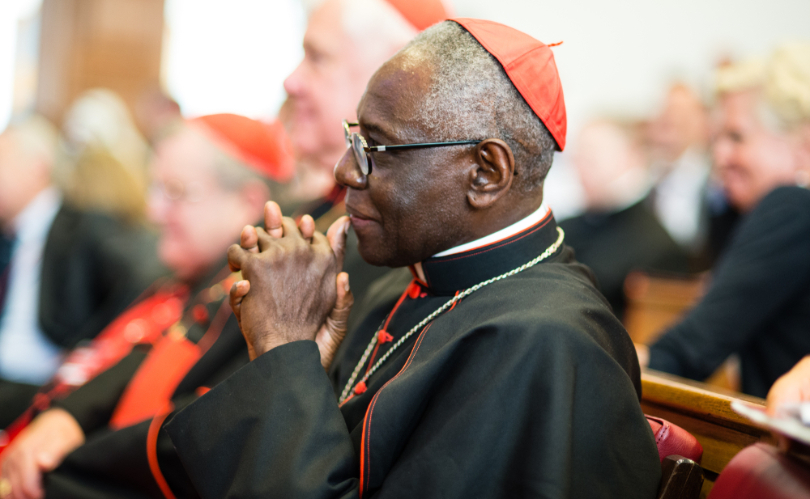
(LifeSiteNews) — Cardinal Robert Sarah has said that the liturgy “has become politicized,” slamming the use of profane music and liturgical abuse during Holy Mass.
Cardinal Sarah made the remarks during two talks delivered at Princeton University in November last year. Catholic journalist Edward Pentin recently published a report on the talks in the National Catholic Register. The African cardinal’s U.S. visit last year centered on the publication of his new book, “The Song of the Lamb: Sacred Music and Heavenly Liturgy,” co-authored with Church musician Peter Carter, who serves as director of sacred music for the Aquinas Institute at Princeton University.
Cardinal Sarah said that the Church’s liturgy has “too often been instrumentalized” and “has become politicized” over the past decades. He said it was “wrong” of Church leaders to have “persecuted and excluded” critics who highlighted liturgical abuses.
The former prefect of the Congregation for Divine Worship and the Discipline of the Sacraments recalled Pope Benedict XVI’s harmonization of the Novus Ordo Missae and the Traditional Latin Mass and his emphasis that “what earlier generations held as sacred remains sacred and great for us too.”
The cardinal said liturgical abuse attacks the twofold nature and purpose of liturgy, namely to “render to Almighty God the worship that is his due” and to recognize that the liturgy “is not about what we do,” but instead about what God “does for us and in us.”
The liturgy “is not something that you or I can make up or change, even if we think we are experts or even are bishops,” he stated. “No. We must be humble before the sacred liturgy, as it has been handed on to us in the Church’s Tradition.”
He stressed the importance of sacred music in the liturgy, noting it was “even scandalous at times” to sing or play music in churches that is not of liturgical or sacred nature.
Quoting Pope Benedict, he said: “As far as the liturgy is concerned, we cannot say that one song is as good as another.”
He recalled learning from his parents and French missionaries who came to evangelize his village that not every type of music belongs in every setting and that liturgical music is set apart for the worship of God. He also knows that, as an African, music used in the Holy Mass need not be “exactly the same as the music of my own culture,” nor necessarily in one’s own language. He sang the traditional chants and learned their meaning “because of the wider Catholic tradition into which they immersed us.”
The cardinal from Guinea explained that sacred music “has an objectivity to it,” which is rooted in the liturgical tradition of the Church.
“That is to say, what is sung in the liturgy can truly be said to be ‘The Song of the Lamb,’ praising and giving glory to Almighty God and supplicating him for the needs of his people,” Cardinal Sarah stated.
“I think that if the music we sing in the sacred liturgy conforms to this criterion, we can truly call it ‘sacred’ and, in conformity with the relevant stipulations of the liturgical books, with Gregorian chant always having pride of place.”
Sacred music, the cardinal said, “is not a ‘nice’ addition to the liturgy; it is an essential component of it.”
“We are created to sing the praises of Almighty God for all eternity,” Cardinal Sarah said. “In doing so as well and as beautifully as we possibly can in the sacred liturgy in this life, we prepare ourselves and others for eternity — indeed, by doing so we are able all the more faithfully to live our supernatural vocation in the daily circumstances of our particular vocation here and now.”