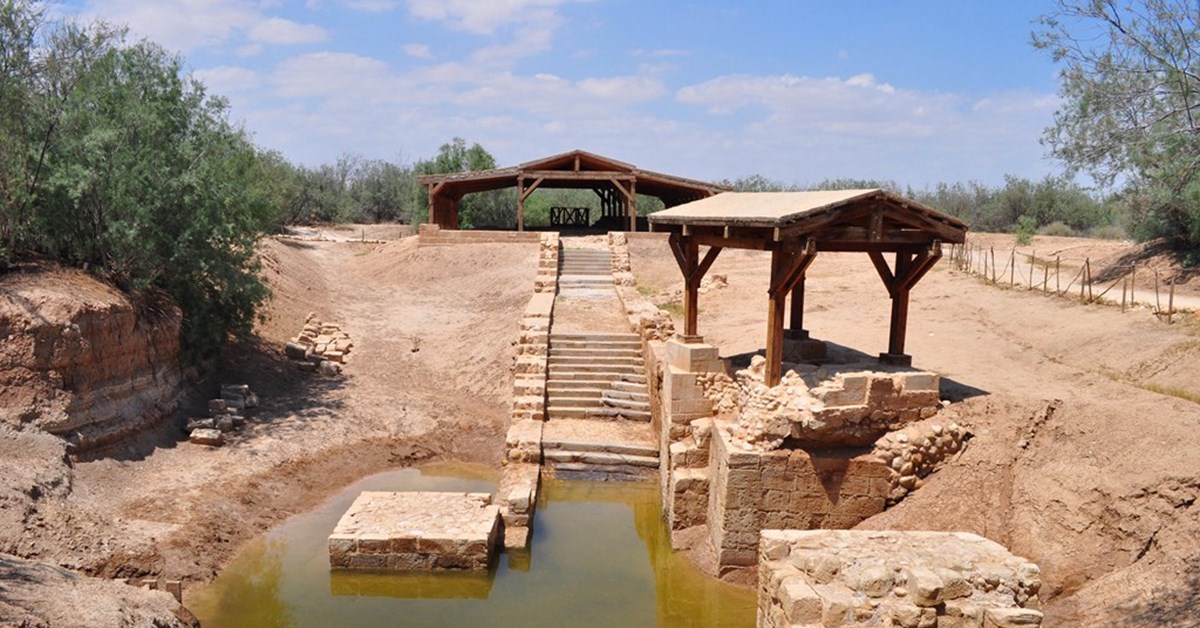
I COULD read it on their faces: utter incredulity and bewilderment. I had not expected this when, as CME director, I led a group of 30 curates to the east bank of the River Jordan. The theme of their pilgrimage was “Developing Leadership”, and I was hoping to inspire them by the account in Joshua 3 of the priests courageously standing in dangerous waters, ahead of the people, as they bore the Ark of the Covenant across the treacherous currents. I thought it was a powerful image of priests standing in the place of risk. But the curates were unimpressed, as they looked down at the muddy trickle of the Jordan. Treacherous waters?
Today, the waters of the lower Jordan are murky and sluggish. It’s a long way from the cry of the psalmist, “Deep calls to deep at the thunder of your cataracts; all your waves and your billows have gone over me” (Psalm 42). Since 1948, both Israel and the state of Jordan have diverted a staggering 96 per cent of the Jordan’s water after its outflow from the Sea of Galilee — for irrigation purposes. This has reduced a once mighty, fast-flowing river coursing down the rift valley to little more than a grimy stream.
In addition, pollution has become a significant problem, as effluents seep into the river system, while pilgrims to the baptismal site see the uninviting sign “Danger! Mines!” Today, the dangerously contaminated river has become too polluted for baptisms, and, in 2010, pilgrims were advised not to enter the water at all. Once-sacred waters have become desecrated.
IF EVER we needed a catalyst or impetus to do something about the pollution of our rivers, at home or abroad, we might look again at the baptism of Christ as celebrated in the Orthodox Church.
In the Orthodox tradition, one emphasis — rarely considered in the West — is paramount: in the coming of Jesus to the Jordan, we see the entry of the divine Creator Word made flesh (John 1.18) into the very midst of creation, as the deep and powerful currents of the Jordan swirl around him.
The early church Fathers noted its significance. Cyril of Alexandria (376-444), in his commentary on Matthew 3, declares: “Christ was not baptised as one repenting but as one sanctifying the waters” (Fragment 29, Stromateis). Maximus of Turin (380-420), in his sermon for the Feast of the Epiphany, puts it: “Christ is baptised, not to be made holy by the water, but to make the water holy, and by his cleansing to purify the waters which he touched. The consecration of Christ involves consecration of the water. When the Saviour is washed, all water is made clean, purified at its source for the dispensing of baptismal grace to the people of future ages.”
CHRIST, by his baptism, sanctifies this water and makes it the means, not only of our healing by partaking of it, but of the renewal of the creation. With the sanctification of water, all creation becomes good, pure again; it becomes what it first was, potentially returning to its first beauty. The Orthodox celebration of the baptism of Christ in the Feast of the Theophany is no mere recalling of a historical event, but rather a celebration of present possibilities.
The celebration reaches its climax with the ceremony of the blessing of the waters, taking place at a local river or around a font or bowl of water placed in the centre of the church building. Surrounded by candles and flowers, this water stands for the beautiful world of God’s original creation and ultimate glorification by Christ in the Kingdom of God, and this hymn is sung:
Let us the faithful praise the greatness of God’s plan for us.
For He Who alone is pure and undefiled
becomes human because of our transgressions . . .
in the Jordan, sanctifying both us and the waters,
crushing the heads of the dragons in the water.
Therefore, let us draw water in gladness,
for upon those who draw in faith
the grace of the Spirit is invisibly bestowed by Christ God,
the Saviour of our souls.
As the priest casts a wooden cross upon the waters, this great hymn by Sophronios, Patriarch of Jerusalem, is sung:
Today the nature of the waters is sanctified:
The Jordan is parted in two.
It holds back the flow of its waters,
as it beholds the washing of the Master.
Today You appear to the universe,
Your Light, O Lord, shines upon us:
You come to reveal Yourself, Light Unapproachable!
This celebration uniquely draws us to a key meaning hidden in the event of the baptism of Christ in the Jordan. The entry of the Word into the centre of creation reconsecrates creation, and declares the natural world sacred, to be treated with reverence, because it is infused with the divine — indeed, it is God-bearing, God-revealing, an epiphany, theophany, making of the earth a veritable sacrament. It invites all the baptised to work in a synergy with the divine as participants in the new creation — themselves, like the earth, Christ-bearers and God-bearers.
AT THE UN COP27 in November 2022, the Israeli and Jordanian governments signed a declaration of intent to partner in the ecological restoration and sustainable development of the River Jordan. There is a glimmer of hope for the environmental renewal of the Jordan.
Meanwhile, as we celebrate the baptism of Christ, let us reverence the physicality of the Jordan and of all rivers, campaigning and working for their restoration, by word and deed, to play our part in the groundswell of action to restore our wounded planet. And let us delight in the spirituality of rivers, a primal sign of God’s providence and renewal.
“For with You is the fountain of life; in your light we see light” (Psalm 26.9).
The Revd Dr Andrew D. Mayes was formerly course director of St George’s College, Jerusalem, and spirituality adviser to the diocese of Cyprus & the Gulf.
This is an edited expanded extract from Unlocking the Fountains: Inspiration and challenge from biblical rivers and springs, published by Wipf & Stock at £18 (Church Times Bookshop £16.20); 979-8-3852-6222-9.