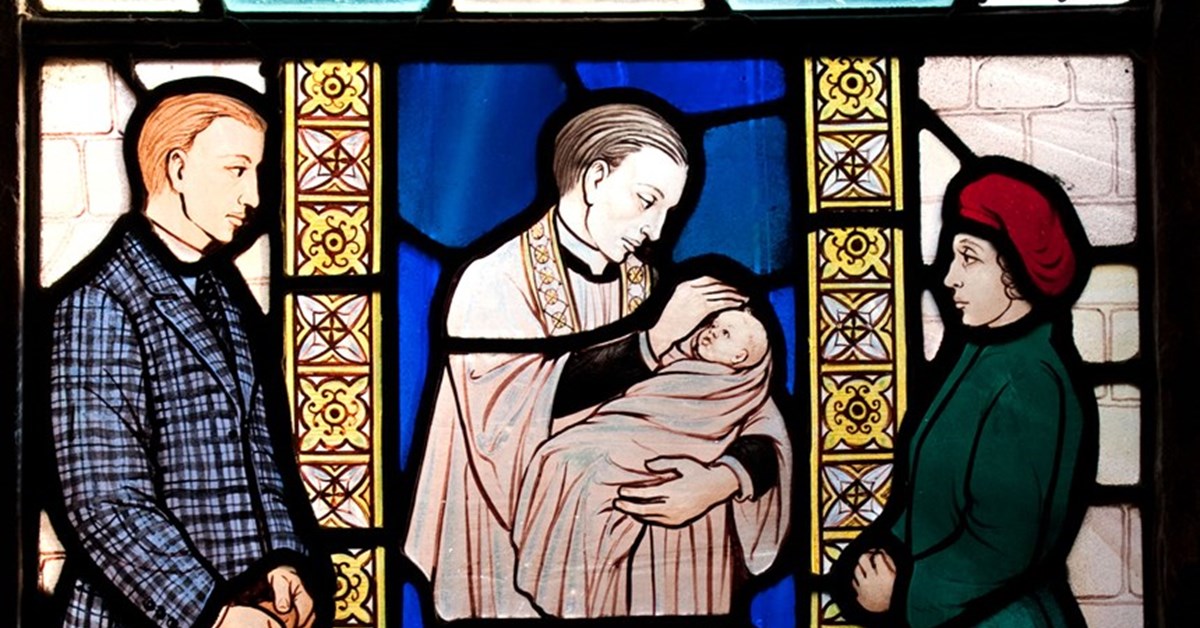
“PERHAPS baptism really ought to have some health warnings attached to it: ‘If you take this step, if you go into these depths, it will be transfiguring, exhilarating, life-giving and very, very dangerous’,” Rowan Williams has written (in Being Christian: Baptism, Bible, eucharist, prayer, SPCK, 2014).
I agree with the former archbishop: baptism should, of course, be a transformative experience that sets the individual on a lifelong journey of faith, undertaken in the company of fellow travellers, with Jesus as companion, guide, and destination. I hope that this is the experience for most church leaders.
I have to fight the temptation to feel quite downhearted as I wave goodbye to yet another baby, surrounded by loving family and friends as they set off for the local pub. I hope to see the group in church next Sunday, but realistically expect to meet them next at a wedding or, more probably, a funeral.
But, as with funerals, a baptism is not about me: it is about God and the candidate and what happens between them. It is not an opportunity for witness, nor is it the reward given to a convert for a profession of faith. What it is is a gift direct from God to us — free from conditions, free from obligations — which sows the first divine seed into a soul, there to take root and grow, or lie dormant for years, perhaps for ever.
I faced this reality gap early on in my ministry, as I stood at the front of the church, speaking the words to congregations who took photos, ate sweets, chatted to one another, and looked at their watches, while I strove to communicate the significance of the event. This feeling has recurred often during subsequent baptisms: that sensation of wading through spiritual porridge, each step an effort as I try to share the sheer magnificent mystery of it all, but to no avail.
RECOVERING afterwards, I take comfort in what for me is the blueprint for the “best type of baptism”: Acts 8.26-40. In this story, we meet Philip, a disciple of Jesus, but not a “big hitter” disciple: when you are trying to remember all twelve, Philip might be one of the ones you forget. And yet, he’s there, chosen by Jesus: inviting Nathanael to meet the Lord (“Come and see”, John 1.46); spreading the gospel after Jesus’s death; travelling miles of road in order to do so — because people aren’t going to come to us. In fact, if they reach the church, we’ve pretty much sorted it. We have to go out there and be among the rest of the world. We cannot shut ourselves away in our cosy church context, wondering why we are being passed by.
Philip asks the grand Ethiopian a question: “Do you understand what you are reading?” Sterling stuff! He meets the man during the course of his daily life, and shows an interest in him. He asks the Ethiopian to tell him his story. That is the part that we have to play: to listen to people’s stories, find out where they are on their faith journey, and start from their experience, not ours.
PHILIP has clearly managed to communicate the good news to his companion, who enthusiastically enquires: “What prevents me from being baptised?” Evidently, Philip agrees that there is no time like the present. The pair “go down into the water”.
Nowadays, things are not as straightforward. The family may be deterred by the cost of the (apparently obligatory) party, which can be almost as grand as a wedding; or by an insistence on “baptism preparation”, which in some places amounts almost to an inquisition, and in others requires attendance at long courses.
Of course, those who are involved in a baptism — whether parents, godparents, or the candidates themselves — should understand the importance of the sacrament; but we should also consider how many barriers we put in place, bearing in mind the warning words of Jesus concerning those who cause “little ones” to “stumble”. We should also be mindful of the type of behaviour which we enforce in church: do we have the right to “forbid” the use of phones to a generation that moderates experience through them?
I am aware of the wonderful lengths to which the clergy go to make their services accessible, from plastic ducks in the font to tailor-made sermons involving Bluey, Paddington Bear, or Batman. Possibly not everyone will agree with the implicit theology, but surely the family must feel welcomed by these valiant efforts.
IMMEDIATELY after Philip has baptised the Ethiopian, he is “carried away” by the Spirit. There is a definite end to his task, and we hear no more of the Ethiopian’s spiritual journey. Perhaps here lies permission not to beat ourselves up for the small percentage of baptised babies and their families who subsequently attend church. Perhaps we are once again trying to take control of a situation that is not in our power. Perhaps we should be content to “let go and let God” — ensuring that a warm welcome awaits everyone who enters the church door, but not beating ourselves up if there appears to be no obvious “follow-through”.
“Then Mummy said Jeremy James was too young to understand but he could look forward to the party afterwards, and Jeremy James decided that if there was going to be a party afterwards maybe christenings were a good thing after all and Jesus knew what he was doing”— Never Say Moo to a Bull by David Henry Wilson (Pan Macmillan, 1984).
The Revd Dr Sally Welch is Vicar of the Kington Group, in the diocese of Hereford.
- It really helps to have a solid baptism policy in place, agreed with the PCC, and few exceptions permitted. Decide whether you will have baptisms only in the main Sunday service, or whether you are OK with stand-alone baptisms. If the latter, decide on the timing: about an hour after the main service is good, as there is a chance that regular and baptism congregations will meet and mingle at coffee, or at least greet each other in passing.
- Baptism preparation, if you have lots of families, can be a really productive time, introducing people to one another and perhaps forming the basis of some new children’s work. If baptisms are rare, however, then an informal conversation is probably the most that you can expect.
- Decide how you feel about the whole thing being photographed and/or filmed, bearing in mind that today this is how many people moderate their experiences.
- Don’t forget that if the family is out-of-parish, it is only polite to contact their local minister to let them know what’s happening.
Church Support Hub has some good ideas for baptism talks and friendly prayers churchsupporthub.org
The Methodist Church Well Creative website is also good: methodistchildrencreativeministry.org