RELIGION rather than secular society is often blamed for using violence to achieve its aims. Professor Howard in Broken Altars: Secularist violence in modern history, in contrast, demonstrates convincingly how violence has been used more often by secular regimes against religion. He seeks in this book to “bring needed nuance and perspective to a complex, often fraught topic”.
He sets out three definitions of secularism: passive secularism, combative secularism, and eliminationist secularism, and focuses in his book on the latter two, describing as passive secularism what we in the West would consider to be characteristic of a tolerant political regime with liberal principles — church-state separation, freedom of conscience, and freedom of the press — all vital ingredients of a democratic system.
He presents, as examples of combative secularism, three case studies of early 20th-century modernisation: Mexico, Spain, and Turkey. But for the writings of Graham Greene, few of us would be aware of the brutal assault on the Roman Catholic Church in Mexico during the 1920s and 1930s; so it is sobering to be reminded of that era. The complexities of the Spanish Civil War are the subject of his next example, while that of Turkey is enlightening for those of us who want to understand today’s Erdogan regime.
Professor Howard’s main focus is on examples that illustrate his category of eliminationist secular regimes, all headed by Communist parties adhering to the tenets of Marxism-Leninism: namely, the USSR, three countries in Eastern Europe (Romania, Czechoslovakia, and Albania) and what he terms Red Asia (Mongolia, China, Tibet, and Cambodia). It is striking how all these Communist regimes used similar methods in their assault on religion: removal of property rights, control of education, anti-religious propaganda, control of the press, desecration of holy sites, imprisonment, exile, torture, and murder.
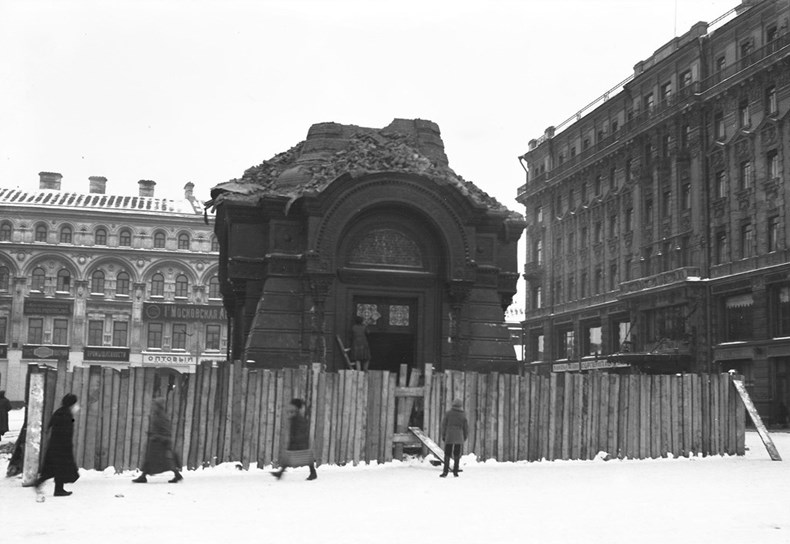 AlamyA chapel is destroyed in Moscow as part of the anti-church policy being enforced in Russia in 1922 (Associated Press, 14 November 1922)
His section on the USSR is thorough, covering Orthodoxy, Catholicism, Judaism, Islam, and Buddhism, though it would have been nice to have more information on the Protestant denominations, and not just a passing mention of the involvement of religious believers in the Soviet dissident movement, which was of great significance from the 1960s onwards. Especially valuable is his chapter on Red Asia, about which we know so little. How many of us have heard about “the virtual annihilation of an entire religious tradition in a matter of months” (p.185) in Mongolia, when Buddhist monasteries and lamas were violently destroyed in the late 1930s? And what of the trauma of the Cultural Revolution for Tibet’s Buddhists, who describe it as a time when “the sky fell on the earth”?
The author ends by qualifying his claim that violence is linked more to secular regimes than to religious organisations. Quoting the American theologian David Bentley Hart, he writes, “religion has been neither simply good nor simply evil but has merely reflected human nature in all its dimensions,” and adds: “something similar applies to secularism and the various uses to which it has been put by modern regimes.”
Xenia Dennen is a Russian specialist, and chairman of Keston Institute, Oxford.
Broken Altars: Secularist violence in modern history
Thomas Albert Howard
Yale £25
(978-0-300-26361-9)
Church Times Bookshop £22.50