THE Pope has voiced alarm at the apparent failure of the international system to cope with current world conflicts, as powerful countries increasingly use military force to achieve diplomatic goals.
“A diplomacy that promotes dialogue and seeks consensus among all parties is being replaced by a diplomacy based on force: war is back in vogue, and a zeal for war is spreading,” the Pope said on Friday morning.
“The principle established after the Second World War, which prohibited nations from using force to violate the borders of others, has been completely undermined. . . Peace is sought through weapons as a condition for asserting one’s own dominion.”
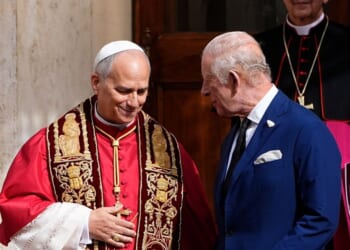
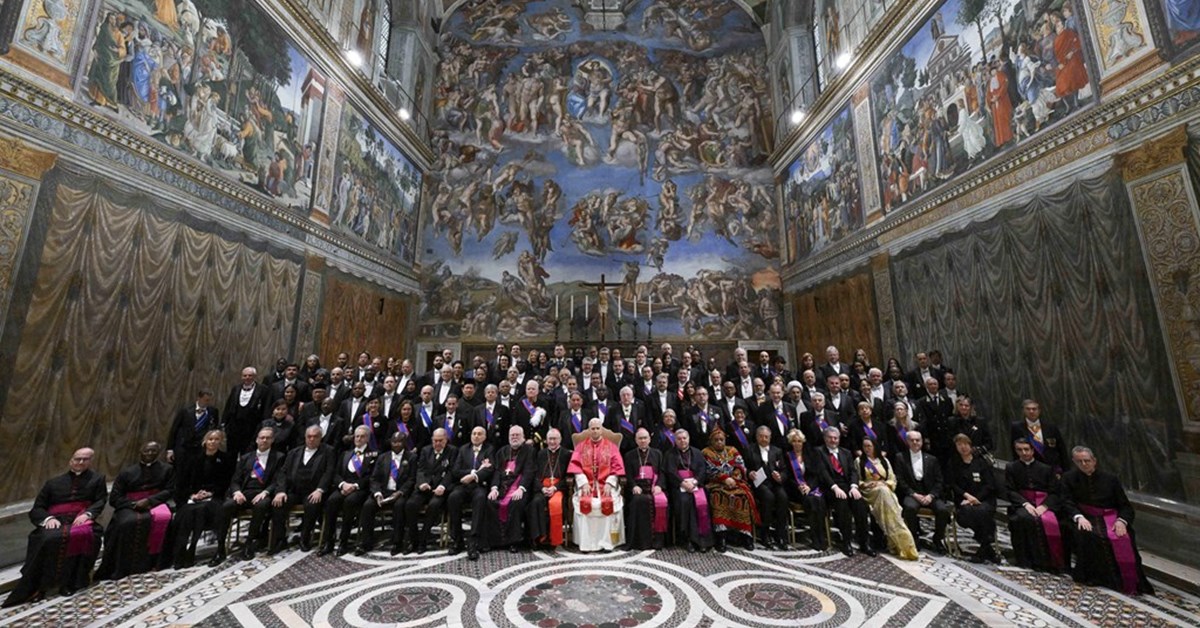
The Pope issued the warning in a New Year address to ambassadors from countries and organisations with diplomatic ties with the Holy See.
He said that the search for “just and peaceful coexistence” had been analysed centuries ago by St Augustine of Hippo, who had warned in his City of God that aggressive powers “have no hatred of peace, but only wish it changed into a peace that suits them better”.
Pride obscured reality, and always lay “at the root of every conflict”, the Pope said, by “paving the way for the mentality of confrontation, which is the precursor to every war. . . Augustine also warns of the grave dangers to political life arising from false representations of history, excessive nationalism, and the distortion of the ideal of the political leader.
“We are now, as then, in an era of widespread migratory movements — of a profound readjustment of geopolitical balances and cultural paradigms. . . It seems that only the earthly city exists, enclosed exclusively within its borders.”
The address was delivered in the Hall of Benediction at the Vatican, against the backdrop of US intervention in Venezuela and threats to annex Greenland, spreading anti-government riots in Iran, and further Russian missile strikes on Ukraine.
The Pope appealed again for the will and rights of Venezuelans to be respected, to ensure a future of “stability and concord”, and for an “immediate ceasefire” in Ukraine to end “suffering inflicted on the civilian population”.
He also reiterated Vatican support for a “two-state solution” in the Holy Land, where Palestinian civilians still faced a “serious humanitarian crisis”, and deplored tensions and violence in Haiti, Central Africa, Sudan, Myanmar, and East Asia.
Compliance with humanitarian law was an inter-state commitment, the Pope said, and could not depend on “mere circumstances and military or strategic interests”.
The Holy See viewed the destruction of hospitals, energy infrastructure, and homes as a “serious violation of international humanitarian law”, which could best be countered by ensuring that the UN became “more focused and efficient”, and reflected “the situation of today’s world rather than that of the post-war period”.
He was concerned, he said, about current “contortions of semantic ambiguity”, as language was employed as “a weapon with which to deceive, or to strike and offend opponents”.
“We need words once again to express distinct and clear realities unequivocally — only in this way can authentic dialogue resume,” the Pope told diplomats.
“This should happen in our homes and public spaces, in politics, in the media, and on social media. It should likewise occur in the context of international relations and multilateralism . . . for preventing conflicts and ensuring that no one is tempted to prevail over others with the mindset of force.”
The meeting follows a two-day “extraordinary consistory” this week, during which the Pope debated mission and synodality with 170 visiting cardinals, in line with requests for greater consultation at his election last May.
In a significant innovation, the Vatican has confirmed that similar discussion consistories, lasting three to four days, will now be held annually. The next is scheduled for late June.
In his address, the Pope said that data suggested that serious and growing violations of religious freedom now affected 64 per cent of the world’s population, and that 380 million Christians, or one in seven globally, were suffering “high or extreme levels of discrimination, violence, and oppression because of their faith”.
He said that religious freedom was now widely considered “more a privilege or concession than a fundamental human right”, and that “subtle forms” of discrimination were spreading in Western countries, where Christians were “restricted in their ability to proclaim the truths of the gospel for political or ideological reasons, especially when they defend the dignity of the weakest, the unborn, refugees and migrants, or promote the family.
“At this moment in history, freedom of conscience seems increasingly to be questioned by states, even those that claim to be based on democracy and human rights,
“It is painful to see how, especially in the West, the space for genuine freedom of expression is rapidly shrinking. At the same time, a new Orwellian-style language is developing which, in an attempt to be increasingly inclusive, ends up excluding those who do not conform to the ideologies that are fuelling it.”
The Vatican has full diplomatic ties with 184 countries, as well as the European Union and Sovereign Military Order of Malta, and participates in 40 international organisations, including the United Nations’ agencies, the Council of Europe, the African Union, and the Organisation of American States.
The Pope said that the Vatican had maintained a consistent stand “in defence of the inalienable dignity of every person”, including migrants and prisoners, and against the death penalty, which “destroys all hope of forgiveness and renewal”.
The international system, he said, had shown a “worrying tendency” to forget the “fundamental social role” of the family, which remained afflicted with abortion, surrogacy, and “deceptive forms of compassion such as euthanasia. In the current context, we are seeing an actual ‘short circuit’ of human rights.”
He concluded: “The right to freedom of expression, freedom of conscience, religious freedom, and even the right to life, are being restricted in the name of other so-called new rights, with the result that the very framework of human rights is losing its vitality and creating space for force and oppression.”