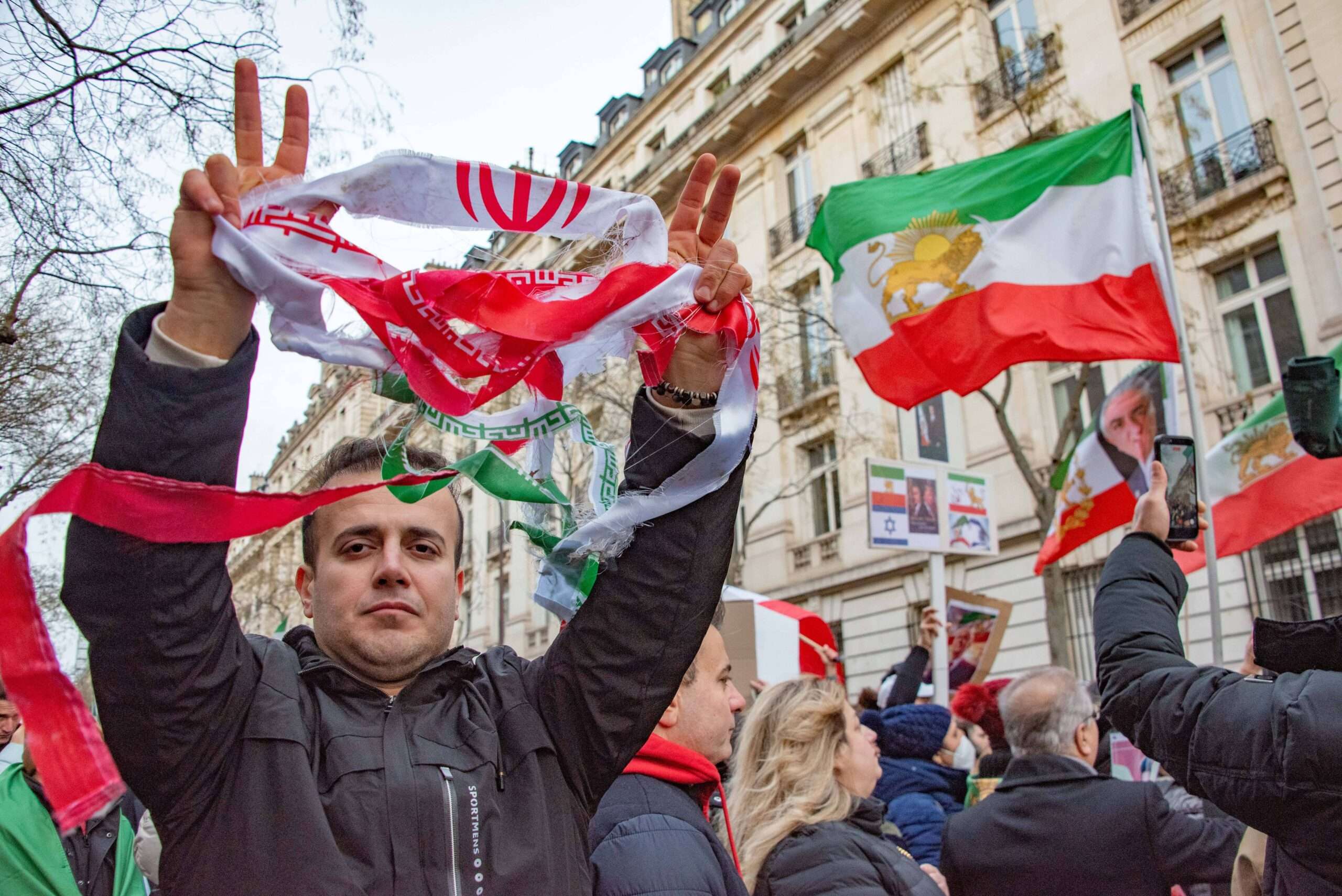
Iran’s death toll: Hundreds of protesters have been killed in Iran, as the government tries to crack down on what look like some of the country’s largest protests since 1979.
“The Center for Human Rights in Iran, based in New York, said it had received eyewitness accounts and credible reports that hundreds of protesters have been killed since the government shut down access to the internet Thursday night,” reports The Washington Post. “The Human Rights Activists News Agency, also based in the United States, said 490 protesters have been killed since the protests began.” The regime has attempted internet and cell service blackouts to try to suppress the spread of information, but the West has still managed to see videos of full body bags spread out, on hospital grounds, substantiating reports of a significant (yet still unknown) death toll.
The Reason Roundup Newsletter by Liz Wolfe Liz and Reason help you make sense of the day’s news every morning.
The protests started over economic grievances, but they have snowballed into more generalized anger with the repressive regime. Meanwhile, the Trump administration has threatened to insert the U.S. into the conflict. “Iranian Parliament Speaker Mohammad Baqer Qalibaf warned Sunday against such strikes,” reports the Post. “If the country were attacked, he said, it could target the United States, Israel and international shipping lanes.”
“Iran’s 12-day war with Israel and the U.S. last June broke the regime’s carefully nurtured image of invincibility, many ordinary Iranians say,” reports The Wall Street Journal. “Israeli strikes across Iran destroyed much of its military leadership, and the follow-on U.S. bombing campaign struck a heavy blow against Iran’s nuclear program. It was a humiliation for a regime that had invested so much of the country’s national wealth into a proxy network that was designed to deter exactly this sort of assault on the homeland.”
A regime that once looked unbreakable has cracks forming everywhere.
Iran is not merely a theocracy, Tahmineh Dehbozorgi points outs on X: “It is a centrally controlled, state-dominated economy where markets are strangled, private enterprise is criminalized or co-opted, and economic survival depends on proximity to political power. Decades of price controls, subsidies, nationalization, and bureaucratic micromanagement have obliterated the middle class and entrenched corruption as the only functional system. The result is not equality or justice. It is poverty, stagnation, and dependence on government’s dark void of empty promises.”
Wealth tax barely understood by normies: “California helped make them among the richest people in the world. Now they’re fleeing because California wants a little something back,” writes Lorraine Ali in an unintentionally hilarious Los Angeles Times article about a proposed “billionaire tax.”
“The proposed California Billionaire Tax Act has plutocrats saying they are considering deserting the Golden State for fear they’ll have to pay a one-time, 5% tax, on top of the other taxes they barely pay in comparison to the rest of us,” continues Ali. “Think of it as the Dust Bowl migration in reverse, with The Monied headed East to grow their fortunes.” Those who’ve already left the state “include In-n-Out Burger owner and heiress Lynsi Snyder, PayPal co-founder and conservative donor Peter Thiel, Venture Capitalist David Sacks, co-founder of Craft Ventures, and Google co-founder Larry Page, who recently purchased $173 million worth of waterfront property in Miami’s Coconut Grove. Thank goodness he landed on his feet in these tough times.”
About that last one: Ali doesn’t seem to understand the mechanics of how the tax would be applied. But the affected people sure do.
“Larry [Page] and Sergey [Brin] can’t stay in California since the wealth tax as written would confiscate 50% of their Alphabet shares,” writes Y Combinator CEO Gary Tan on X. “Each own ~3% of Alphabet’s stock, worth about $120 billion each at today’s ~$4 trillion market cap. But because their shares have 10x voting power, the…billionaire tax would treat them as owning 30% of Alphabet (3% × 10 = 30%). That means each founder’s taxable wealth would be $1.2 trillion. A 5% wealth tax on $1.2 trillion = $60 billion tax bill, each. That’s 50% of their actual Alphabet holdings—wiped out by a ‘5%’ tax.”
Consider the way the law is written: “For any interests that confer voting or other direct control rights, the percentage of the business entity owned by the taxpayer shall be presumed to be not less than the taxpayer’s percentage of the overall voting or other direct control rights.” This is probably to ensure rich people can’t use complex share structures to make it seem like they have lower ownership (and thus a lower tax burden).
This law is being pitches as a means of making up for the $100 billion state budget shortfall, including $19 billion in federal cuts to Medi-Cal, $7 billion to $9 billion in state cuts to the same program, and possible cuts to the state’s Supplemental Nutrition Assistance Program. And the line that keeps being repeated—that these billionaires couldn’t have done it without the state of California, or without being in their specific location—is kind of a strange one. Sure, Silicon Valley agglomeration effects are great, but it’s not like they were bilking the state in some way.
“Billionaires have built their extraordinary fortunes with the help of California resources and were the largest beneficiaries of the federal legislation that contributed to the current state budget crisis,” write the drafters of the law. “It therefore is both necessary and equitable to ask those who have benefitted most from California’s resources to contribute proportionately to support health care, education, and nutrition in California through a one-time 5% tax on billionaire wealth.”
Scenes from New York: “The group Palestinian Assembly for Liberation organized a rally outside Young Israel of Kew Gardens Hills yeshiva in protest of an event promoting real estate investments in Jerusalem,” reports CBS. “Protesters gathered on the sidewalk behind barricades across the street from the yeshiva at the corner of 150th Street and 70th Road, some carrying Palestinian flags. In at least one video posted to social media, the demonstrators appear to be chanting, ‘We support Hamas here.’…’Showing support for terrorist organizations outside of the synagogue is a horrific act,’ said Scott Richman, regional director of the Anti-Defamation League New York and New Jersey.”
QUICK HITS
- “The U.S. attorney’s office in the District of Columbia has opened a criminal investigation into Jerome H. Powell, the Federal Reserve chair, over the central bank’s renovation of its Washington headquarters and whether Mr. Powell lied to Congress about the scope of the project, according to officials briefed on the situation,” reports The New York Times.
- “Venezuela’s current political moment is a paradox of tutelage: a partial rupture with authoritarian rule that has not translated into democratic control,” writes Juan Miguel Matheus in the Journal of Democracy. “The removal of Nicolás Maduro marks the end of a long and suffocating autocratic cycle centered on a single ruler. Yet, the way in which that rupture has occurred—through external intervention and in coordination with remnants of the old regime—has produced a political landscape that is at once post-Maduro and still undemocratic. Liberation has begun, but it remains partial, contested, and insufficient to restore Venezuelan self-government….Venezuela’s present moment does not fit the model of democratic transition made familiar by the third wave. It is neither a negotiated pact between authoritarian incumbents and democratic challengers, nor a clean electoral alternation, nor a revolutionary rupture. It is instead a unique conjuncture produced by the intersection of extreme autocratic entrenchment, external intervention, institutional collapse, and the displacement—rather than the empowerment—of democratic initiative. What Venezuela is experiencing is not a postliberation order, but a partial liberation. Maduro has been removed, but the regime has not been defeated.”
- “I went sober to prioritize my health,” writes Dean Stattmann for GQ. “But then slowly but surely I realized the best parts of life were passing me by.” (This is why I’m long booze.)
- “Nearly 16,000 nurses at three major hospitals in New York City are expected to strike amid a severe flu season, the last group of New York Nurses Association practitioners who have not settled their contracts,” reports Bloomberg. “A strike would come three years after a similar labor dispute ended in a historic contract. Operations at hospitals including Mount Sinai Medical Center and NewYork-Presbyterian in Manhattan as well as Montefiore Medical Center in the Bronx are expected to be affected.”
- Pivot to manufacturing isn’t going so well:
The US continues to lose manufacturing jobs—payrolls are down 75k over the last year, & another 8k jobs were lost in December
Transportation (especially auto manufacturing), wood, and electronics/electrical manufacturing are the biggest losers, but few subsectors are doing well pic.twitter.com/8tHZyUfpNN
— Joey Politano ????️???? (@JosephPolitano) January 9, 2026
“…THERE WILL BE NO MORE OIL OR MONEY GOING TO CUBA – ZERO! I strongly suggest they make a deal, BEFORE IT IS TOO LATE. Thank you for your attention to this matter.”- President Donald J. Trump pic.twitter.com/bHEIysJ7q1
— The White House (@WhiteHouse) January 11, 2026