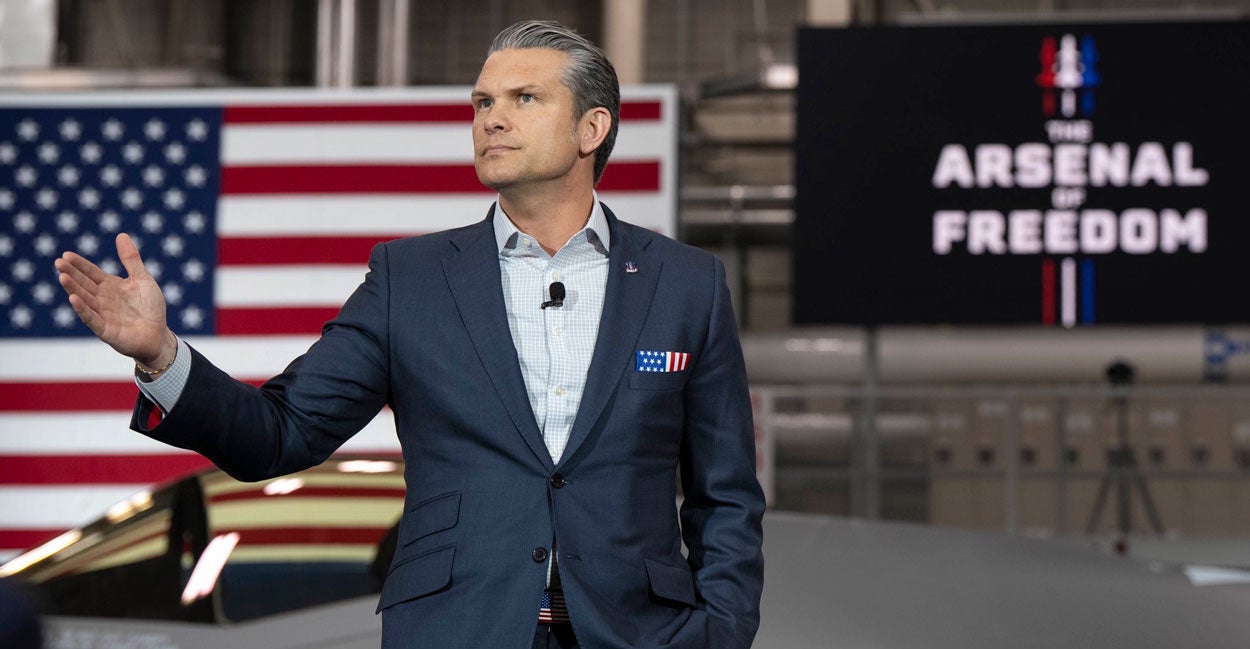
STARBASE, Texas—War Secretary Pete Hegseth is on a mission.
As he tours military installations and visits defense contractors, Hegseth is laser-focused on what it will take to make sweeping changes for America’s military.
He recognizes it won’t be easy, but there’s no other choice if America wants to maintain its dominance in our rapidly changing world. China, Iran, and Russia, along with other adversaries, are external threats. Closer to home, however, a slow-moving bureaucracy, lack of innovation, and a business-as-usual mentality present a different set of challenges.
“When it comes to our current threat environment,” Hegseth declared, “we are playing a dangerous game with potentially fatal consequences. We need innovation to come from anywhere and evolve with speed and purpose.”
Hegseth emphasized this point repeatedly during Monday’s trip to Texas, where he was accompanied by the state’s Republican senators, John Cornyn and Ted Cruz, alongside other members of Congress.
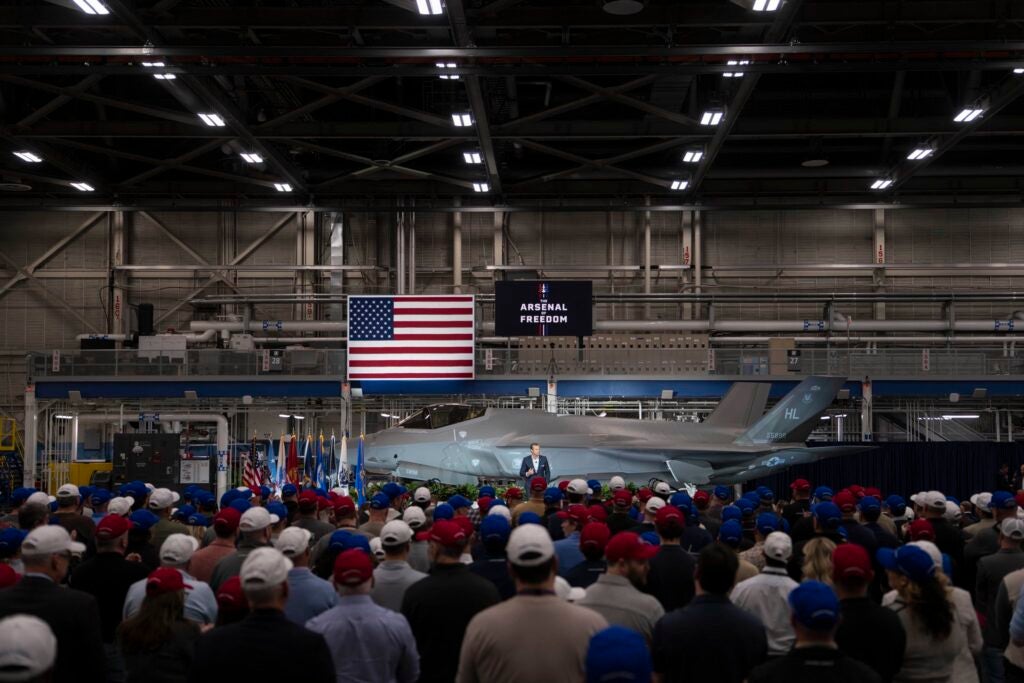
Dubbed the Arsenal of Freedom tour, Hegseth is traveling the country to see America’s warfighting capabilities firsthand—and to send a not-so-subtle message to his own department and the defense contractors who support it.
That much was clear when Hegseth set foot inside Lockheed Martin’s F-35 factory in Fort Worth and SpaceX’s headquarters on the outskirts of Brownsville.
“We need to be blunt here,” Hegseth said Monday. “We can no longer afford to wait a decade for our legacy prime contractors to deliver the next perfect system only to find that it’s delivered years behind schedule and costs 10 times what it should.”
Amidst the fanfare of his visits, Hegseth’s message was consistent: Military superiority depends on both longtime partners like Lockheed and new disruptors like SpaceX.
America’s Most Lethal Fighter Aircraft
Inside of Lockheed Martin’s mile-long building, America’s military might was on full display. With planes under construction on the factory floor, Hegseth paid tribute to the company’s veteran-heavy workforce and complimented them for leading the way—quite literally.
During last year’s Operation Midnight Hammer to destroy three nuclear sites in Iran, F-35s flew ahead of the B-2 stealth bombers that dropped the payload. More recently, during Operation Absolute Resolve, F-35s played a key role in the capture of Venezuela’s Nicholas Maduro.
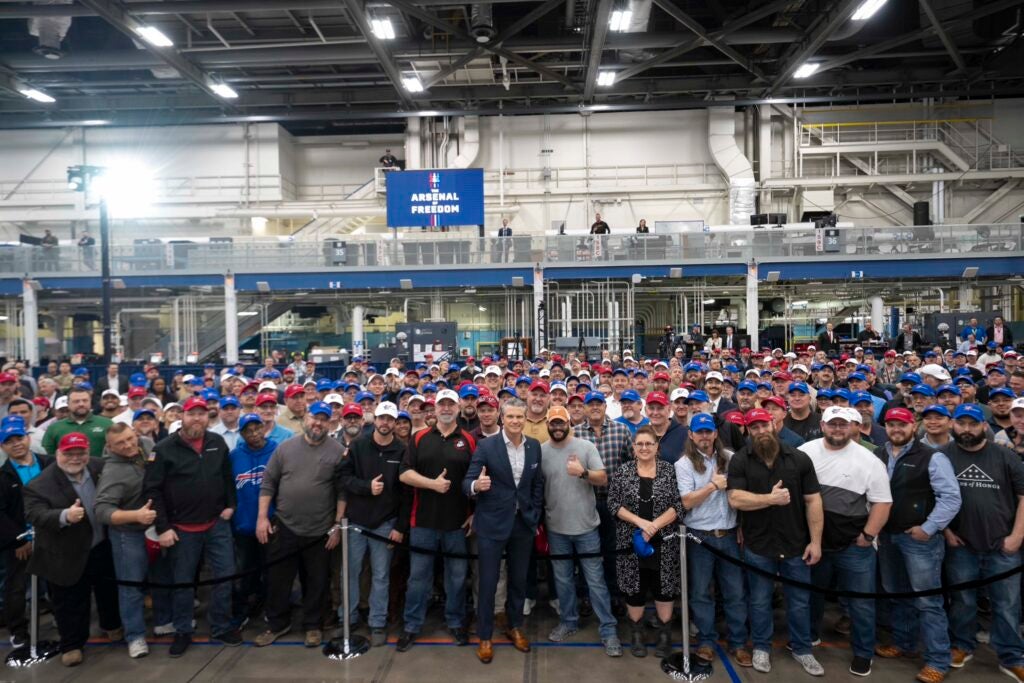
Lockheed Martin delivered a record number of 191 fighter jets in 2025 at a breakneck pace. The company says its F-35 production line is running five times faster than any other allied fighter. The mile-long factory employs 19,000 workers and relies on nearly 2,000 suppliers across America.
Hegseth’s visit served not just as a pep rally but also as an opportunity to showcase a company that he pointed to as a model he’d like others to emulate.
“We ultimately don’t care what the name is on the side of the missile or the plane or of anything that’s made at the War Department,” Hegseth said. “We just want the best, and our expectation is that every company competes, and every company competes on a level playing field.”
‘Make Star Trek Real’
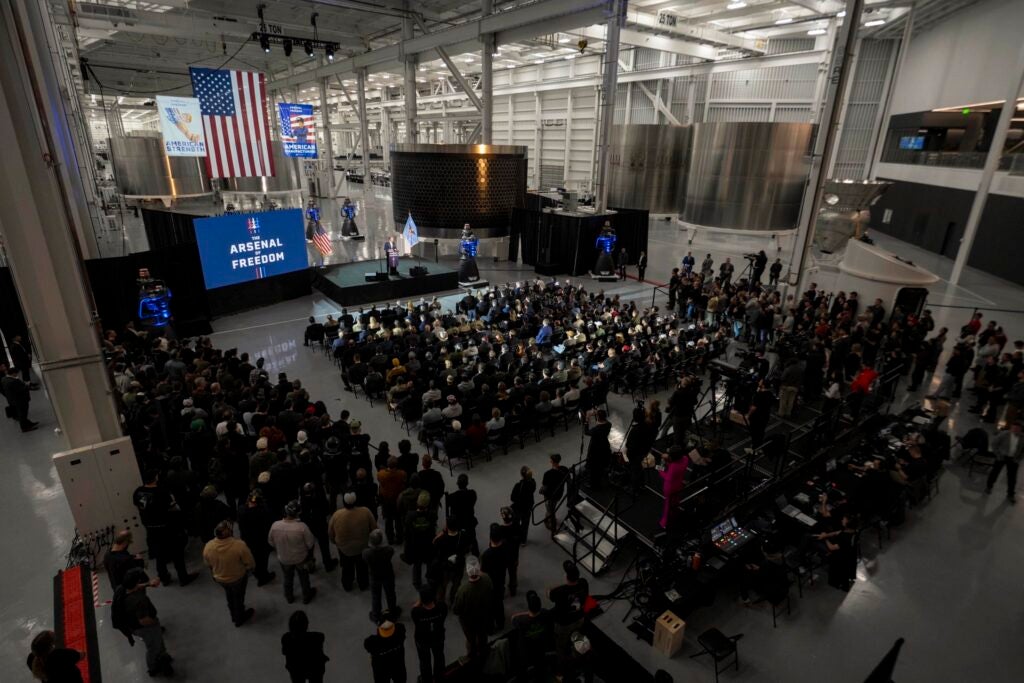
More than 500 miles south in Starbase, along the U.S.-Mexico border, Hegseth spoke to hundreds of workers gathered Monday evening at SpaceX’s cutting-edge factory, where Elon Musk set the stage by casting a futuristic vision.
“I’ll tell you a little bit just about the purpose of SpaceX,” Musk said. “It’s like, we want to make Star Trek real, OK?”
Acknowledging that SpaceX moves at a speed far faster than the Pentagon, Hegseth vowed to cut through red tape and make changes to reshape acquisition, embrace technology, and revolutionize how business is done at the War Department.
“Here you iterate in terms of hours and days, maybe weeks,” Hegseth quipped. “In Washington, we talk in terms of months, years, and oftentimes multi-years. It’s too slow.”
Hegseth’s speech was heavy on AI’s potential, and he announced that Musk’s Grok would follow Google’s Gemini as the next frontier AI model company to join GenAI.mil.
He then proceeded to declare war on the Pentagon bureaucracy, abolishing the Defense Innovation Steering Group, the Defense Innovation Working Group, and the CTO Council.
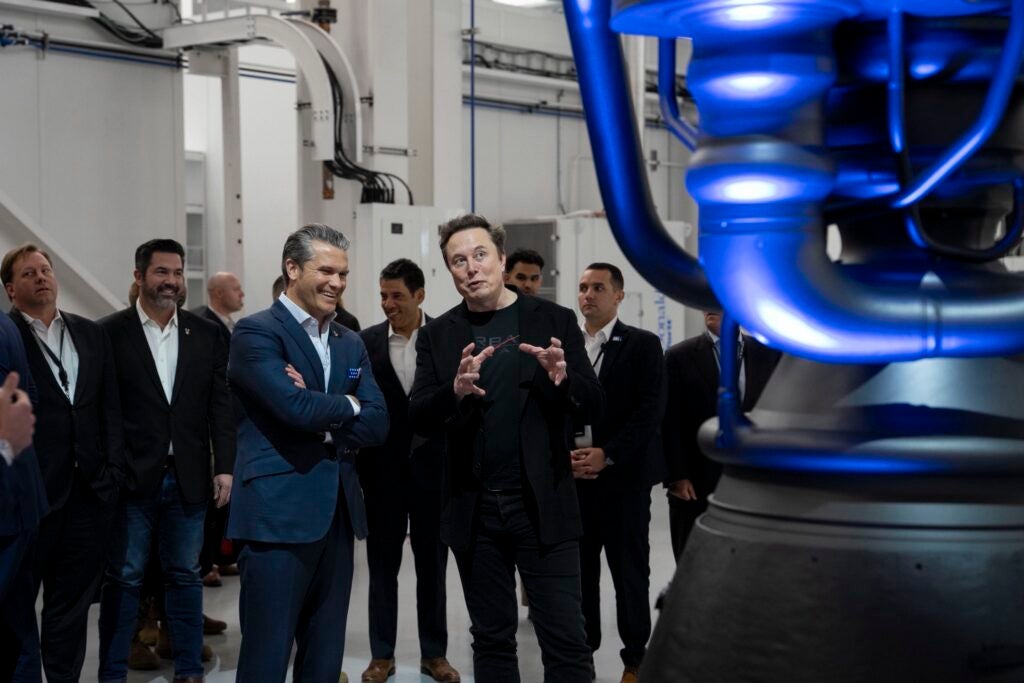
“In modern warfare, the fastest innovator and iterator will be the winner, and no one can out-innovate an American entrepreneur who has been liberated from the constraints of cycling bureaucracy. That old era ends today,” Hegseth said. “We are done running a peacetime science fair, while our potential adversaries are running a wartime arms race.”
Mission Alignment
The adage “personnel is policy” clearly resonates with Hegseth, who inherited a Pentagon that was unfocused, misaligned, and not clear in its mission.
By putting an emphasis on the “warrior ethos” and viewing everything from the perspective of the warfighter, Hegseth has already made remarkable changes to a department that inherently resists them.
“Winning requires a new playbook,” he said, crediting Musk’s algorithm to “question every requirement, delete the dumb ones, and accelerate like hell.”
Hegseth namechecked his key lieutenants who are making those changes happen: Deputy Secretary Steve Feinberg, Undersecretary of War for Research and Engineering Emil Michael, and Undersecretary of War for Acquisition and Sustainment Mike Duffy. He also announced that Cameron Stanley was appointed chief digital and AI officer and that Owen West would run the Defense Innovation Unit.
Hegseth’s stops in Texas marked the latest leg of his Arsenal of Freedom tour. Previous stops included a shipyard in Newport News, Virginia, and Rocket Lab in Los Angeles.
Trump’s $1.5 Trillion Budget Proposal
The tour coincided with President Donald Trump’s Jan. 7 executive order empowering Hegseth to identify defense contractors that underperform and fail to prioritize U.S. government contracts. Trump’s order also prohibits contractors from stock buybacks and corporate distributions if they’re not hitting the Pentagon’s targets.
Trump followed that news by calling out a defense contractor by name.
“Raytheon,” Trump wrote on Truth Social, “has been the least responsive to the needs of the Department of War, the slowest in increasing their volume, and the most aggressive spending on their Shareholders rather than the needs and demands of the United States Military.”
Later that same day, the president announced he would propose a $1.5 trillion budget for the War Department, the largest ever in U.S. history.
Hegseth called it “a historic and generational investment in American security.” He added: “All of this will make our forces more agile, more lethal, and more ready to deter and, if necessary, win a future fight. This is what President Trump demands, and this is what we will deliver.”
The War Department has not yet announced where Hegseth will visit next, but you can count on hearing the same notes he hit Monday and last week. He wants you to know the status quo is unacceptable, and he won’t tolerate excuses.
“This is not reform for the sake of reform. It never has been. This is about whether our warriors fight with yesterday’s tools, or they fight overmatching our adversaries using tomorrow’s technologies,” Hegseth said at SpaceX. “We know the threat. We know the opportunity. We know what must be done. We share the urgency. Now we will do it, and we must do it at wartime speed.”