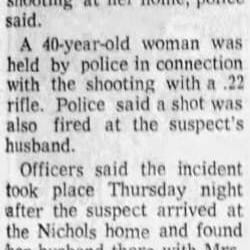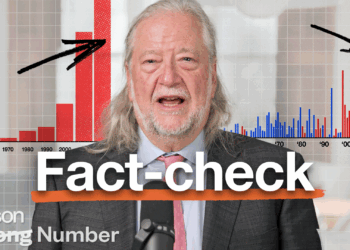
There was an unusual exchange in Hecox. The Justices had little interest in pursuing the mootness argument. Yet, Justice Sotomayor tried to explain why Hecox would drop the case for non-strategic reasons. Sotomayor suggested that it is a burden to be a named plaintiff in a Supreme Court case. And this pressure could explain why Hecox dropped out after the case left the safe confines of the Ninth Circuit. Justice Sotomayor pressed the Idaho Solicitor General if he “studied your law cases” and if he “studied the people” behind those cases:
JUSTICE SOTOMAYOR: Do you dispute that having a case named after you makes your infamy –infamy live forever? Think of –
MR. HURST: No, Your Honor.
JUSTICE SOTOMAYOR: No? You don’t think that Brown and any of the other named plaintiffs that we have in famous cases draw an attention to those people as people? Have you studied your law cases? Students do all the time. I think one of my colleagues had a course where they looked at the lives of the plaintiffs. Do you doubt that having a named case with such an eventful event is going to continue attention on this person?
MR. HURST: I don’t doubt there will be attention. And I –I confess I –
JUSTICE SOTOMAYOR: Negative attention.
MR. HURST: And I confess I have studied a few law cases, but –
JUSTICE SOTOMAYOR: Have you studied the people?
I found this question was insulting.
I have studied the people behind Supreme Court cases. And Justice Sotomayor has things–at best–half right. Conservative litigants live in infamy. Liberal litigants are glorified. Do I need to name names? James Obergefell. Edie Windsor. John Lawrence. Christy Brzonkala (from United States v. Morrison). Gregory Lee Johnson (from Texas v. Johnson). Norma McCorvey (from Roe v. Wade), at least until she became Pro-Life. Mary Beth Tinker. Richard and Mildred Loving. Estelle Griswold. Linda and Mildred Brown. Fred Korematsu. Elsie Parrish. Eugene Debs. Lee Yick. Homer Plessy. Myra Bradwell. Dred Scott. And so on. Yes, I’ve studied the cases.
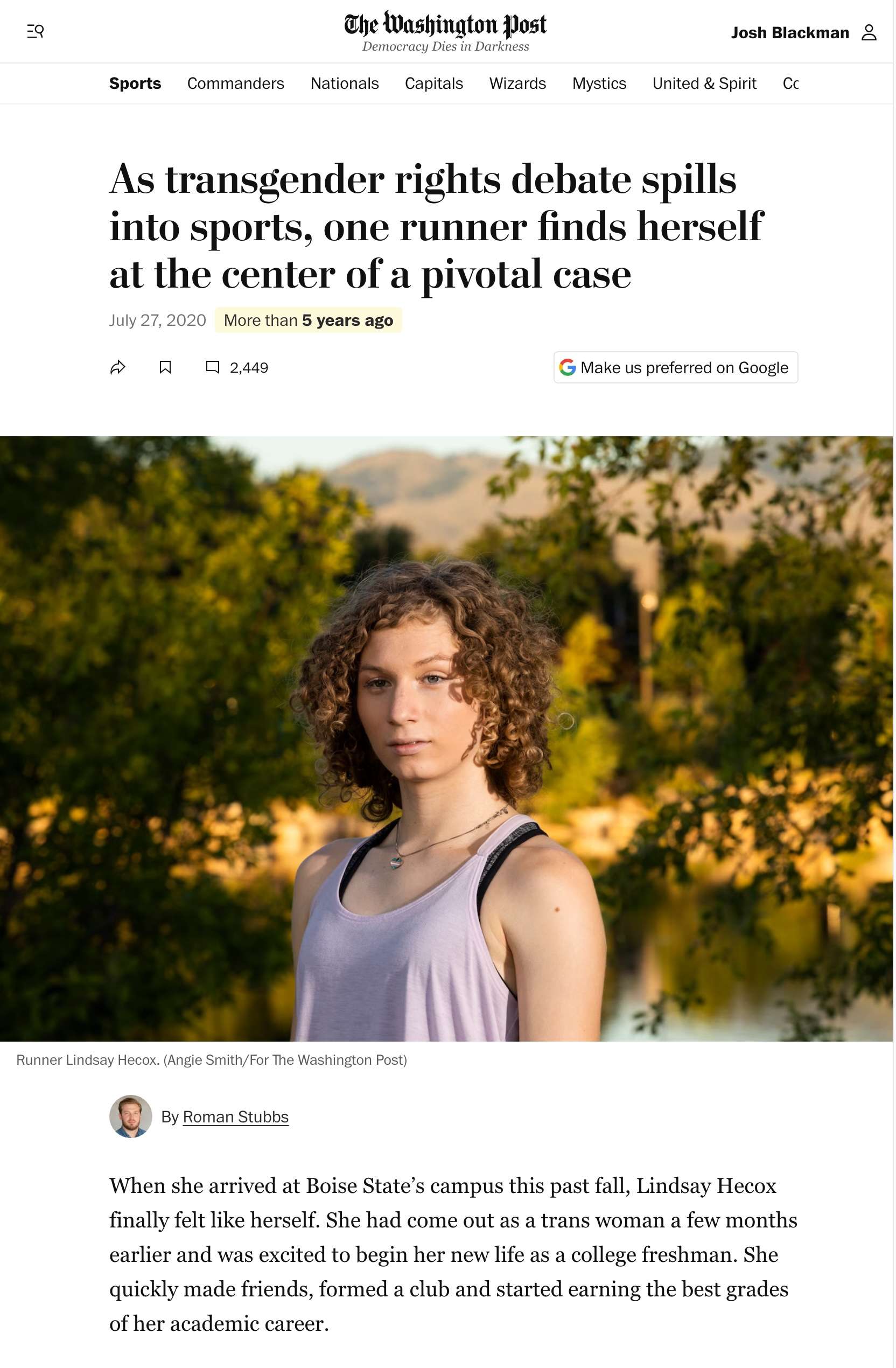
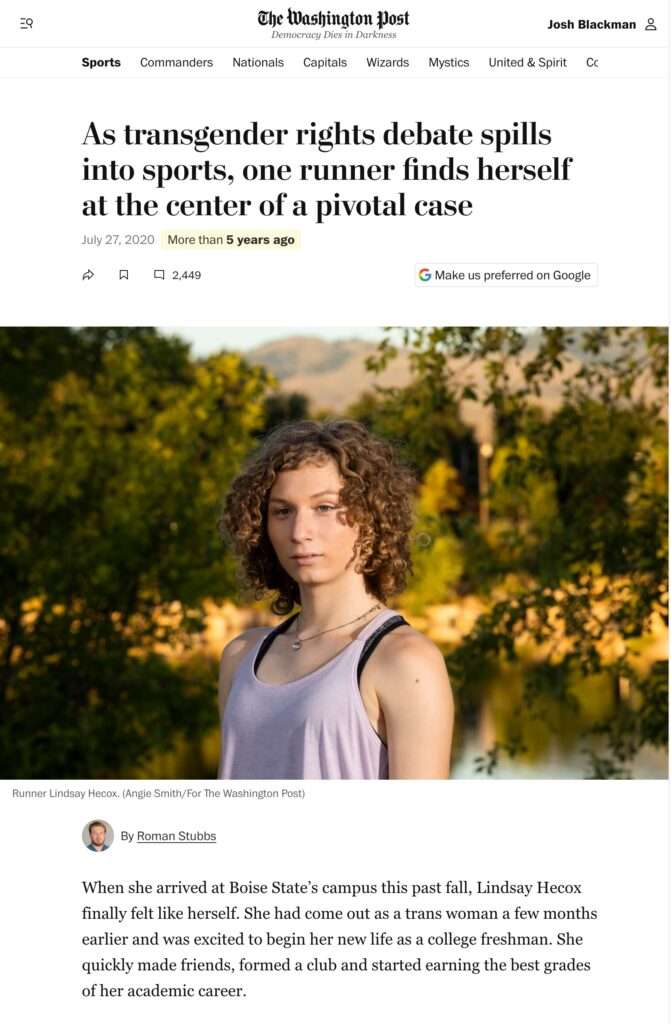
Back to Hecox. In July 2020, Hecox was content to have a glamor photo appear in the Washington Post. Everyone knew this case was headed to the Supreme Court. And Hecox’s counsel thought it was a strategic benefit to plant favorable press stories. But now, on the eve of a Supreme Court decision, Hecox’s counsel wants the case to go away. It is a bit rich to claim that this pressure has now affected Hecox’s decision to drop out of the case.
There is another relevant example involving students. Everyone knows Abigail Fisher, the lead plaintiff in the challenge to the University of Texas’s affirmative action. And she was excoriated. Remember #BeckyWithTheBadGrades? This meme was shared by the BBC.
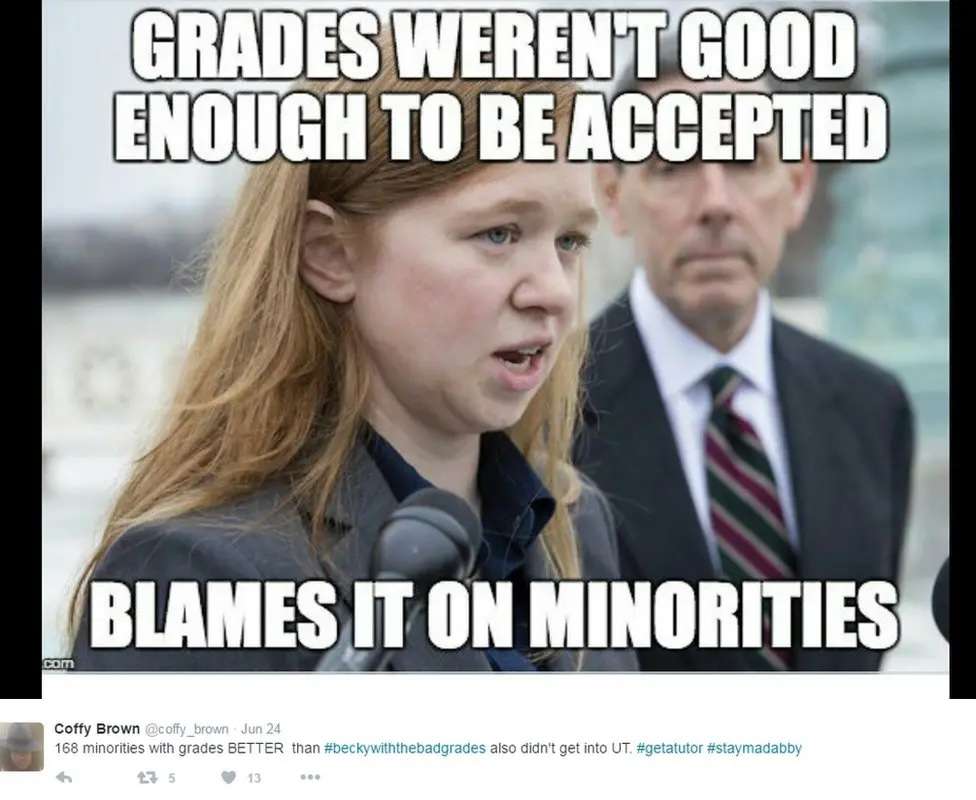
Another site summed up her life:
It’s hard not to draw the conclusion that Fisher’s lawsuit is a product of her entitlement. She’s noted that all of her friends and family went to the University of Texas at Austin, and so she felt like she was entitled to go too, never mind the fact that she didn’t have the grades to get in. And if getting her way means destroying a policy that has been proven to benefit white women the most, then that’s what Fisher evidently intends to do.
One site offered a roundup:
It is not surprising that the reaction to the decision focused on Abigail herself. Media coverage of the case when it was argued this winter also focused primarily on the plaintiff: her mediocrity, her “race-baiting lawsuit,” and, most of all, her privilege. It encouraged her to #staymadabby and compared her to “a boiled and condiment-less hot dog sitting in a room-temperature bun.”
As the case went to the Supreme Court, Fisher was the only named plaintiff. But in the lower courts, there was another plaintiff. However, she dropped out of the case after the Fifth Circuit decided the appeal in 2011. Why? Because she was admitted to a Texas law school. As the story went, the future law student did not want to be a named plaintiff. Can you imagine being the law student who was actively litigating against a policy your law school favored? The ire would only go in one direction. But a law student who challenges some conservative policy would be celebrated.
Indeed, one of the reasons that Students for Fair Admissions was created was to allow students to anonymously challenge affirmative action policies, without fear of reprisal. Abigail Fisher served on the SFFA board–a point Justice Sotomayor gratuitously pointed out in her SFFA dissent. After all, Harvard argued that SFFA lacked standing. The brief in opposition to cert stated, “SFFA is not a genuine membership organization—it is a vehicle designed to advance the policy preferences of its controlling founder, who has no personal stake in the controversy.”
If there is a concern that Supreme Court litigants will be subject to harassment, then organizations like SFFA should be considered as a favorable option. Nothing would have stopped Hecox’s counsel from forming a group called Students for Fair Athletics, or something like that. Maybe if they certified a class of all transgender student athletes in red states, they could get around the facial/as-applied problem.