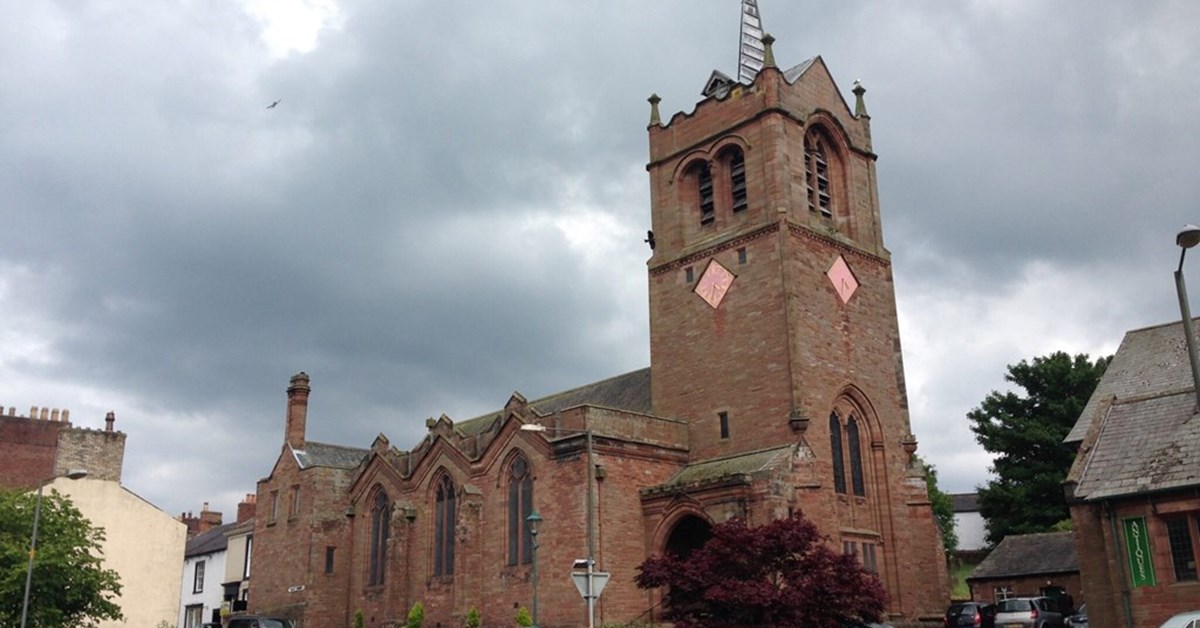
THE incumbent of St Martin’s, Brampton, who wished to install a lift, ramp, and railings at the church entrance to improve accessibility for elderly parishioners, has been refused permission to do so because of the “architectural significance” of the building.
The Consistory Court of the diocese of Carlisle refused to grant a faculty to permit these external works to be carried out at the Grade I listed church, and has refused an application for permission to appeal.
St Martin’s was built in 1877-78 and its tower was completed in 1906. It is the only church designed by the celebrated architect Phillip Webb. It also has a complete set of stained-glass windows designed by Edward Burne-Jones and made by William Morris’s company. It is on the national list of Buildings of Special Architectural and Historic Interest.
The three petitioners — the incumbent, Canon Patricia Rogers, a churchwarden, and the lead of the church’s Equal Access Group — sought a faculty permitting them to undertake certain internal and external works at the church.
The court granted a faculty for the proposed internal works, but the proposed external works were opposed by the Victorian Society. That external work included the installation of a lift at the entrance alongside the stairs that rose to the main door of the church, with ramped access and associated railings.
The Diocesan Chancellor, the Worshipful James Fryer-Spedding, accepted the Victorian Society’s view that the special interest of St Martin’s rested largely on its being the sole and unaltered work of an internationally distinguished architect, that it had remained unchanged since completion, and that it was Webb’s only surviving work in an untouched state.
The petitioners identified fundamental problems of accessibility which prevented many people from entering or using the church in its current state. Twelve steep steps needed to be navigated to reach the only access to the building.
For reasons of accessibility, longstanding members of the congregation could no longer attend services, family members had missed weddings, funerals, and christenings of close relatives, and choirs, music groups, schools, and other organisations had curtailed their use of the church.
Visitors drawn to the historic and architectural significance of the church, and those with disabilities, had to remain outside. The current arrangements caused embarrassment, distress, indignity, and a sense of exclusion, the petitioners reported.
The Victorian Society said that the entrance to the church was “carefully articulated to provide an architecturally interesting and engaging introduction to the building”, and that the access proposals would introduce a new and highly conspicuous element on to the most prominent part of the building and detract from the simplicity of Webb’s original entrance.
The Victorian Society said that the petitioners should further explore the possibility of introducing a new accessible entrance in the “less sensitive” western elevation under the stained-glass “Paradise Window”.
The Chancellor considered the case within the Duffield principles set out by the Court of Arches and decided that implementing the petitioners’ access proposals would lead to a high degree of harm to the church as a building of special architectural or historic interest.
The access lift “would be a material departure from the presently unaltered whole of this unique Grade I listed building”, he said, and “would be recognisable as a separate and identifiably new feature of the building”.
That high degree of harm was not outweighed by the high degree of public benefit that would result from the proposed works, the Chancellor concluded. This could not be regarded as an exceptional case, he said, since there remained a genuine and not yet exhausted prospect of securing comparable benefits at a lesser cost to the church’s character and significance.
A potentially less harmful alternative proposed by the Victorian Society had not been explored, partly owing to a misunderstanding over rights related to the adjoining car park.
The Chancellor refused the petitioners’ application under the Faculty Jurisdiction Rules for leave to appeal because he did not consider that an appeal had any prospect of success or that there was some other compelling reason that it should be heard.