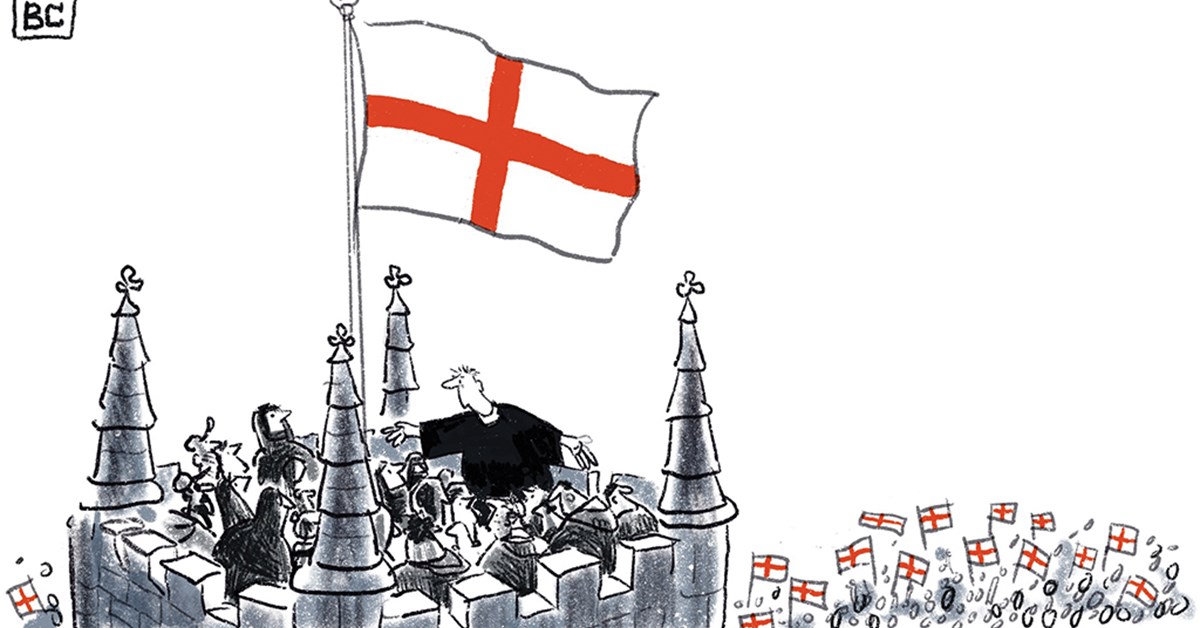
IN THE 1950s, when Irish workers came to the UK, they often found hostile signs in guest houses and pubs: “No Blacks. No Irish. No Dogs.” Thankfully, those signs are gone, but the sentiment feels uncomfortably familiar. Wherever a St George’s flag is painted on a roundabout or wall, it can seem to say: “No Foreigners. No Asylum-seekers. No Muslims.”
How quickly things have changed. Only a few years ago, our towns and cities were awash with rainbow posters celebrating NHS workers. Then came the blue-and-yellow flags waving in solidarity with Ukrainians fleeing war. Today, public displays often feel more ominous, instruments of fear rather than symbols of honour or welcome. The closest we see to kindness is the occasional shopfront offering a bowl of dog treats. Something has shifted.
In moments such as this, the Church has a unique, prophetic part to play: to offer a counter-example, to shine light in the darkness, and to embody a different story in the midst of a divided society. We have the opportunity to publicly welcome, honour, and embrace those whom others think are undeserving. Our noticeboards can proclaim it; our doors can open to it; our walls can bear witness to it. But, most importantly, we can practise what we preach. We can look for ways to offer practical assistance to those resettling in the UK after war, persecution, or tragedy.
CHURCHES have already been working at the forefront of community sponsorship schemes, helping families to rebuild their lives. Lambeth Palace became the first UK sponsor in 2016 (News, 22 July 2016), and more than 20 Church of England parishes have since acted as lead sponsors for refugee families.
These successes show that hospitality is not just a moral ideal: it is achievable, tangible, and transformative. Every time that a refugee is welcomed and helped to integrate, it pushes back against the voices that claim that asylum-seekers are unwelcome.
But the Church can do far more. We have the networks, compassion, and resources to replicate this a thousand-fold, modelling what true Christian welcome and hospitality look like. And the good news is that the Government seems to be in support of this: the Home Secretary, Shabana Mahmood, stated last November the intention to introduce a full Named Community Sponsorship Programme.
The Named Community Sponsorship Programme could allow the tens of thousands of churches around the UK to identify refugees whom they know to be at risk of violence or persecution, and to provide the practical and pastoral support needed for them to come to the UK to rebuild their lives. It is a model that combines compassion with control: matching people in genuine need with communities ready to support them. It offers a lifeline to the most vulnerable while also showcasing the best of what our communities can offer.
Pilot schemes have shown that, when local communities choose the refugees whom they wish to welcome, and commit to supporting them, integration succeeds in ways that top-down placement cannot. Sponsors become advocates, ensuring that newcomers receive a warm welcome and practical help. Refugees gain social connections, employment opportunities, and a sense of belonging faster.
Long-term costs to the state are reduced. Research from the organisation More in Common finds broad public support for co-ordinated community resettlement, even among migration-sceptical groups. US data confirms that, when safe, legal routes are available, unregulated migration falls, dangerous journeys decline, and traffickers lose their business. Compassion and control can co-exist — and thrive.
YET the Government’s commitment to Named Community Sponsorship is hidden in Ms Mahmoud’s draft of widely criticised immigration reforms (News and Comment, 21 November 2025). These proposals, on the whole, make it harder for migrants to gain indefinite leave to remain, extend qualifying periods, tighten eligibility, and increase uncertainty for those who have already settled. The Bill risks sending a stark message: refugees are not welcome.
As we await the details of what will happen to this Bill, and the proposals included, the opportunity for the Church is clear. We must let the Government know that we are ready and waiting to take advantage of the Named Community Sponsorship Programme, and urge it to begin this process as soon as possible. The nation that welcomed Ukrainians with generosity is ready to do so again, as soon as the framework is in place.
Dr Krish Kandiah is the founder of the Sanctuary Foundation.