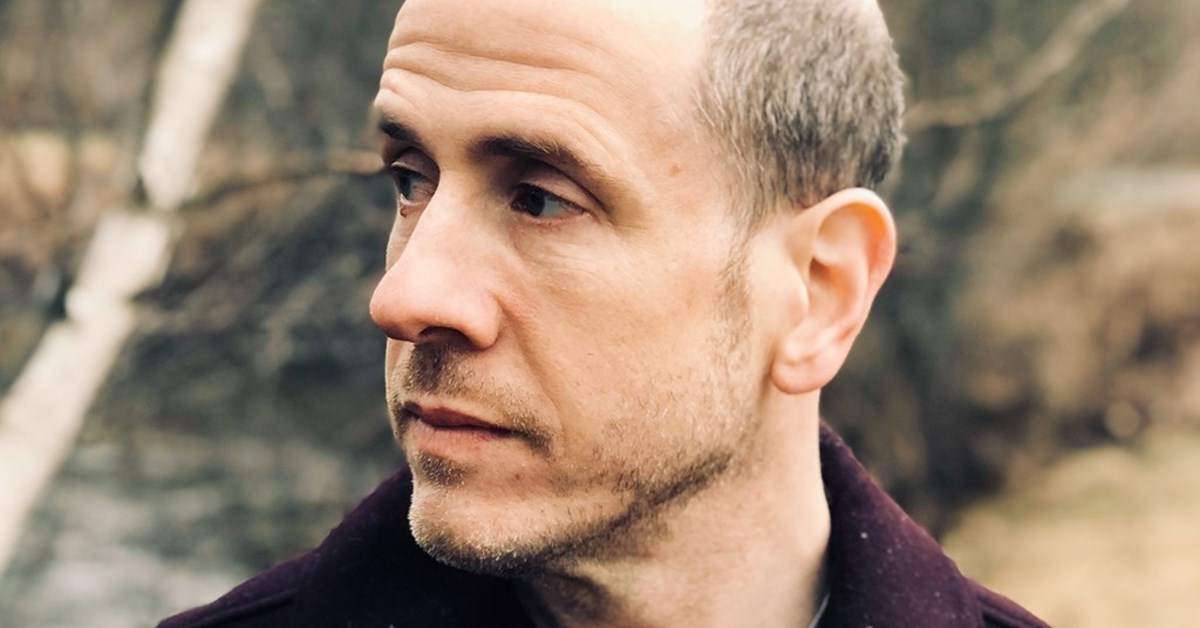
JEFF SHARLET, the writer, journalist, and academic, has been chronicling the shift towards nationalism in conservative American Christianity since the 1990s. He is a New York Times bestselling author, and his eighth and most recent book, The Undertow: Scenes from a slow civil war, journeys across the United States in the time of Trump. It recounts the story as the writer embeds himself in the heart of the unravelling social contract — joining right-wing political rallies, approaching houses covered in threatening flags, and visiting far-Right and nationalist churches, all to engage with the people he finds there.
The insurrection on 6 January and the shooting of the rioter Ashli Babbitt in 2021 triggered his journey and took him to the grass-roots of nationalist fervour. The book is a road-trip fever-dream — guns, conspiracy theories, threat and menace — much of which takes place in the churches themselves. These are overtly, proudly, right-wing churches: “churches just calling themselves war churches”, he says, in a conversation during his time in London in November.
During the trip, he explores the likelihood that America could face civil war again. What might have seemed initially a niche and even outlandish proposition has turned into viable reality for many he meets, some of whom regale him with plans for violence and retributive executions.
The United States at the moment is “not a fully fascist regime”, he says, “because it’s not consolidated. It’s still a fascist movement that controls government, and that’s a distinction.” The aim of the administration, though, he says, is to become “a fully fascist regime”. Alongside sweeping policy change at governmental level, he predicts that this would involve activity throughout the country in the form of locally organised militia groups and heavily armed citizens.
At the heart of it all is Donald Trump, whose first presidential term was made possible in large part by the fervent support of Evangelicals. His second term continued with their favour (News, 7 May 25). Now, Sharlet observes a growing emboldening among members of a more radicalised Christian Right, who see Trump as the messianic embodiment of endless fear-filled prophecies of violence and unseen enemies, God’s chosen man for this time.
In Undertow, Sharlet writes about a Trump rally that he attends: “A preacher nobody knew took the podium and started crying, ‘He’s worthy! He’s worthy!’ The crowd knew he meant God and Trump and them all at the same time, and when the preacher shouted, ‘Praise him!’ they did. And when he finished his sermon — sharp with crime and heroin and missing children, prophecy and Trump and the father-nation — and said, ‘His name is Jesus and he approves this message’, they laughed.”
Mr Trump is “the second best speaker I’ve ever seen”, Sharlet says, of his time at the rallies. “Obama’s best, but Trump is really good.” His religion is real, too, he believes, though not pious: “I don’t think he’s lying when he says he’s talks a lot about worrying about where he’s going when he dies.”
SHARLET is the son of a Jewish father and a Christian mother, and describes himself as a secular Jew. He has been writing about religion since he was a young man, despite not having a faith. (“I wish I was a believer. I’d love to be. Since 1998, I’ve wanted to be an Episcopal priest.”)
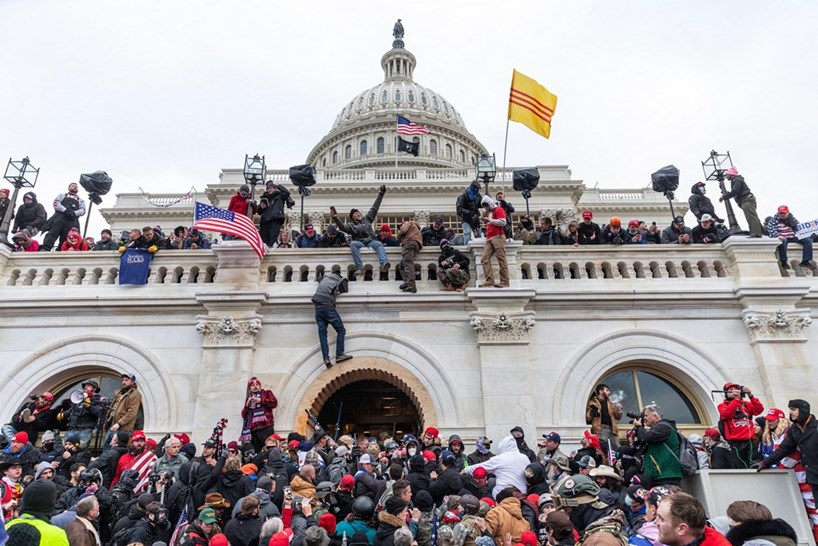 AlamyPro-Trump protesters on the Capitol building in January 2021
Finding himself welcomed into a secretive and yet highly influential Washington-based group, the Fellowship, in his twenties, he discovered plans to embed and support “God’s chosen men” in positions of political power. Tipped for high office, they were nurtured into high-profile careers to further conservative goals, and then forgiven when later scandals emerged.
The organisation also involved itself in the affairs of other countries, including Romania and Uganda, discreetly influencing lawmakers to pursue conservative “Christian” policies such as Uganda’s anti-LGBT death-penalty law. It became the subject of his 2008 book The Family, and was adapted into a 2019 Netflix series of the same name.
Over the course of this century he has seen the stories he covered in religious reporting move to the centre of politics and society. Nationalism and the MAGA movement have pulled previously niche views into the mainstream, where they seem set to become embedded.
He has noticed a change in the students to whom he teaches creative non-fiction at Dartmouth College — “the way they were in 2017, and the way they are now. Trump has been part of their lives since they were eight. . . They have a different frame than anybody before then — sometimes you do authoritarianism, sometimes you don’t. It’s not out of bounds.”
“The only real hope is that which is rooted in despair,” he says, of how those who oppose the movement should respond; and he describes it as “a very Christian sense of hope”. He refers to the American philosopher and theologian Cornel West’s framing of the “Long Saturday” — the Holy Saturday before Jesus’s resurrection — as a metaphor for where the US now finds itself.
That would suggest that a resurrection of sorts will follow. “No fascism has lasted,” he agrees, and, although he is “resistant to the idea of inevitability”, he now believes “we are in, and going to go through, fascism, and not quickly.”
He is keen that the present time should not be wasted. “The temptation for a lot of people is to say, ‘Well, it’s coming,’” he says. He mentions “networks of local people resisting ICE [United States Immigration and Customs Enforcement] in their community setting. This is not anywhere near enough . . . but every minute this doesn’t get here is time to organise and build.
“Everything’s going faster, but everything’s going slower . . . and, I think, we should appreciate and hold on to all of that slowness.” If for no other reason, “we’re a nuclear power. There’s never been a civil war in a nuclear power.”
WHEN he is asked what could be learned about standing against similar movements in the UK, and what the Church could do, his advice is to “hold the line” responsively, avoiding the “binary of either ‘We’re moving forward,’ or breaking and running”. Being physically present matters: “Your body’s in the street; that’s your witness. That’s the great thing about Christianity that us secular people don’t get. That’s the part about Jesus.”
He says that “Global fascism is a surge and abstraction,” and the Church’s part could be “to counter abstraction”. Trumpism is “a weird move”, he observes, “because it takes fleshiness. Trump rallies are a turn toward the body in a way that had been absent in American politics. And so that’s why a lot of people are there. There’s lots of joy. People underestimate that.”
How do you counter that? Embodiment. “A soup kitchen is not abstraction. . . A space where people come with their bodies. I don’t think that’s specific to Christianity. Christianity has incarnation; they have the body. But any religion that has a gathering says ‘These ideas are true, but the way we know they’re true is because we bring our smelly bodies. We all sit in a stuffy room together for a while.’”
Religion can also offer symbolism, and the power of imagery to change minds. He recalls being invited several years ago to attend “a special service at a Black church. They had invited the white DA [prosecutor] of a county north of Miami. A serial killer had killed a soloist in their church choir. He had been caught, was going on trial, and what they wanted was to persuade the DA to seek the death penalty.
“They all wore red. The big number was ‘The power of the blood’. What blew me away was they were not deaf to what they were asking. They wanted the electric chair: power in the blood they got. The double meaning, the red, was for the blood they wanted.”
He also remembers meeting Martha Hennessy, granddaughter of the Roman Catholic social activist Dorothy Day: “She’s in her old age, lives a very, very modest life. She’d been arrested for breaking into a nuclear-submarine base and pouring red paint, in a kind of demonstration. Plenty of are people going out and putting their bodies on the line, but it’s mostly symbolic. That’s what Dorothy Day was doing, and that’s what Martha Hennessy, her granddaughter, is doing.”
Whether or not these kinds of symbolic actions can make a material difference, he believes that they matter. “I think it’s probably the only thing you can really do, and it’s very important, and it holds that thread. It’s a placeholder.”
Embodiment — and “throwing paint” — can take different forms. Of the Bishop of Washington, DC, the Rt Revd Mariann Edgar Budde — who challenged President Trump at a service marking his inauguration (News, 24 January) and used her sermon to appeal to him to show mercy to migrants, children, and LGBTQ+ people (Features, 5 September 2025), Sharlet says “That was beautiful. That was ‘throwing paint on things’.”
Of the incoming Archbishop of Canterbury, he suggests that “maybe just the very simple biological fact of her female body in that space is a kind of witness.”
As for his own spiritual practice, he says, “The dodge I always use on that is the writing is the practice; but I don’t think it’s a dodge, actually.” In terms of what restores balance after being exposed to stories steeped in violence and despair, he says, “I am figuring that out new at this point in my life; I have often lost that balance.”
His kind of writing requires perspective after the fact, to acknowledge “What happened to me is not as bad as what I witnessed, but it’s something, and I think that’s the spiritual practice, and recognising that you are taking in stories.”
Although he now regards himself as healthy, he suffered a heart attack at the age of 44, in unexpected, though perhaps prescient, circumstances: “I was watching the second [Trump] debate in the hospital, and they’re pumping drugs in me. . . I am literally watching my blood pressure as this goes, and it would be better not to witness it; but the second best prize is to get to witness it, right?”
The Undertow: Scenes from a slow civil war by Jeff Sharlet is published by W. W. Norton & Co. at £14.99 (Church Times Bookshop £13.49); 978-1-324-07451-9.