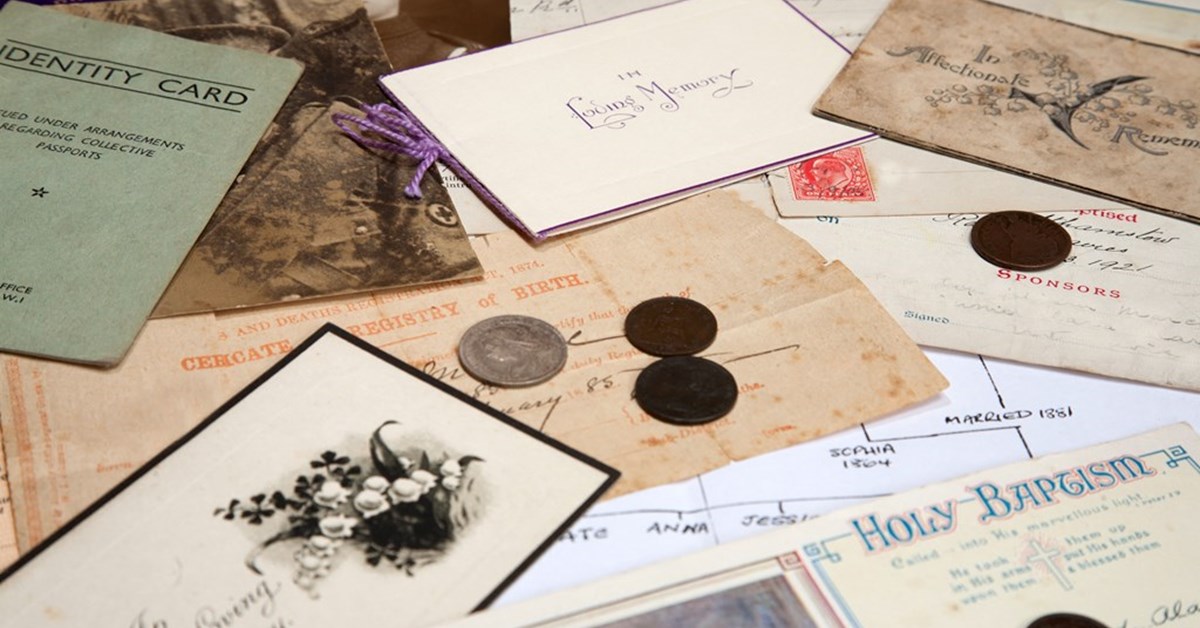
“I’VE been trying to unravel the mysteries of my family.” So begins the story of Anthony Easton, as told in BBC Radio’s recent The History Podcast series “The House at Number 48”. The show follows Mr Easton as he goes on a remarkable — and, at points, almost unbelievable — journey of discovery, to find out the “secrets and dark past” of his family.
It is riveting listening: in the course of ten curated episodes, the story is carefully pieced together and then revealed, both to Mr Easton and to the listeners.
It is a narrative set against the backdrop of the Second World War and the deep tragedies across Europe in the mid-20th century. While the show does not directly touch on the Christian faith, the themes of reconciliation, redemption, and restoration lurk just beneath the surface.
This may be a particular story about a particular family, but, at the same time, it speaks to a universal human longing: to know who we are, where we’ve come from, and what makes us the people we grow to be — for good and ill. In listening to The House at Number 48, you don’t only get the sense that you are discovering some of the Easton family’s history: you are also being invited to understand your own.
THE human longing to know where we come from is no new thing. St Augustine wrote of humanity as “restless” in its quest for meaning. Hundreds of years later, the Holocaust survivor Viktor Frankl penned a book bluntly entitled (in the language of the time) Man’s Search for Meaning.
The popularity of programmes such as the BBC’s Who Do You Think You Are? and websites such as ancestry.co.uk suggests that we are fascinated not simply by the sometimes murky family histories of celebrities, but by our own stories as well.
In a similar vein, ITV’s Long Lost Family reunites relations who have been separated, including some who discover siblings that they never knew they had. Bringing all this closer to home, the development of self-administered DNA-testing kits means that we can learn about our family background without leaving our sofas. The quest for meaning has never been more accessible.
ALL of this has plenty to say both to those who profess the Christian faith and to a society that is increasingly dislocated from the Christian story. One of the Church’s fundamental beliefs is that, through baptism, we are welcomed into a new family. Think of the words in the Common Worship rite: “We welcome you into the fellowship of faith; we are children of the same heavenly Father; we welcome you.”
Those who have been baptised now belong to two families: our biological family and our Christian family. While one may fade over time, the other will last for ever. Joining a new family can be a great comfort for those whose experience of earthly families has been difficult or complicated — although that is not to say that the family of God can’t be complex, either. But to join God’s family is to be told that we are loved, that we were created for a purpose, and that we have a place in his Kingdom.
THE most recent public example of this came in 2016, when the Archbishop of Canterbury, Justin Welby, discovered that his biological father was not, as he had believed for 60 years, Gavin Welby, but Sir Anthony Montague Browne (News, 8 April 2016). Despite the huge shock this must have presented, Archbishop Welby succinctly articulated a deeper sense of belonging: “I know that I find who I am in Jesus Christ, not in genetics, and my identity in him never changes.”
Going further, he reflected on the question that he had been asked at his inauguration service: “Who are you?” Looking back, he said: “I responded, ‘I am Justin, a servant of Jesus Christ, and I come as one seeking the grace of God to travel with you in his service together.’ What has changed? Nothing!”
THE growing interest in finding out who we are and where we come from presents an opportunity for the Church to say something positive to an anxiety-riddled society. It is entirely possible to see this as a conversation-starter for unpacking our human need for connection, for family, and for purpose; and then articulate the truth that we can find these things truly fulfilled only in God.
In one of his addresses in The Weight of Glory, C. S. Lewis (perhaps building on St Augustine’s famous quote about restlessness, “You have formed us for yourself, and our hearts are restless till they find rest in you”) spoke of how all those other places where people looked for meaning and connection were simply reverberations of God: “They are not the thing itself; they are only the scent of a flower we have not found, the echo of a tune we have not heard, from a country we have not visited.”
Like Anthony Easton, we can go on a journey to learn more about our family, but, in doing so, we may discover where we have come from but still without fully knowing who we are. This missing piece of the puzzle can be found only when we turn to God, who loves us and knows us at our deepest level of being (1 Corinthians 8.3).
Besides being fascinating listening, “The House at Number 48” is a reminder of something much deeper. All of us seek to understand who we are. To answer that question, people often turn to their ancestry, their careers, or their experiences. These are undoubtedly all part of what makes us who we are. But they don’t tell us where we really come from, nor where we’re really heading. Only God can do that.
The Revd James Dwyer is the Vicar of Flackwell Heath and Area Dean of Wycombe, in the diocese of Oxford.
To listen to the History Series podcast “The House at Number 48”, visit BBC Sounds. bbc.co.uk/sounds/series/m002l4ys