JEAN LAMB has a track record for reimagining the Stations of the Cross in new and challenging forms.
Her carved sculptural Stations of the Holocaust, besides illustrating the Passion narrative, included images from the Holocaust showing the Jewish people as they were forced into ghettos, humiliated, tortured, and executed. This thought-provoking set of Stations was described as being a brave work that offered fraught and disturbing links between Christianity and Judaism.
Her latest set of Stations — An Urban Passion — is essentially an act of protest.
An Urban Passion emerges from Lamb’s reflections on the state of the Church of England in a time of internal divisions, the challenges of secularisation, and, most especially, revelations of significant abuse that have been covered up by the institution.
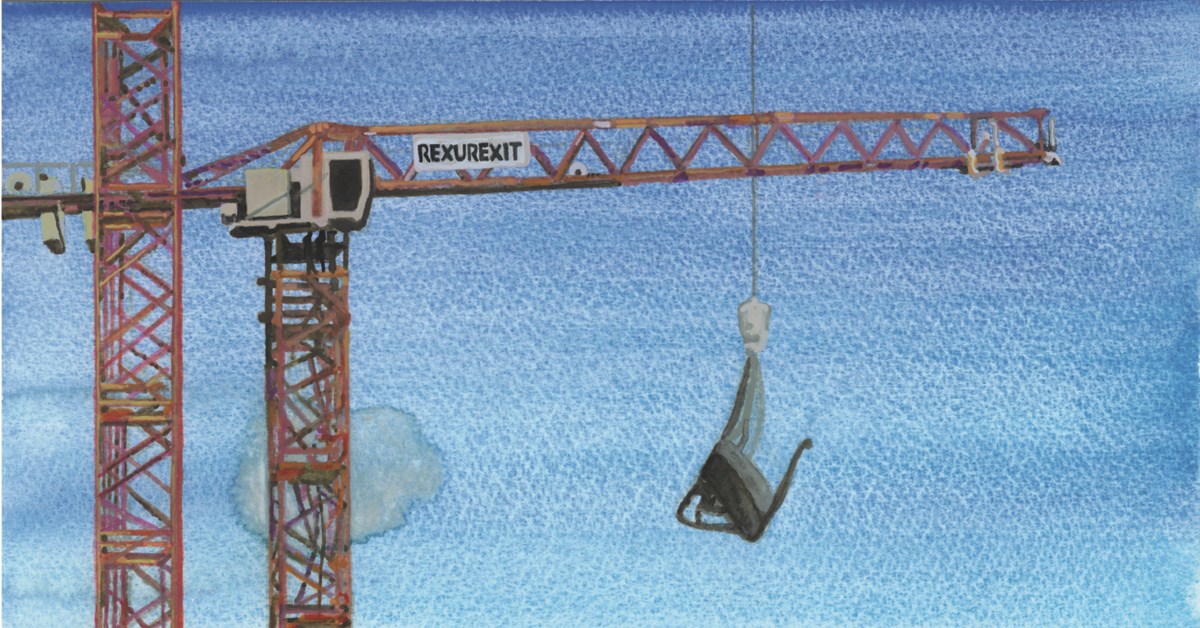
Nevertheless, the images that she has created are of a building site in Sneinton, a suburb of Nottingham where she herself lives. In these images, the small, coal-blackened tower of St Stephen’s, Sneinton, which used to be a focal point of the landscape, is dwarfed by the towering concrete structures of a new development providing student accommodation for Nottingham’s two universities.
The church tower is the cypher for Christ in these images, and the facilitators of construction and the constructed forms themselves are the forces aggressively overwhelming and overpowering it.
On the one hand, these are depictions of the building site and its surroundings, derived from photographs taken by Lamb, and showing a transformation of the area which she and others who live there view negatively. On the other hand, these are also images of a church that is experiencing its own exile or crucifixion in the face of the seemingly overwhelming forces of modernism and secularism.
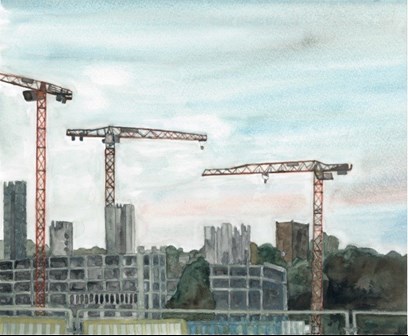 Jean LambI “Jesus is condemned to death: In the Beginning — Condemnation” from Jean Lamb’s An Urban Passion
Yet, the story told in and through these Stations is of a dark night of the soul leading into rebirth and renewal. Lamb’s images therefore prompt the question what resurrection will look like for the community in Sneinton and also for the Church of England.
She writes that she has imagined her building-site scenes as “becoming a vehicle for metaphysical meaning” and that, in these 15 watercolours, she has tried “to explore the feelings of separation and alienation between the community which surrounds St Stephen’s Church and the impersonal grid of regularised concrete”. She notes that, in these images, the Church “becomes another fragment of geological history, discarded, compressed underfoot”.
As a result of these elements, this set of Stations is not a simple urban Passion in which the scenes of the Passion are translated from their actual context to a contemporary context. Lamb’s conceit is much more complex and involved, meaning that the shapes of the cranes and towers, which can be seen as equating to crosses, are never utilised in that way. Instead, what we see depicted is the crucifixion of communities — whether the local community in Sneinton or the community of the Church (local and national).
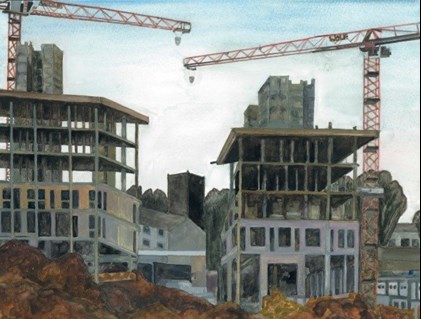 Jean LambIII “Jesus falls for the first time: Parallel realities” from Jean Lamb’s An Urban Passion
They work in a way that has synergies with Of Innocence: Scenes from the Passion, a series of paintings that record the places rather than specific incidents in the artist George Shaw’s experience of growing up in the Tile Hill area of Coventry. In both series, we are presented with urban landscapes without figures which are nevertheless seen as relating to the scenes and events of the Passion.
Lamb has a particular fascination for the names given to the machines and structures involved in construction. The images reward close attention to spot the varying ways in which such names feature.
Some names, such as Wolf, indicate the rapacious nature of what is occurring. Others, such as HTB and SDF, align those institutions and initiatives with the forces of destruction rather than rebirth, while the German names for the Holy Trinity suggest that God is nevertheless active in the midst of seeming destruction and tragedy.
These multi-layered images are mounted on cardboard that Lamb salvaged from fruit boxes discarded after use at Sneinton Market. These recycled remnants from the old community in Sneinton, which feels itself to have been superseded by the new, are fragile in contrast to the solidity and strength of the new structures that are now overshadowing them.
Lamb’s belief, as expressed in her images, is in the potency of what is small and vulnerable and dying. That is where God is found in this powerful series of Stations.
“Jean Lamb: An Urban Passion” is in St Marylebone Parish Church, Marylebone Road, London NW1, until 2 February; and then it will transfer to St Peter’s, St Peter’s Square, Nottingham, and run from Ash Wednesday (18 February) to Good Friday (3 April).