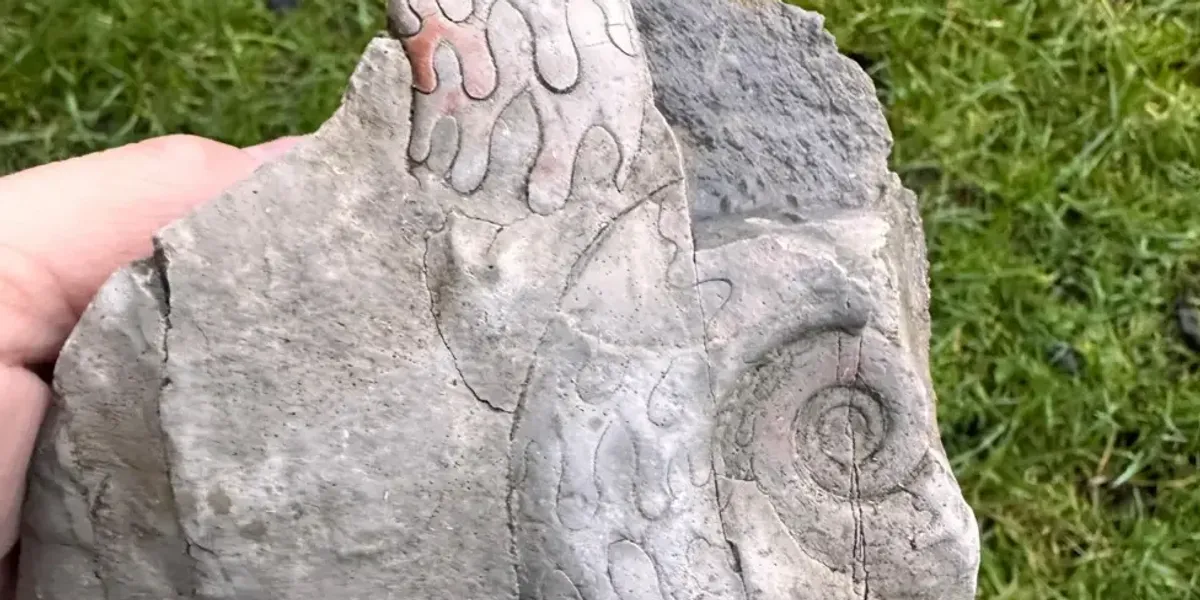
National Trust staff have unearthed remarkable fossils dating back 340 million years within a dry stonewall in Staffordshire’s White Peak region.
The ancient remains belong to two goniatites, marine creatures that once inhabited prehistoric oceans and bore similarities to modern squid and octopus.
Rangers who made the discovery were struck by the extraordinary condition of the specimens, which stood out due to their exceptional preservation.
However, the conservation charity has opted to withhold the precise location of the find, fearing that publicising it could trigger an influx of visitors hoping to uncover similar treasures themselves.
Ranger David Ward, who was present when the fossils came to light, described his astonishment at their condition.
“I said ‘have you drawn [the markings] on the rock?’ because it was so intricate, these little wavy patterns,” he recalled.
Ward explained that whilst limestone typically contains numerous fossils, they are frequently fragmented and incomplete.
“We are really lucky because limestone is full of fossils but often they are in bits, little fragments,” he said.

National Trust staff have unearthed remarkable fossils dating back 340 million years
|
NATIONAL TRUST
“I have seen shells similar to this but not as well preserved.”
The level of detail visible on the specimens was unlike anything the ranger had previously encountered in the area.
Susannah Lydon, a palaeontologist from the University of Nottingham, shed light on the nature of these ancient creatures.
She explained that goniatites were shelled marine animals, comparable in form to squid or octopus, which thrived in warm tropical waters millions of years ago.
MORE INCREDIBLE SCIENCE DISCOVERIES

Ranger David Ward, who was present when the fossils came to light, described his astonishment at their condition
|
NATIONAL TRUST
Upon death, these organisms would descend to the seabed, where the fossilisation process gradually preserved them in stone.
Lydon noted that goniatites share a similar appearance to ammonite fossils, which emerged during a later geological period and are commonly discovered along the coastlines of Whitby and Lyme Regis.
Lydon emphasised the broader significance of such discoveries for local communities.
“If you find a fossil in the rocks beneath your feet, you learn something about the deep history of where you are living and I think it is relevant to everyone to understand their place on the planet,” she said.
“I think everyone wants to know where they came from, it is part of that really big story. I think it is great when people find local fossils.”
The National Trust has confirmed it will retain the specimen, with Ward stating it would be used during educational talks to encourage others to seek out similar finds.